

I'm an undergraduate at Virginia Tech that studies bones! Follow me for interesting facts about bones, pictures of specimens, and much more. @RebeccasBugs
Blacksburg, VA
Joined September 2018
- Tweets322
- Following56
- Followers729
- Likes1.2K
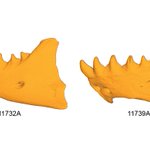


My first ever #research paper with @VTechmeetsPaleo & @Paleoswego has been published!! 🎉 It's about #skull differences in a species of worm #lizard. The research & paper took about 4 years to finish. You can read it for free here: doi.org/10.1002/jmor.21508 #ScienceTwitter

How do #rodents keep their incisors (front teeth) sharp? It's all thanks to their tooth structure! Instead of being covered in enamel, rodent incisors only have enamel on the front. This makes the front wear down slower than the back as they gnaw, keeping a sharp edge. #osteology

Occipital condyles are what connect the back of the #skull to the spine! Mammals & amphibians have two occipital condyles while birds, reptiles, & fish only have one. Two occipital condyles give finer control of head movements but also restrict side-to-side movements. #osteology

Did you know that some #rodents have grooves on their incisors (front #teeth)? Their function isn't well understood, but the grooves may improve the strength or efficiency of the #incisors. Regardless, since only some rodents have them the grooves are useful for ID! #osteology

Sutures are the lines where two or more bones join together. They can be straight, squiggly, zigzag, or more! Here's a particularly beautiful #suture from a white-tailed #deer skull. The top bone is the parietal and the left & right bones are the frontals. #osteology #skull

Hello everyone! Sorry for not posting in so long, I've been busy with school and grad school applications. I want to start posting facts again. For now, here are some pictures of mammal #skulls from owl pellets in SW VA! These pictures are from a project last semester. #osteology

Musk #deer are named for their musk glands, but they also have another cool feature: their long #canines! Instead of growing antlers, males have canines that they use to fight other males. A few other ungulate species have long canines too, like water deer & muntjacs. #osteology

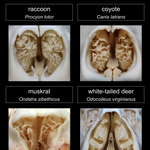
Here's a redo of one of my first tweets! Nasal turbinates are thin, scroll-like #bones found in the #noses of mostly mammals. They increase surface area in the nose, helping to 1) moisten and warm the incoming air and 2) increase smell reception. They're also pretty! #osteology

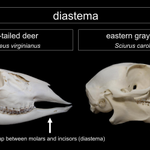
Many #herbivores like #ungulates and #rodents are known for the large gap between their molars and incisors, called the #diastema. The diastema provides space to store and manipulate food for chewing. This is useful since plants are a tough food! #osteology #teeth

Unlike bovid #horns (ex. cow), #rhino horns are completely made of keratin and aren't part of the #skull. But you can still see their impact on the skull! Rhino nose bones are enlarged to support their front horn. Some rhinos also have a second, smaller horn behind it. #osteology

There are many different types of #horns in the animal kingdom! The horns of #bovids (ex. #cows, #goats, #antelopes, etc.) have a bony core with an outer keratin covering. These parts are called the "horn core" and "horn sheath", respectively! #osteology

#Flightless #birds like #ostriches have modified skeletons! For example, their sternums (breastbones) are flat. Normal birds have keeled sternums so that there's room for their large flight muscles to attach. Since ostriches don't fly, they don't need the room. #osteology

#Marsupials and #monotremes have an extra pair of bones on their #pelvis called the epipubic bones! These bones are involved in hind leg movement and may help support marsupial pouches as well. Placental mammals like us have lost the epipubic bones. #osteology

Some animals (ex toothed and baleen #whales) have #skulls that break away from the typical skull bone arrangement! Their front & back skull bones are very close. Many bones overlap too. This condition is called telescoping. See it in this figure adapted from DigiMorph! #osteology

I made a second account just for bug facts, check it out! This way I can stick to just bone facts on this account 💀

Not all #flies are ugly, check out the golden dung fly! The males of this common, widespread species of fly are covered in golden hairs. Females are duller. The adults are carnivorous and mostly prey on other flies, but they can eat nectar too. They breed on dung. #entomology

2
#Penguin wings are highly adapted for swimming! Their wing bones are thicker & flatter than other birds. Their wings are also stiff b/c joint movement is restricted. Lastly, their "thumb" is fused to nearby bones. These changes make their wings the perfect flippers! #osteology

#Sesamoid bones are bones that form in tendons to help reduce friction! They can form naturally or as a result of strain. Some sesamoids are present in everyone while others are variable. Some even have their own names. The patella (kneecap) is the largest sesamoid! #osteology

#Roosters are known for the sharp spurs on their legs. Did you know that these spurs have a bony base? To form the spur, the bony base is covered in keratin just like a claw. These spurs are used for defense and fighting other roosters. #Hens sometimes have them too! #osteology
