

...searching for nearest red Earths to the Sun. Want to be involved? Join us: access data & participate in science discussions! #RedDots
Joined May 2017
- Tweets121
- Following137
- Followers776
- Likes132




Pinned Tweet
Nothing to do? #FF @BarnardsStar_b, the official twitter account of a whole new world!
The paper describing the results is still undergoing revision, but you can check the current version in arxiv.org/abs/1908.04717 comments welcome! Once accepted, we will tell you a bit more... spoiler alert! one of the planet candidates is within the habitable zone of the star ;)

Combining @RedDots data with public data from the programme "Bright M-Dwarf Systems with Transiting Planets" archive.eso.org/wdb/wdb/eso/…) reveals the presence of a compact planetary system with -at least- three terrestrial planet candidates!!!
RedDots retweeted

Barnard's Star b #1 of the list “The Most Fascinating Exoplanets of 2018”.
“A candidate super-Earth planet orbiting near the snow line of Barnard’s star”
(Ribas, et al. 2018, Nature 563, 365, nature.com/articles/s41586-0…) #barnardsstar @BarnardsStar_b @CARMENES_exopl @RedDotsSpace


RedDots retweeted

📣📣 Paper finally sent to review! See the evidence for VERY slow rotation and activity cycle of Barnard's star by Borja Toledo & collaborators! Featuring 20+ yrs of spectroscopic data and hundreds of contributed @AAVSO observations from pro-am astronomers around the globe! 📣📣

Stellar activity analysis of Barnard's Star: Very slow rotation and evidence for long-term activity... [SSA] arxiver.moonhats.com/2018/12…

RedDots retweeted
See 'Prospects for detecting the astrometric signature of Barnard's Star b' by Lev Tal-Or & co (submitted to A&A) via arxiv.org/abs/1811.05920 A bit technical, but punchline is : it will be hard enve with a perfectly working @ESAGaia! why? it is about the orbital inclination...

RedDots retweeted
We have been asked wether @ESAGaia could detect @BarnardsStar_b using the astrometric method. Gaia is operating and producing data, so what can we expect? Our colleagues have been thinking about it for a while and have written a paper!

In 2017, Red Dots monitored #ProximaCentauri again for additional planets, and expanded the search to two other very nearby stars : #Ross128 and #BarnardsStar. A lot of analysis is underway an all these stars. 3/20

RedDots retweeted
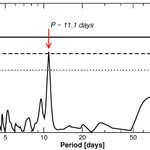
You like the artists impressions? This is how the actual evidence of Barnard's Star b existence look like. A ton of points following a subtle wobble of ~4.5 km/h every 230 days...
This Post is from an account that no longer exists. Learn more
We created an 'official' account for Barnard's star b @BarnardsStar_b where you can follow the updates and new findings on this awesome planet. Even some expected skepticism about the detection after our colleagues review the huge amounts of data available ;)
See release article based on @IEEC_Space one in reddots.space website. Enjoy!
reddots.space/announcing-bar…
Paper available tomorrow @Nature . Get awesome videos and artistic impressions from our partner institutions and friends including @IEEC_Space @ESO @QMUL @CARMENES_exopl and many more. 20/20
Welcome to the new world @Barnardsstarb!
youtu.be/_Vch8vY5af4 via @YouTube
thx @IEEC_Space for the video!
19/20
@BarnardsStarb is more massive than Earth, but doesn’t really tell us much of how it may look like. It could be anything from a large ‘mostly’ rocky world, or a mini-Neptune. One thing is for certain, it must be a pretty gloomy place. 16/20