

Reed College Mathematics Department, https://teapawt.net/t.co/RtgetHQLR0
- Tweets196
- Following140
- Followers385
- Likes118







ALT Flyer for Moon Duchin's talk. Text: Is Justice Blind? A Case Study Dr. Moon Duchin PROFESSOR OF MATHEMATICS, TUFTS UNIVERSITY Wed, March 9 7 p.m. Vollum Lecture Hall In-Person (No virtual option available) Open to Reed Community 2022 MNS Division Speaker If you are following the rumblings in the Supreme Court, you know that race-blind everything is all the rage with the Court's conservatives. This will figure into two important cases in the coming term. Affirmative action and the Voting Rights Act are both in the balance. Dr. Duchin will discuss the legal contours of colorblindness and will focus on the case study knows best: race-blind redistricting. Moon Duchin is an Associate Professor of Mathematics at Tufts University. In addition to geometric group theory and geometric topology, Dr. Duchin studies the mathematics of redistricting, and mathematical interventions for racial justice.
ALT Flyer for Moon Duchin's talk. Text: Is Justice Blind? A Case Study Dr. Moon Duchin PROFESSOR OF MATHEMATICS, TUFTS UNIVERSITY Wed, March 9 7 p.m. Vollum Lecture Hall In-Person (No virtual option available) Open to Reed Community 2022 MNS Division Speaker If you are following the rumblings in the Supreme Court, you know that race-blind everything is all the rage with the Court's conservatives. This will figure into two important cases in the coming term. Affirmative action and the Voting Rights Act are both in the balance. Dr. Duchin will discuss the legal contours of colorblindness and will focus on the case study knows best: race-blind redistricting. Moon Duchin is an Associate Professor of Mathematics at Tufts University. In addition to geometric group theory and geometric topology, Dr. Duchin studies the mathematics of redistricting, and mathematical interventions for racial justice.

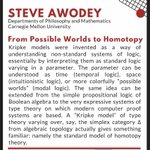
ALT STEVE AWODEY Departments of Philosophy and Mathematics Carnegie Mellon University From Possible Worlds to Homotopy Kripke models were invented as a way of understanding non-standard systems of logic, essentially by interpreting them as standard logic varying in a parameter. The parameter can be understood as time (temporal logic), space (intuitionistic logic), or more colorfully “possible worlds” (modal logic). The same idea can be extended from the simple propositional logic of Boolean algebra to the very expressive systems of type theory on which modern computer proof systems are based. A “Kripke model” of type theory varying over, say, the simplex category Δ from algebraic topology actually gives something familiar: namely the standard model of homotopy theory. THURSDAY, NOVEMBER 18, 2021 ELIOT 314 4:45PM. DM for Zoom link.


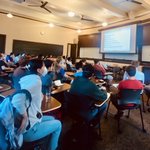
ALT Photo of recently redcorated math lounge at Reed.


ALT Reed math common room under construction.