

CEO & co-founder @Serellium. Federal market intelligence for American industry.
Washington, DC
Joined July 2022
- Tweets1.7K
- Following1.1K
- Followers2.3K
- Likes2.3K







There's been a pretty significant push by the federal government this year to bring more American manufacturers into the defense industrial base.
We looked at 9 of the biggest moves made in 2026 to expand domestic manufacturing capacity, attract new suppliers, and make it easier for commercial businesses to participate in defense production.
Some of these are getting very little attention outside the defense contracting community. Quick summary:
- Office of Industrial Base Growth: Expanded focus on identifying and developing new defense suppliers, including commercial manufacturers with no previous federal experience.
- LYNX: New digital platform to help businesses assess their readiness for defense work, identify gaps, and connect with potential partners.
- Civil Reserve Manufacturing Network: ~$177M in FY26 funding to identify commercial manufacturers capable of adapting existing production capacity to defense requirements during national emergencies.
- Made in America Loan Guarantee: SBA expanded its International Trade Loan guarantee to 90% for eligible manufacturers, helping improve access to financing for equipment, facilities, and production expansion.
- Reduced SBA Loan Fees: Certain manufacturing loan fees waived in FY26 to lower financing costs for qualifying businesses.
- Smaller War Plants Commission: Established in August to help identify smaller manufacturers, expand access to capital, & address barriers to defense production.
- Priority 8(a) Processing: SBA is prioritizing eligible applicants in 10 defense critical manufacturing industries, including ammunition, shipbuilding, machine shops, electronics, and aerospace components. Only about 1% of current 8(a) participants operate in these sectors
- New SBA/DoW Capital Agreement: Signed in Oct to coordinate financing and potential investment support for businesses expanding critical defense manufacturing capacity.
- Army Manufacturing Rodeo: Planned for early 2027 to stress test manufacturing capacity and supply chains, identify production bottlenecks, and expose weaknesses across the industrial base.
A few major challenges govt is trying to solve at the same time: finding manufacturers outside the traditional defense supplier base, helping them access capital, and figuring out how to expand production capacity when national security requirements demand it.
Most importantly, the full potential supplier base is much broader than companies making weapons or military equipment. It's precision machining, metal fabrication, industrial automation, electronics, batteries, castings, forgings, specialized equipment, and the many commercial capabilities required to support defense production.
These are excellent steps in the right direction, but there's still a serious barrier to entry.
A manufacturer can qualify for a loan guarantee, register on a supplier platform, or pursue a federal certification and still have no idea who actually buys what it makes.
Which agencies are purchasing those capabilities? Which prime contractors control the market? Where is demand growing? How concentrated is the competition? Where could a new supplier realistically get its first opportunity?
These are the problems my company's solving.
Full breakdown of the 9 initiatives in link -- worth a quick read if you're building, investing in, or advising American manufacturing businesses.


Space Force just released Volume 1 of its Space Access Portfolio Vision & Requirements, covering the Eastern & Western Ranges (Cape Canaveral and Vandenberg). 27 requirements, deadlines FY29 thru FY36, and 19 of them due by FY31.
The context is that launch demand is about to outpace what the ranges can handle. In Space Force's own words, the surge "risks turning our ranges into a bottleneck rather than an enabler."
My quick takeaways for investors & companies outside the space sector that might not realize they have a play here:
- The doc says requirements can be met thru commercial assets & commercially procured services, alongside govt-owned systems; as-a-service business models have a door here.
- Commercial providers will have opportunity to plug their own capabilities directly into the range architecture.
- They want to combine private money with public funds using airport & seaport style financing. That needs statutory & policy changes first, but it's worth watching.
- There's no budget, solicitation or contract vehicle in the doc. Treat it as a roadmap. The $$ that follow will tell you how real it is.
Especially interesting for adjacent industries. A big part of range modernization has nothing to do with rockets:
- Energy & water: run multiple major operations without commercial utilities (FY36)
- Construction, rail, port & logistics: receive hardware up to 10m by road, rail, air & sea, and move multiple pieces of flight hardware at once (FY36)
- Industrial gases & commodities: replenish fast enough to support a 12 hr launch recycle, with contractor-supplied commodities named specifically (FY34)
- Counter-drone & security: detect, identify & disable unauthorized air vehicles over the spaceport (FY31)
- Software, data, & cyber: automation for flight safety, onboarding and analytics, one data architecture across both coasts, everything open and native IP by FY36
- Workforce: staffing and training are named as part of how these requirements get met
FY31 will be a significant milestone, with 17 of the 27 requirements landing there, planning & buying decisions happen well before.
Link in comments --

Absolutely wild (in a great way) what SBA did with 8a for small manufacturers last month. This was a huge one a lot of people missed, and I bet most manufacturers have no idea it applies to them. So breaking it down:
On Sept 10, SBA announced that it will prioritize review & processing of 8a applications from small businesses in 10 critical defense areas:
- small arms ammunition
- ammunition (except small arms)
- guided missiles & space vehicles
- other aircraft parts & equipment
- search, detection, navigation, guidance instruments
- other electronic components
- iron & steel mills & ferroalloys
- machine shops
- all other misc. fabricated metal products
- shipbuilding & repairing
8a is an SBA 9-yr federal contracting and business development program for small businesses owned by socially & economically disadvantaged U.S. citizens. As of Sept 10, any citizen who can document that disadvantage can apply. 8a is such a big deal because it offers potential access to sole source awards (up to $8.5M on manufacturing contracts, options included), and limited competition (only among 8a firms) above that.
What's crazy is that of nearly 4,000 active 8a firms, 47 list one of these industries above as their primary NAICS. That's only 1.2%.
In fact, 3 of the NAICS above have ZERO 8a firms: guided missiles, iron & steel mills, and non-small arms ammo.
The $$ tells a similar story. Federal agencies obligated $120.8B in govt contracts across these 10 industry areas in FY26 yet only $120.2M -- million -- went to 8a. For comparison, 8a firms in commercial building construction pulled $1.63B. Billion. Computer systems design pulled $1.62B. Each one, by itself, represents 13X all 10 defense manufacturing industries combined.
So the 8a competition pool in these manufacturing industry areas is tiny, and in 3 of them it's empty, sitting against a $120B+ market the Dept of War is actively trying to add suppliers to.
And the fast track for eligible small manufacturers matters. SBA approved only 65 new 8a firms btw Jan 2025 and June 2026. About 4,190 firms applied in FY25 alone. That wait's been brutal. Defense manufacturers in this codes now get priority.
Small manufacturers still have to qualify for 8a -- 51% owned & controlled by disadvantaged U.S. citizens, personal net worth under $850k, and 2 yrs of revenue in your primary industry (waivable under certain conditions).
Super interesting time to be a small manufacturer relevant to the defense industrial base. Especially for firms in sectors SBA & Dept of War have flagged as priorities: munitions & components, drones, microelectronics, critical minerals, shipbuilding & repair components, sensors, batteries, castings & forgings, textiles.
Here's a snapshot of the major federal moves this yr aimed at pulling more small manufacturers in to meet national security needs:
1. Office of Industrial Base Growth: In January, Dept of War stood up the Office of Industrial Base Growth, which absorbed the Office of Small Business Programs and widened its mandate to new entrants, mid-tier firms & nontraditional suppliers.
2. LYNX: On January 29, DoW launched LYNX, a platform built for new entrants, small businesses & nontraditional suppliers that have the technical chops but struggle to navigate defense requirements & find partners.
3. Civil Reserve Manufacturing Network - $131 million pilot: Created in the FY26 NDAA, CRMN builds a network of commercial manufacturers willing to convert production capacity to defense work during a crisis.
4. Made in America Loan Guarantee - up to $5 million at a 90% guarantee: On March 31, SBA announced a 90% federal guarantee for small manufacturers (vs. the standard 75% under 7a) to finance equipment, facility modernization, inventory, acquisitions & capacity expansion.
5. Manufacturer fee waivers - 0% upfront fees: SBA, 7(a) & 504 loan programs. Through Sept 30, manufacturers paid 0% upfront fees on 7(a) loans up to $950K and 0% upfront & annual fees on 504 loans. The FY27 fee schedule, effective Oct 1, keeps a 0% upfront fee on 7(a) loans to manufacturers up to $700K.
6. Smaller War Plants Commission: SBA & Dept of War, joint MOU, central coordinating body for small defense suppliers. On August 25, SBA & DoW established the SWPC, named after the WWII-era Smaller War Plants Corporation. The mandate is to pair enhanced SBA guarantees with investment & contracting opportunities, build an inventory of small business production capacity for CRMN, deploy joint teams to remove regulatory barriers, and report regularly to the President.
7. 8(a) fast track for critical defense manufacturers: SBA, 8(a) Business Development Program, 10 priority NAICS codes. On September 10, SBA began prioritizing 8(a) applications from firms in 10 defense-critical manufacturing codes, including:
- ammunition (small arms & other)
- guided missiles & space vehicles
- aircraft parts
- navigation & guidance systems
- electronic components
- iron & steel
- machine shops
- fabricated metal
- shipbuilding & repair
The gap is significant. Only 1.2% of active 8(a) firms are registered in those codes, and three of them have zero 8(a) firms.
8. SBA & Dept of War capital agreement: On October 12, SBA & DoW signed an MOA putting money behind the SWPC. DoW's Economic Defense Unit will identify small defense suppliers that need financing & refer them into SBA's 7(a) & 504 lender networks. SBA will also handle diligence, underwriting & portfolio management for DoW-funded redeemable preferred equity in small & mid-sized firms.
9. Army Manufacturing Rodeo: On October 12 at AUSA, Acting Army Secretary Adam Telle announced a "Manufacturing Rodeo," a race between industrial base partners early next year that will strain the Army's organic industrial base & the broader manufacturing network to find the weak links, fix them & keep iterating.
How many promising technologies never make it into the hands of our warfighters because the companies building them can't figure out how to sell to the govt?
I think about this a lot.
Yesterday, DOE announced nearly $11.1M for 8 energy workforce training projects for jobs supporting oil, natural gas, coal, & geothermal energy industries.
The program is PACT (Partnerships for Academic-Industry Career Training). DOE's Hydrocarbons and Geothermal Energy Office funds 6 projects (almost $8.8M) and the Office of Indian Energy funds 2 (about $2.3M).
Quick summary of the 8 projects:
- New Mexico Junior College, $1.9M: 4-week Digital Field Operations Technician credential covering SCADA, artificial lift diagnostics, and radio/ networking. Devon Energy and Mewbourne Oil are employer partners
- Southern Methodist University + Dallas College, $1.93M: 225-hour field data and infrastructure operations certificate covering oil/gas operations, produced water, GIS/CAD, and field data QA/QC. Diamondback Energy is among the employers
- Somerset Community College (KY), $1.5M: geothermal drilling training from field technician to driller, with the Geothermal Drillers Association, aimed at Appalachia
- UT Rio Grande Valley + South Texas College, $1.5M: produced water technician training in treatment/ recycling, saltwater disposal, and process controls. NGL Energy Partners, Texas Pacific Water Resources, and Western Midstream are partners
- University of Alaska Fairbanks + AVTEC, $1.66M: a 2-yr pathway to train technical education instructors, with Alaska Village Electric Cooperative and Sitka Electric
- San Jacinto College (TX), $298K: energy logistics and GIS, with LyondellBasell, INEOS, and Port Houston
- Leech Lake Tribal College (MN), $2.0M: new GIS certificate plus geothermal instruction in its carpentry program
- Navajo Technical University (NM) + ASU, $300K: nondestructive testing training and an ultrasonic testing lab, for oil and gas, pipelines, power generation, and manufacturing

Veterans Affairs published its approved $2.68 billion in infrastructure projects for Q4 of FY26. I went through the full list, it's ~700 projects at 140 VA facilities, in 49 states plus DC & Puerto Rico. By my count of project descriptions, here's the work that shows up most:
- HVAC, boilers, chillers, and steam: 100+
- Elevator modernizations: 90+
- Infrastructure for the electronic health record rollout: 85+
- Roofing, windows, building envelope: 40
- Electrical: 35
- Fire alarm, security, and nurse call: 33
Biggest states by project count: CA (57), FL (46), PA (44) TX (35), NY (34). Philly and Seattle each have 18 projects.
All part of VA's non-recurring maintenance program, which covers significant repairs & upgrades at existing VA medical facilities. The FY27 NRM budget was $4.8 billion, the largest in VA's history, and VA says it obligated all of it.
Major market for commercial firms with capabilities to support.
DIU dropped a new call for commercial companies to replace the Marine Corps' mobile power distribution systems. For those building in electrical equipment, including those who have never sold to the military, here's the breakdown:
Some context. These are the panels that take power from generators & batteries and send it to the equipment Marines depend on -- communications, command posts, fire control, combat operations centers, and force protection. They get used in places with no stable power grid.
The problem: the systems in the field now are at the end of their life cycle. As forces spread out and operate more on their own, inefficient power distribution will actively impair missions.
DIU wants to take existing commercial products and adapt them for military use, in 2 phases. Phase 1 is 6-12 months to modify a commercial system, deliver prototypes, pass military environmental testing. Phase 2 is 1-3 months of field evaluations with operational units.
Technical ask:
- Take in 120V and 208V three-phase AC, send out 120V AC, 208V three-phase AC, and 28V DC
- Inputs have to run in parallel, and everything has to work w/ the current MEPDIS-Replacement system
- Anything over 200 amps must be skid-mounted and movable with standard Marine Corps material handling equipment
- DIU lists 5 panel sizes: 1200A micro grid, 200A, 120A, 30A, and a 30A bidirectional DC panel
Both U.S. and international vendors can respond on their own or as a team, with a solution brief of 5 pages or 15 slides.
This one runs as an Other Transaction agreement, so at least one of these has to be true: a nontraditional defense contractor plays a significant part, every participant is a small business, or 1/3 of the prototype cost comes from non-govt $$.
Solution briefs due October 28 thru DIU submission form. Link in comments
Dept of Energy gets all the energy headlines. But the Dept of War has been quietly building out energy investments, and it's putting small nuclear reactors, geothermal wells, and new power plants on military bases. Quick summary on what this market looks like and who is winning --
Starting with the problem: military bases run on the civilian power grid, and their backup power is mostly diesel. The Pentagon wants bases that keep running if the grid goes down, and its missile defense systems need a lot of power. So it's bringing in private companies to build power on base land, with utilities as partners.
This all picked up speed in May 2025, when an executive order put the Army in charge of nuclear power for the whole military and set a deadline: an Army-regulated reactor running on a domestic base by Sept 30, 2028.
A second order created a Dept of Energy program to speed up testing of new reactors, and the July 2025 budget bill added $125M for small, portable reactors.
The way the Army is doing it is unusual. Companies design, build, own, and run the reactors on Army land. The Army pays in installments as each company hits milestones, and the Army oversees the safety of its own projects. In this case, a military customer lets a startup prove its reactor works, so it can later sell to others.
The $$ flowing towards this is interesting. The Army launched a program called Janus in October 2025. On Aug 26, 2026 it picked 5 companies for 5 bases, with up to $2.2B in govt $$ through 2031 and 20+ reactors expected. The Air Force ran its own version and picked 3 companies in April.
And here are the winners so far:
3 names appear in both the Army & Air Force programs, which makes them the early leaders: Antares, Radiant, and Westinghouse.
In June, Antares became the first company in the DOE reactor test program to get a test reactor to criticality, the point where a reactor sustains a nuclear reaction. Federal contract records show a Janus agreement worth up to $435.6M, with $58.5M funded so far, and a separate Air Force agreement with $11.4M funded so far. Its reactors are planned for Fort Bragg and Joint Base San Antonio.
Radiant is planned for Fort Benning in the Army program and Buckley Space Force Base in the Air Force program. Federal records show $22.6M funded so far on its Air Force agreement. The company has announced a Janus agreement, but its value doesn’t appear in federal records yet.
Westinghouse is planned for Fort Drum and Malmstrom Air Force Base. On Aug 24, a test of its eVinci reactor design reached criticality at a Nevada test site. Federal records show $10.6M funded so far on its Air Force agreement and its Army agreement value hasn't been disclosed.
The other two Army picks matter too. BWXT, at Fort Campbell, is already building the Pentagon's earlier prototype reactor and is the only one of the 5 Army picks that makes its own fuel. General Atomics, at Fort Hood, uses a different fuel design than the rest. Oklo has a planned reactor at Eielson Air Force Base in Alaska.
Fuel is where this gets fascinating. These reactors need special fuel that very few companies can make, and Army officials say supplying more than 20 reactors will likely exceed what the U.S. can currently produce. That gives an edge to whoever locks in supply early. BWXT makes its own, and in August Radiant and Antares both signed long-term fuel deals with Standard Nuclear.
Reactors are only part of it. On Sept 18 the Army conditionally awarded land leases at 6 installations to 3 developers, Ameresco, Indelible-Bloom, and Frontier Power, to build power plants that sell to the grid and back up the base. The Army pays nothing to build them. And since 2023 the Navy, Army, and Air Force have been exploring geothermal power, using heat from underground, at bases in 6 states with companies like Fervo, GreenFire, and Sage.
Pulled all together, the Dept of War is acting as the first customer, landlord + test site for a new energy industry, and interesting to see the small group of companies already holding the base sites & first contracts.
Yesterday at AUSA, the Acting Army Secretary announced the Army's first ever Manufacturing Rodeo. Here's what that means for manufacturing companies across America --
Early next yr, the Army will run a race btwn industrial base partners built to strain the organic industrial base and stress the supply chain to show "exactly where it breaks."
This follows the Army's push to build advanced manufacturing hubs including Red River, Anniston, and Tobyhanna Army Depots, along w/ public-private partnerships with Hadrian and Siemens. Now it wants to test the broader national manufacturing network too.
If you're a manufacturer who wants a role in the defense industrial base, here's how I'd think about it:
1. A hunt for weak links is a hunt for capability. Materials, components, machinery, automation, inspection, software suppliers, etc, and the companies that deliver the final output, all sit inside this network.
2. Most businesses will hear about this kind of thing late. By the time a solicitation drops, the companies with a clear market strategy are already positioned.
3. Know your federal market before the call comes. Figure out your play well in advance. There's a dire rate of attrition and I believe much of it comes down to weak market research and strategy on the front end, which causes most American businesses to view the federal market as too complicated to be worth their time. For instance, in federal hardware manufacturing (hinges, latches, clevises, casters, etc), 1,330 companies were new to federal contracts in the past 3 yrs. 80% were small businesses. New entrants won only 10% of $1.61B in spend, and fewer than 20% won more than once.
Those firms can make the products. What most miss is a clear read on who buys what they make, how the govt buys it, and who is already winning.
The Army will start finding the weak links in its supply chain. Some of them will turn out to be gaps that capable American manufacturers could have filled, if they had known where to plug in.
That's the problem we're solving at @serellium: a rapid, clear, actionable map of where a company's capability meets real federal demand, and a strategy built on that map.
If the defense industrial base needs American manufacturing capacity at scale, the firms holding that capacity need to know where they fit before anyone comes looking.
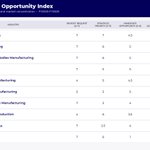
At @serellium we are defining the shortlist of the highest opportunity industries for the private sector in national security. Disruptable. Here are some of the sectors we’ve ranked at the top:
1. Critical infrastructure
2. Aircraft manufacturing
3. Munitions - guided missiles manufacturing
4. Shipbuilding
5. Semiconductor manufacturing
6. Radar detector manufacturing
7. Munitions: explosives manufacturing
8. Fossil fuel energy production
9. Munitions: small arms
10. Space R&D

Anduril just made what I think is the smartest bet in federal contracting history.
Yesterday, the White House and Anduril announced Arsenal-2, a new $6.6 billion shipyard in Baltimore County to build Virginia-class submarine components.
Anduril's putting in $3.7 billion of its own capital. The Navy awarded a contract worth up to $2.9 billion.
$3.7 billion sounds massive but it's actually a drop in the bucket.
CBO estimates Navy shipbuilding will cost $40+ billion a year for the next 30 years. That's potentially more than $1 trillion. Anduril's investment is less than 0.4% of that, and the timing is perfect.
The Navy's FY27 Shipbuilding Plan puts ~$125 billion into submarine construction over the next 5 yrs alone. The FY27 budget request includes $65.8 billion for shipbuilding overall.
Anduril's entire stake = about 3% of 5 yrs of submarine spending. Additionally, the Navy needs to add ~55 vessels in 4 yrs, going from 395 in FY27 to 450+ by FY31.
The current industrial base can't deliver that, for a number of reasons.
Today, 10% of shipbuilding work happens at distributed sites. The govt wants that at 50%. Arsenal-2 is a distributed site -- build the components & ships them to Electric Boat and Newport News for final assembly.
Additionally, look at the gap they're filling. Torpedo tubes are a gating component on Virginia-class subs. Getting them sooner speeds up boats already under construction. Arsenal-2 could add up to 9M labor hrs per yr, a roughly 15% increase in capacity. That will ultimately be indispensable for this market's needs.
There's also a workforce angle. Navy's FY27 shipbuilding plan depends on upskilling thru tech like VR trainers, computer controlled machinery, and advanced manufacturing. Arsenal-2 will run on ArsenalOS with digital work instructions and built-in quality controls designed to support and train new welders, pipefitters, shipfitters, etc faster.
But above and beyond those items, there's the broader problems in the federal market for shipbuilding that Anduril is positioned to fill in, in a huge way.
The govt spent $71 billion on federal contracts for shipbuilding and repair over the past 3 yrs. The top 5 companies captured 66% of that $$. Only 24% was fully and openly competed. Half wasn't competed at all. Breaking into this market as a capacity solution the primes and the Navy both desperately need is how to win, and how we will deliver on national security priorities.
And the craziest part: there are other gaps just like this across the federal market.
Need more companies stepping up like this.
The Dept of War released its new Manufacturing Technology Strategy for 2026-2031 earlier this week. Developing the world's best tech doesn't mean much if we can't actually manufacture at the speed, scale & cost required. My top 5 takeaways for private industry:
1. Manufacturing capacity is a national security priority.
Developing weapons & tech is important, but just as important is whether the U.S. can actually manufacture them, quickly scale production, replenish, and sustain that production.
2. Commercial industry is needed, badly.
More and more, there's a recognition that the traditional defense industrial base cannot alone solve this. Partnerships with private industry, academia, and the Manufacturing Innovation Institutes must bring manufacturing tech into defense production. This opens a critical lane for companies that may not think of themselves as defense companies.
3. Defense manufacturing isn't just weapons.
Advanced materials, robotics, additive manufacturing, automation, AI, castings & forgings, batteries, biomanufacturing, supply chain tech, workforce development -- if a capability helps manufacture faster, cheaper, more reliably, or at greater scale, there very well may be a defense application.
4. Big emphasis to bridge the gap between innovation and scaled production.
Focus is on tackling manufacturing problems that have long been too risky or expensive for industry to solve alone, with opportunities for govt to help de-risk the capability needed to get promising tech to scale. The question now is can industry come to the table.
5. Manufacturing Innovation Institutes are a major doorway.
The institutes connect govt, manufacturers, startups, universities, and other industry partners to run projects, provide access to equipment and expertise, and help transition commercial tech into defense applications.
The biggest misconception right now is that companies across America don't have to manufacture missiles, drones, subs, ammunition, etc to play a role in the defense industrial base.
Those building the tech, equipment, materials, software, and processes that can help America manufacture better and faster are needed more than ever in the federal market.

This one has been sitting in sam since Dec 2025 but worth a look if you're anywhere in the advanced manufacturing space.
Army has an open call for commercial tech that could help modernize its ammunition manufacturing industrial base.
You do NOT need to manufacture ammunition to fit here.
The Army is looking for commercial solutions across 5 areas:
1. Advanced manufacturing: robotics, additive manufacturing, AI/process optimization, automation
2. Digital transformation, IoT, digital twins, predictive maintenance, advanced analytics
3. Workforce: AR/VR training, advanced manufacturing training and certification
4. Supply chain: visibility, predictive analytics, disruption management, supplier collaboration
5. Sustainability: energy efficiency, waste reduction, lifecycle analysis
Put simply, the Army operates a large network of production for ammunition, explosives, propellants, and components. It wants to make those production plants faster, smarter, more automated, more resilient, and easier to scale.
If you commercial tech that could help do that, the Army wants to hear about it.
Super simple initial submission --
- 1 page quad chart
- 2-page white paper
If they like the concept, they can invite you to a 60-min pitch or move into full proposal.
This one's been open since Dec 2025, refreshed 2 days ago, and remains open for submissions.

Massive construction RFI released yesterday. USACE is exploring a new multi-yr contracting vehicle to support construction for the Sentinel Intercontinental Ballistic Missile modernization program, starting at Malmstrom Air Force Base in Montana.
The first 5 construction packages alone represent $700M to $1.2B:
- Consolidated Maintenance Facility: $200M-$300M
- Integrated Training Center: $100M-$200M
- Missile Handling Complex: $100M-$200M
- Integrated Command Center: $100M-$200M
- Operations Group Facility: $200M-$300M
USACE is considering establishing a 5-yr contracting mechanism, potentially extending to 7 yrs, that could ultimately support additional military construction across Montana, Washington, Idaho, and Oregon.
What's interesting is that they're looking at doing this thru an OTA, with multiple contractors supporting individual construction projects awarded thru project orders.
Major opportunity in Montana. Potentially $1.2B in construction at Malmstrom over the coming yrs, with opportunities for general contractor, specialty trades, electrical, mechanical, concrete, steel, site work, suppliers, logistics & other construction support businesses. These projects will need massive supply chains behind the primes, and local & regional businesses can mobilize now to position to participate.
RFI responses due Oct 20