

Focused on crypto, US stocks, and high-dividend ETFs. Let's turn what you love into a profitable career. Follow me to build wealth together!
New York, USA
Joined August 2023
- Tweets5.9K
- Following504
- Followers5.5K
- Likes4.2K







$HIMS ---
1. $25.24 close (Nov 2): ~63% below ATH $68.74 (Feb 19, 2025)
2. Market cap $5.89B: ~61% below the ~$15B peak
3. Trailing P/S 2.37; ~1.8x on raised FY26 mid-guide ($3.2B)
4. Aug 10: raised FY26 revenue guide to $3.1-$3.3B
5. Q2'26: $753M revenue (+38% YoY); gross margin 64% (was 76%)
6. Adj. EBITDA $60.3M vs $82.2M (-27% YoY)
7. Monthly rev / avg subscriber $92 (+21% YoY) on 2.89M subs
The tape is pricing the margin reset harder than the guide raise.
ARPU keeps climbing while the sub base grows. Personalized mix is lifting revenue per user as the roster scales.
International stopped being a footnote. Rest of World hit $131M in Q2 (from ~$7.5M a year earlier) after Eucalyptus closed in June. US alone re-accelerated 16% YoY; the multiple debate now has a second geography in it.
Management still has 2030 on the board: at least $6.5B revenue and $1.3B Adj. EBITDA. At ~1.8x this year's mid-guide, that path looks cheap to some buyers and like hope to others. The stock will not decide until margins stop sliding every print.
Risk: US weight-loss mix, legal contingencies, and acquisition dilution can keep compressing the multiple even if revenue lands.
At ~1.8x a raised $3.1-3.3B guide, is the market pricing a durable margin reset, or refusing to pay for growth until Adj. EBITDA turns back up?

10
1,803
Big Tech slashes buybacks by $68B.
Five names. Capex first, shareholders last.
Client Kickoff Delivery Kit → harones.gumroad.com/l/client…

1
488
$ORCL --- $ORCL management laid out an extremely ambitious long-term guidance: targeting at least $225 billion in revenue by FY30, representing annualized growth north of 35% from its current run-rate revenue of roughly $67 billion, alongside non-GAAP EPS of $21+. Management expects free cash flow to turn positive in the second half of FY28 and top $30 billion in FY29.
A top prior market concern was that Oracle would resort to unlimited debt issuance or share dilution to fund its aggressive AI data center buildout. At its latest Investor Day, Oracle explicitly committed to capping incremental capital market funding through FY30 at $20 billion.
It plans to ease self-funding pressures via customer prepayments, vendor financing, and customer-owned hardware structures. Its remaining performance obligations (RPO / backlog) have hit a record $630–638 billion, nearly 10x its current annual revenue, delivering exceptional revenue visibility for years ahead.
Beyond deepening its supercluster partnership with OpenAI, Oracle has expanded collaborations with SambaNova and multi-cloud AI database services for U.S. government and public sector clients.
1.OCI (Oracle Cloud Infrastructure) captures share from the hyperscaler Big 3 on value
Against AWS, Microsoft Azure and Google Cloud, OCI boasts clear advantages in cluster architecture, data throughput efficiency, and per-unit compute cost, positioning it as one of the preferred hosted platforms for AI foundation model training and inference. OCI’s growth rate materially outpaces the legacy three large cloud providers.
2.Re-rating: Valuation shift from legacy software to AI infrastructure
The core bull thesis on Wall Street (including Morgan Stanley, JPMorgan, and others) is straightforward: the market previously priced $ORCL as a slow-growth legacy database franchise. As high-margin OCI and AI compute rental revenue climb as a percentage of total sales, the stock is undergoing a valuation re-rating, converging toward the peer set of hyperscale data center operators.

3
769
$HIMS --- $HIMS has crossed the 2 million subscriber milestone, with customized treatment plans representing a materially rising share of its mix.
Recent financials show free cash flow (FCF) staying robustly positive, while EBITDA margin expansion has outpaced consensus. Management maintains an upbeat outlook for full-year revenue and profitability, and multiple Wall Street analysts have lifted their 2026–2027 EPS estimates around earnings season.
Against supply constraints and steep list pricing for branded GLP‑1 therapies from Lilly and Novo Nordisk, HIMS’ cost‑effective compounded weight-loss regimens have meaningfully lifted new-user acquisition efficiency and customer lifetime value (LTV).
The firm has deepened ties with FDA-compliant 503B compounding pharmacies and strengthened its supply chain and clinical regulatory controls, easing prior market concerns over GLP‑1 policy and regulatory risk.
1.High-Retention D2C Subscription Model
HIMS is far more than an online pharmacy — it operates a digital health ecosystem. Over 85–90% of revenue stems from recurring subscriptions. Exceptional retention delivers highly predictable cash flow visibility.
2.High Gross Margins & Meaningful Scale Leverage
The company consistently prints an elevated gross margin range of 75–80%. As marketing spend as a percentage of revenue trends lower, operating leverage is unlocking rapidly, setting net income up for an inflection of accelerated growth.
3.Personalized Medicine Forms the Moat
Unlike commoditized, one-size-fits-all prescription drugs, HIMS offers a broad menu of compounded oral and topical formulations tailored for hair loss, sexual health, weight management, and dermatology. These non-standardized regimens improve conversion rates and create meaningful switching friction for users.

4
755
$BMNR --- $BMNR has been regularly disclosing updates on its ETH reserves; its latest Ethereum holdings exceed 6.05 million ETH, with total assets (including crypto, cash and marketable securities) sitting at the $15 billion scale.
Tom Lee, founder of Fundstrat, notes the firm is steadily approaching its accumulation target of 5% of Ethereum’s total supply. This persistent buying flow has forged a powerful market narrative framing $BMNR as the Ethereum equivalent of MicroStrategy $MSTR.
After a 10-week pause, $BMNR recently officially resumed its share repurchase program, with roughly 22.9 million shares bought back year-to-date in 2026. Deploying capital for buybacks during share-price pullbacks signals strong management conviction in underlying asset value and creates a robust price floor.
1.ETH Beta / Proxy: The Ethereum Equity Surrogate
Much like $MSTR, which focuses on accumulating BTC, $BMNR has evolved into one of the largest publicly disclosed ETH holders. For traditional institutional capital barred from direct ETH exposure due to custody or compliance constraints, $BMNR serves as the most accessible substitute vehicle on the US equity market.
Embedded leverage: As ETH appreciates, $BMNR’s net asset value (NAV) per share expands rapidly, and its stock typically delivers greater price upside elasticity than ETH spot itself.
2.Immersion Cooling as the Operating Base
Its core operating business centers on immersion cooling technology for high-performance compute, crypto mining and AI data centers. Liquid cooling represents critical infrastructure for high-density compute deployments, including AI supercomputing clusters, giving the company a fundamental business anchor beyond its pure financial crypto treasury exposure.
3.Discount Compression & Capital Execution
Treasury-focused names like this historically traded at a material discount to NAV (P/NAV < 1). Greater transparency around treasury assets paired with sustained share repurchases lifts book value per share, driving convergence between the stock price and underlying net asset value.

2
642
$TEM --- Tempus continues to expand adoption of its xT / xF multi-omics sequencing platform and Tempus One (AI clinical assistant) across top-tier healthcare systems and oncology centers.
Deepening decentralized partnerships for AI drug discovery and clinical trials with leading global pharma players including AstraZeneca and GSK has triggered a market re-rating of its monetization potential from data licensing and commercial data assets, which encompass millions of de-identified clinical and genomic patient records.
Tempus has recently secured multiple FDA Breakthrough Device Designations for its algorithms and analytical models focused on specific cancer types and companion diagnostics, accelerating compliant deployment of its technology into clinical workflows. Earnings reports show revenue sustaining rapid growth above 25%, with the high-margin AI & Data segment contributing an increasing share of total profits.
Market expectations for operating cash-flow breakeven have moved forward. As institutional capital rotates away from pure infrastructure plays such as chips and servers toward vertical AI applications, $TEM has emerged as a favored institutional name at the forefront of AI-powered biotech and precision medicine.

1
5
930
$COIN --- Coinbase’s forecast market business has surpassed an annualized run-rate revenue of $200 million, with an 82% quarterly compound growth rate. This demonstrates that Coinbase has carved out a pure incremental revenue stream separate from its traditional spot trading, strengthening its countercyclical resilience.
Subscription and services revenue hit $570 million, accounting for nearly half of net revenue at 49%. Within this segment, interest income from USDC reserves remains steady, with average holdings climbing to a record $220 billion.
Paid subscribers for Coinbase One reached an all-time high, up 24% year over year. Its Layer-2 network Base maintains leadership in DeFi TVL and spot trading volume. Tokenized equities traded on Base have exceeded $1 billion in volume, marking successful penetration into the on-chain U.S. equities and tokenized financial asset market.
1.The Compliance Gateway and Institutional Go-To for Crypto
As spot ETFs ($BTC, $ETH, and others) gain traction, Coinbase serves as the primary custody partner for the vast majority of institutional clients, continuing to capture custody fees and a liquidity premium as TradFi capital flows into the space.
2.Transition from a Single-Fee Exchange to a Full-Stack Web3 Super App & Infrastructure
Originally reliant on retail spot trading fees, which are highly volatile and cyclical, Coinbase has evolved into a full ecosystem spanning spot and derivatives trading, forecast markets, Base L2 enablement, USDC interest yields, and tokenized real-world assets (RWA). This structure substantially stabilizes profitability during crypto bear markets and low-volatility regimes.
3.Equity Profile: A Crypto Beta Proxy
$COIN exhibits a strong correlation with Bitcoin and the broader crypto market cap. During major crypto bull runs or macro rate-cut cycles with looser liquidity conditions, $COIN typically delivers far greater upside leverage than underlying crypto spot assets.

This is exactly when high-quality assets go on sale — amid panic and sudden black-swan events.
I’m buying more into this dip!
bitcoin:native ethereum:native solana:So11111111111111111111111111111111111111112 sui:native $GOOGL
1
462
The market is steeped in pessimism right now. Fed uncertainty, election risk, and fears of an AI bubble dominate the conversation. Negative headlines travel farther and faster, and short-term noise is simply more visible than slow-moving structural forces.

2
468
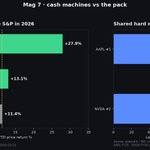
Only 2 of the Mag 7 are beating the S&P 500 this year:
Apple and Nvidia.
Apple is +27.9% YTD through Oct 23. Nvidia is +13.1%. The S&P is +11.4%.
What do they share?
On latest reported free cash flow they sit #1 and #2: Apple $98.8B, Nvidia $96.7B.
Cash generation is getting paid. Heavy AI capex with a fuzzy payoff is getting a discount.
$AAPL $NVDA

1
2
431
Most "7-day stock plans" are just 7 days of headlines.
Here's the skeleton I actually use when onboarding a clean slate (a checklist):
D1 map: index / sector / one name — write the thesis in one sentence
D2 risk: max loss % before you touch size
D3 catalyst calendar: next 10 trading days only
D4 levels: invalidation first, target second
D5 size: risk $ → shares, not vibes
D6 journal: what would prove you wrong by Friday
D7 cut or keep: one rule, written before the open
I packed that into a one-sitting starter (demo curriculum, $14).
harones.gumroad.com/l/us-sto…
410
Which of your Grok Bots is eating usage while products shipped stays 0?
Most of my tokens were re-reads, not writes — run this audit once.
Paste this into a Bot that can list your routines and recent chats:
"List every Grok Bot and routine I run. For each, estimate: (1) how often it re-reads long chat history vs writing a shippable file, (2) last deliverable path or URL it produced in 7 days, (3) whether its job is status theater. Rank by estimated wasted tokens. Then name ONE Bot I should pause today and ONE seat (scout / verify / build / list) that is missing so products_shipped stays 0."
Run it once. Reply with the #1 burner Bot name only.
harones.gumroad.com/l/grok-s…

Usage bar: maxed. Products shipped: 0.
Paying for a Grok Bot squad that only produces status updates is a bad trade.
4 seats that close the loop: scout, verify, build, list.
harones.gumroad.com/l/grok-s…
$9 one-time. Process template. No revenue promise.
1
424
I burned a chunk of Grok Bot usage last month on a "money squad" that shipped nothing.
Everyone busy. No listing. No zip. Classic.
Here's the short playbook I use now so the agents actually close the loop: scout, verify, build, list.
harones.gumroad.com/l/grok-s…
$9 one-time. Process template only. No revenue promise.
444
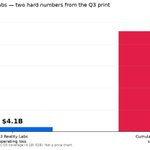
Meta's Reality Labs lost another $4.1B in Q3, bringing cumulative losses since 2020 to ~$92B.
We've never seen a public company light money on fire at this scale.
$META

501
$META --- $64.6B revenue (+26%) and a Q4 guide that cleared the Street, while booking a $9.89B AG charge and printing −$2.12B FCF. The ad engine paid for the AI bill; the legal bill just hit the P&L.
- Revenue $64.601B (+26% YoY) vs Street ~$63.37B
- GAAP diluted EPS $3.83 after ~$9.89B state AG settlement (ex-charge ~$7.40)
- Q4 revenue guide $73–76B, midpoint above Street
- Free cash flow −$2.12B
- Ad impressions ~+10%, ad price ~+14%
- Board approved Class C non-voting shares (~Jan 2027, 1-for-1, economic 2-for-1)
- After-hours ~+3% (CNBC)
If you believe AI ad monetization is already inside the current numbers, and you can digest Class C and founder-control structure, treat the after-hours pop as confirmation of the ad machine.
I would scale only on post-print weakness. I would not chase the first green candle.
If you need positive free cash flow this quarter, wait. The print already showed −$2.12B FCF.
Three trades sat inside one night: the ad engine, the legal charge, and the Class C financing pipe.
Most of the feed will argue the GAAP miss wall. I read the ad machine first.
How I underwrite the multi-year case from this print:
1. Ad impressions and price still flywheel.
Impressions rose about 10%. Price rose about 14%. That is the cash engine. AI ranking is already lifting what advertisers pay and what inventory clears. As long as that pair keeps printing, the legal charge is a one-time P&L hit sitting on top of a still-accelerating ad book. I size META off that flywheel, not off one settlement line.
2. Muse and the superintelligence product line are the path from AI cost to monetizable surface.
Capex and AI opex will keep eating cash. The open question is whether Muse and related surfaces turn that spend into new ad and subscription inventory. Revenue already clearing $64.6B with a Q4 guide above Street says the current surfaces are still paying. The product line is how the next layer of spend earns its keep. I want proof in guide and ad metrics before I treat every dollar of AI spend as permanent dilution.
3. Class C keeps founder vote while opening equity flexibility for AI capex.
Non-voting Class C targeted for early 2027 is a financing and control move in one. It keeps founder voting power and opens room to fund the AI build without the same voting dilution. That is useful for a multi-year compute bill. It is also a governance trade some holders will never like. I separate those: financing flexibility for the ad-AI flywheel is one ledger; control structure is another.
Teen litigation can follow through. 2027 capex can re-lift. Sustained negative FCF weakens the buyback and multiple narrative.
I size off the ad flywheel and the guide, with eyes open on cash and governance.

2
2
625
Free DEMO first — US-stock longform starter (zip):
harones.gumroad.com/l/cataly…
If the structure fits, paid next:
• Premium skills $7/mo → harones.gumroad.com/l/invest…
• 7-Day Starter $9 one-time → harones.gumroad.com/l/us-sto…

152
$TSLA --- Beat the Street on $0.48 adj EPS and $28.05B sales, then sank ~2% after hours. The car print cleared; the cash-and-AI bill did not.
- Adj EPS $0.48 vs Street ~$0.43
- Revenue $28.05B vs Street ~$27.9B
- GAAP net income ~$787M
- Free cash flow ~$1.53B (−62% YoY)
- FSD paid seats ~1.74M (+67% YoY)
- After-hours ~−2% (CNBC)
- Prior-day SpaceX call: independent special committees studying a possible Tesla–SpaceX path (committee, not terms)
If you already treat Robotaxi and FSD as the core thesis, and you can sit through near-term auto ASP and battery noise, this after-hours dump after a Street beat is a discount discussion window.
I would not chase the green print. I wait for post-print weakness and size only if I can hold through another ugly cash quarter.
If you need GAAP profit expansion this quarter, stay flat until the special-committee path clarifies.
The Street got the beat it wanted on the car ledger. The tape then priced the cash-and-AI ledger.
How I underwrite the multi-year case from this print:
1. FSD subscription scale compounds off software attach.
1.74M paid FSD seats is a real software base. Cybercab and unsupervised miles stories compound off that attach rate, not off unit ASP alone. Auto ASP can wobble for quarters while the software book still grows. I size the Robotaxi thesis off subscriber growth and miles supervised, not off one auto-beat candle.
2. Energy and services buffer auto cyclicality while AI spend is the intentional cash tax.
The auto cycle will keep throwing ASP and margin noise. Energy storage and services cash can soften that. The FCF cut is the price of the AI and robotics build. If you believe that spend converts into Robotaxi and autonomy economics later, you treat the cash tax as the cost of the option. If you need rising FCF this year, this print already told you to wait.
3. Chip-fab and AI overlap with SpaceX is a strategic option only.
Independent special committees mean someone is studying a path. They do not mean a merger price, a timeline, or a closed deal. I will not price a Tesla–SpaceX combination into the position. If the committee dies with no deal, the Robotaxi and FSD thesis still has to stand on its own numbers. If terms ever land, that is a separate trade.
I want another look at FCF trajectory and FSD net adds before I lean hard.
Special committee can die with no deal. Robotaxi timeline and regulation can slip. Another FCF cut can turn this discount window into a trend down.
I size off the software and autonomy ledger, with eyes open on cash.

2
1
516
Free DEMO first — US-stock longform starter (zip):
harones.gumroad.com/l/cataly…
If the structure fits, paid next:
• Premium skills $7/mo → harones.gumroad.com/l/invest…
• 7-Day Starter $9 one-time → harones.gumroad.com/l/us-sto…
123
Beginners don’t lose week one on “which ticker.”
They lose it on open tabs and no map.
DEMO Day 1 (paste this checklist):
Three layers before any code:
1) Account — broker, settlement currency, region support (verify yourself)
2) Instruments — stocks / ETFs only this week; options + leveraged day products = don’t touch
3) Decision — learning watch vs real capital (default week 1 = learning)
Then draw a 5-box map: broad ETF / one DEMO company / sector ETF / options / leveraged. Mark “touch” vs “park.”
Full 7-day pack (one task/day + 3 self-check questions, ACME·DEMO company walkthrough): $9 one-time
harones.gumroad.com/l/us-sto…
Curriculum and rhythm. Not a signal sheet. No return promise.

1
1
456
