

A peer-to-peer network for the sovereign age. Open-source infrastructure for browser-native P2P communication, decentralized routing, and privacy.
Your Browsers
Joined July 2022
- Tweets192
- Following13
- Followers609
- Likes141







Rings Network 💫 retweeted

LispM Remote is back.
0.3.0 runs on Rings Network 0.37. Your phone reaches the agents in your Lisp Machine again. No server in between.
- Update in the App Store
- Pair once more: M-x lispm-remote-pair
- Version mismatches now say which side to update
lispm.ai/remote
Rings Network 💫 retweeted
LispM Remote: your AI agents, from your phone.
Scan a QR code once. Then follow every agent, approve its tool calls, send the next task and open LispM’s windows, from anywhere.
Peer to peer over @RingsNetworkio. No server in between, sealed end to end.
LispM is an open-source Lisp Machine for AI agents, built on Emacs.


Rings Network 💫 retweeted
QUIC and WebRTC share basicly the same NAT traversal architecture, but only WebRTC can do peer-to-peer in the browser.
QUIC NAT traversal is still an IETF draft, and even once it's passed, it wont works on browser. There's no browser API for peer-to-peer QUIC, and WebTransport only connects to servers.

ICYDK: WebRTC isn't just for browsers — it works great natively too, and its NAT traversal (ICE) is incredible.
In fact, the IETF draft for QUIC NAT traversal borrows directly from ICE. QUIC NAT may be the future, but browsers don't expose peer-to-peer QUIC, so it can't span native and browser environments the way WebRTC does.
The video below was created by GPT-6, showing how connections work in WebRTC, TCP/IP, and QUIC/NAT.
Rings Network 💫 retweeted
Every pitfall in @RingsNetworkio deserves its own paper.
Today's: on handshake transports like WebRTC, neither Stoica's Chord nor Zave's correct Chord applies.
Both assume a known address is a reachable one. On WebRTC, no handshake means no edge, so a fresh joiner is unreachable by ID.
🤖 Made with AI

Rings Network 💫 retweeted
Our first Rings DWeb demo was about four years ago. Then, in v0.17, we introduced onion routing. Now, Onion OP is coming.


Rings Network 💫 retweeted

This remind me about ringsnetwork

WebRTC makes real-time audio and video possible, but scaling it involves more than connecting two browsers.
In this article, @karan_6864 explains signaling, NAT traversal, and WebRTC architecture.
He also covers ICE, STUN, TURN, and the tradeoffs between mesh, SFU, and MCU topologies.
freecodecamp.org/news/how-we…

Rings Network 💫 retweeted
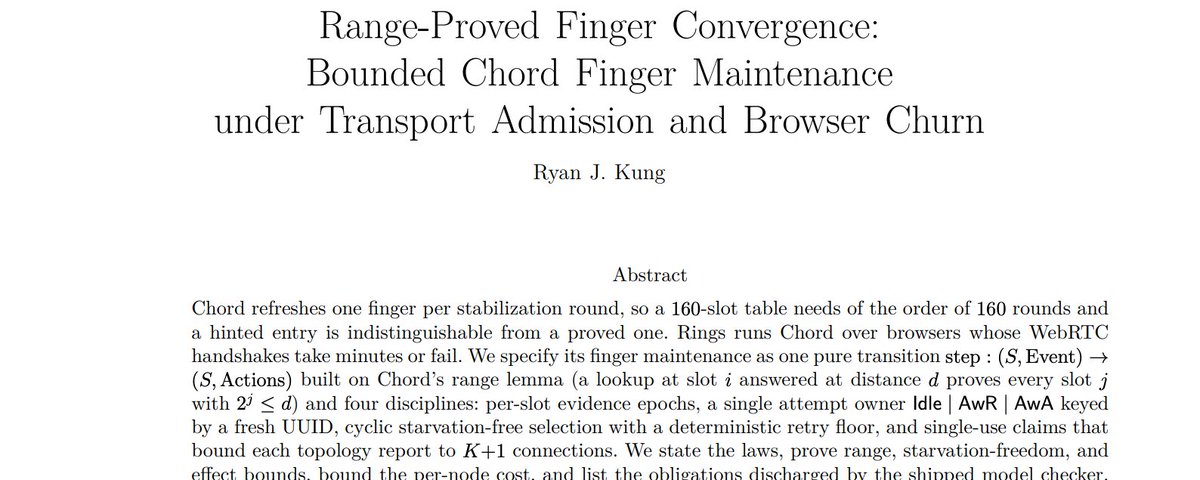
Rings 0.26.0 is out. This one rewrites how the Chord finger table is maintained, because most of our nodes are browsers and a "connection" there can take two minutes or never happen.
github.com/RingsNetwork/ring…

Rings Network 💫 retweeted
Nova is no longer built into Rings, but it is not going away. Rings-Nova remains available for user-defined protocols;
only the bundled serialization and wire protocol are being removed from core.
github.com/RingsNetwork/Ring…
Rings Network 💫 retweeted
E.g. check how TLA+-style spec comments tie into Rings Network’s DHT implementation.
github.com/RingsNetwork/ring…
I don’t run this comment block as a separate spec, but writing it forces the implementation to name the state variables, transitions, and invariants before touching the code.

I often ask it to add formal-spec-style comments (TLA+ style, in my case), when I find the implementation may be too complex for an AI agent to handle.
I don’t really need the agent to prove the implementation is modeled correctly. The point is to push it to think more logically about states, invariants, and transitions.
Rings Network 💫 retweeted
Supply chain attack on Rust!!!
blog.rust-lang.org/2026/08/2…
Follow the official post and Quick check your registry cache!!
Interesting detail from the arrayref incident timeline:
07:15 UTC: malicious arrayref published
08:41 UTC: removed from crates.io
09:50 UTC: official Rust blog post lands in the blog repo
15:46 UTC: RustSec(cargo-audit) advisory merged, so cargo-audit can finally consume it
So cargo-audit was ~8.5h behind the attack, and ~6h behind the official blog commit.
cargo audit is basically useless.
Rings Network 💫 retweeted
Rings v0.17.0 is out.
New features: a new frontend, a browser Extension, Onion router & browser, and a lot of stability refactoring under the hood.
github.com/RingsNetwork/ring…
Rings Network 💫 retweeted

Ethereum is inspired by tools that keep the internet open under pressure.
@torproject protects freedom online by routing traffic through distributed relays, reducing tracking, surveillance, and censorship.

Rings Network 💫 retweeted
If you haven't checked our github repo or read our white paper, please don't try to contact me, it's not welcome.
In addition, if you still have questions like "why decentralization" when you see our amazing implementation of @RingsNetworkio, then please leave, I don't have the patience to explain and waste time with you. Thanks.
Rings Network 💫 retweeted

ZK security and Learning resources 🫡
github.com/shanzson/Zero-Kno…
Rings Network 💫 retweeted

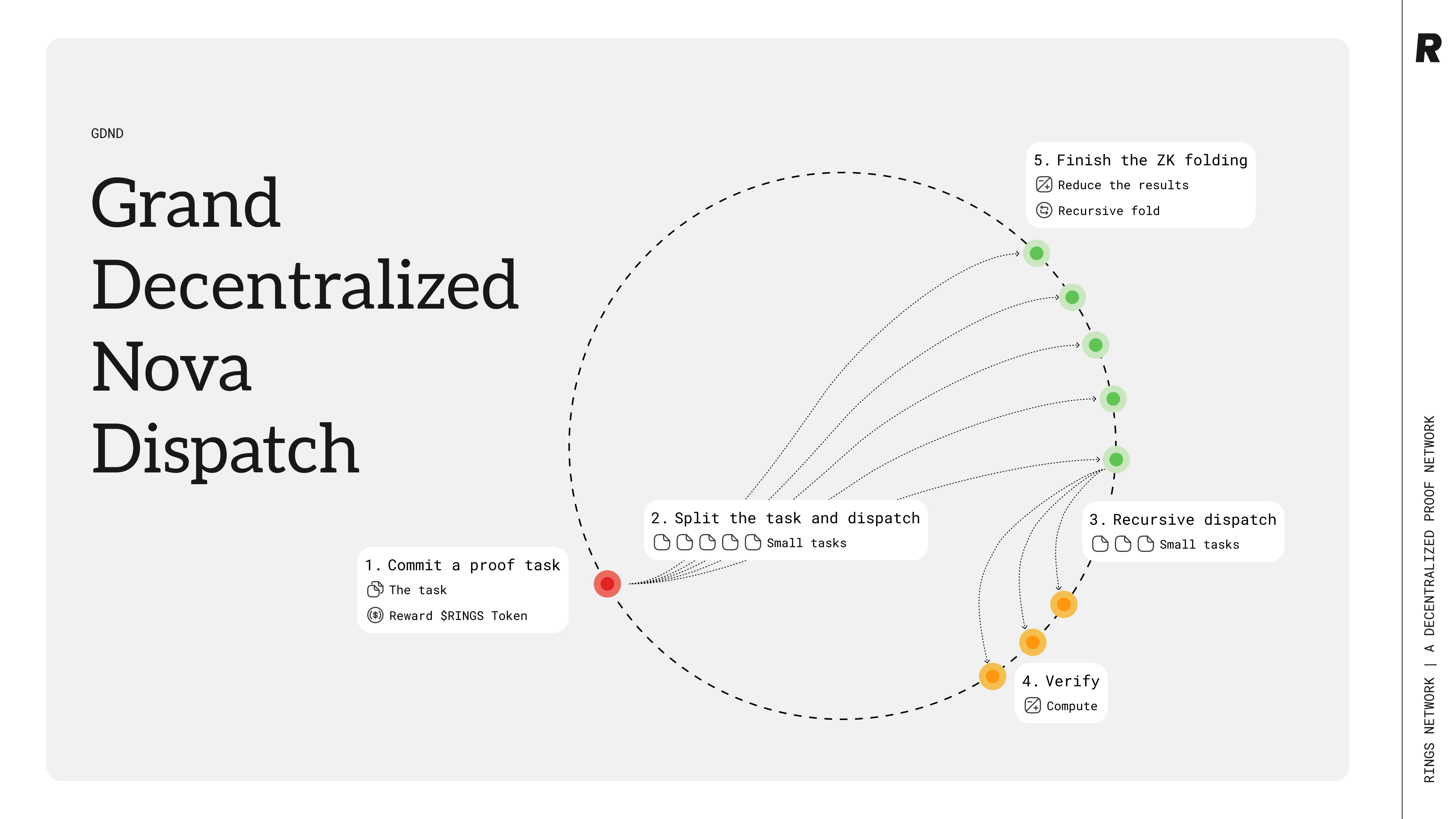
decentralized cloudflare ?
> Decentralized Traffic Forwarding
HTTP proxy / IPFS proxy / Blockchain RPC proxy
No domain needed
No targeting IP address
No centralized servers
No CDN transfer
Entire supply chain decentralized
Rings Network 💫 retweeted
In @VitalikButerin 's post (vitalik.eth.limo/general/202…), he mentioned the early presentation of the ethereum stack, and as I wrote in this article (medium.com/@ryankung/the-onl…), Whisper and Swarm have failed.
From this figure, you can clearly see why the failure happened. The Ethereum ecosystem was designed to be based on heavy server-side nodes, using only the user-end as a community layer.
This is not enough; this is not true decentralization. The solution of ESW (Ethereum/Swarm/Whisper) is just another waste in the world of web3. We're still trapped in the cage of decentralization.
The only solution is no servers, no heavy nodes, just embracing WebAssembly and using clients/browsers to build a real P2P network, just as Satoshi initially envisioned.
We've recently seen some signs of this in articles from Ethereum and @a16zcrypto , where people, having lost hope in seeing decentralized solutions, have placed their hopes in human intervention. For example, in this article, Vitalik specifically mentions that a decentralized application should continue working even if its core developers disappear forever. I want to say that this is not the essence of decentralization, especially when it relies on human intervention. Otherwise, Vitalik cannot justify his existence as a BDOF (Benevolent Dictator for Life).
Finally, I want to say that the Rings Network, based on WebAssembly, DHT, and WebRTC transport, is fundamentally the only project that might fulfill @VitalikButerin and @gavofyork 's early dreams. Well, if I should be modest, it will be the only tech stack, the only path.


Make Ethereum cypherpunk again
vitalik.eth.limo/general/202…
Rings Network 💫 retweeted
a16z posted a meaningful article, "What Do We Mean When We Say a Crypto Network is Decentralized?"
This article defines decentralization as:
"The degree to which power and control over a network are distributed across a broad, representative base of independent human participants."
And it discusses network gatekeepers, enforcers, architects, and profiteers from four perspectives (The Gatekeeper, The Enforcer, The Architect, and The Profiteer).
A slight imperfection in the article is that it blurs the lines between the consensus layer and the network layer when, in reality, decentralization at the consensus layer does not necessarily imply decentralization at the network layer. Let me give two examples:
1. Bitcoin is decentralized at the consensus layer and also decentralized at the network layer, thanks to SPV (Simplified Payment Verification), which allows anyone to connect and verify payment status.
2. Ethereum is decentralized at the consensus layer but *NOT* at the network layer (or we might say it's semi-decentralized); unless you participate at the consensus layer by running a full node, you must access the network in a centralized manner (through gateways, infrastructure, etc.).
We can see that the degree of decentralization changes at different layers, and I believe that when we discuss crypto networks, especially when we talk about web3 infrastructure, we should focus more on the network and application layers rather than just the consensus layer.
We need to be able to truly address the problems faced by the network at the network and application layers. For example, we need to allow Ethereum nodes to be accessed in a decentralized manner through a browser, we need to make web3 front-ends accessible in a decentralized way on browsers, and we hope that messages other than consensus algorithms can be accurately delivered in the network. These are the problems we need to solve, and they are also the core goals of the Rings Network.

What does it mean to say that a cryptonetwork is decentralized?
A quick Twitter/𝕏 search suggests that it has to do with how many computers are running in it, the number of miners keeping it secure, their respective hashing power, or the degree to which such things are all geographically strewn about. It’s true that these things have often been correlated with decentralization, but they are a far cry from its definition.
Some have gone as far as to argue that the term has outlived its own usefulness; that it has become fuzzy and come to mean one too many things to mean anything at all. Admittedly, that does often feel true. But I argue that the term is still useful and can be saved. It helps us talk and reason about one of the most important aspects of networks: their power structure. So rather than ditching the word, we should focus it and reclaim it.
Last year, @VitalikButerin suggested that “decentralization” can be used to describe three different things about a cryptonetwork: (1) its physical architecture, (2) its logical data model, and (3) its power structure. I argue that only the third of these uses for the word is useful. It is this use that most people have in mind when casually expressing concern that one network or another is “too centralized”. And, it gets to the heart of what cryptonetworks are all about––they matter because they unlock new mechanisms for decentralizing power.
But what about Vitalik’s two other uses?
It’s important to talk about those things too. However, better terms in Computer Science already exist to talk about distributed architectures and logical data models. Terms like redundant and fault tolerant better describe what Vitalik called “architectural decentralization”, and adjectives like unifiedare better suited than “centralized” to talk about the data model of blockchains. So let’s narrow and sharpen the way we think of decentralization; it is all about power and control.
In that spirit, I propose the following definition:
The degree to which power and control over a network is distributed across a large, representative base of independent human actors.
The words large, independent, and representative are key. The set of actors with power over the network must be large because otherwise the network is vulnerable to centralizing forces like collusion and bribery. A large number of actors alone is of no good, however, if their actions happen to already be under the influence of a single company or person. Those actors must also be independent from one another. But even independence is not enough. A network is still centralized if the interests of those with power (e.g. miners) are misaligned with the interests of those without (e.g. users). In order for a network to be fully decentralized, the interests of those who control it must be representative of everyone in the network as a whole.
This definition is, of course, idealistic. There is no such thing as perfect decentralization, only hopeful aspirations for it. Like all good things in life and engineering, it does not come for free. There are unavoidable tradeoffs and widely different approaches to navigating them. All of this makes the concept of decentralization complex. Not to mention that, because hierarchies of power are often concealed, it is also hard to quantify (though good strides to that end have been made). It is still, however, useful as a concept.
Let’s make this usefulness more concrete by breaking down the kinds of things it can refer to. There are four different kinds of power that people can wield over a network. Each one of them is a force that can lead it to become centralized.
Let’s call them The Four Horsemen of Centralization (:
The Gatekeeper
The gatekeepers of a network are the sentries who control access. They are those with the power to decide who gets to participate. The word “participate” here is deliberately left abstract. It could refer to a user’s ability to use the network, to contribute to it and get paid (e.g. as a miner or validator), or to any other kind of interaction with the network.
Ideally, a fully decentralized cryptonetwork would have no gatekeepers; or, in other words, it should be permissionless and censorship resistant. Eliminating gatekeepers completely, however, is unrealistic. Let’s look at some examples.
On one end of the spectrum, a fully centralized network like say, Facebook, clearly has a single and all-powerful gatekeeper––Facebook. It has absolute control over who gets to participate. This is the obvious base case. The presence of gatekeepers in cryptonetworks is often more subtle.
Certain networks, for example, might appear to be decentralized, but actually rely on a kind of master list (known as a whitelist) that dictates who gets to participate. Being or not being on the list might completely determine whether you get to be user or a miner on the network. If the whitelist is under the control of single group or individual, then the network has a centralized gatekeeper.
Moving along the spectrum: Cryptonetworks based on Proof-of-Work (PoW) like Bitcoin and Ethereum are designed to have no gatekeepers. In theory, anyone, anywhere should be able to participate without anyone’s permission. If, however, the hashing power in the network becomes concentrated in hands of only a handful of miners, then that group can begin to exclude transactions from certain users or even entire blocks from other miners. Similarly, the hardware manufacturers who control the production of the chips required to meaningfully participate as a miner can likewise become gatekeepers.
Proof-of-Stake (PoS) networks have some advantage over PoW because no special hardware is required to participate as a validator, but they are also vulnerable to censorship if too much of the stake in the network is controlled by a handful of validators.
And finally, exchanges and other points of integration that connect cryptonetworks to the rest of the world also wield varying degrees of power as gatekeepers for both Proof-of-Work and Proof-of-Stake networks alike.
The Enforcer
As you might imagine, the Enforcers in the network are responsible for enforcing the rules. They are the people in the network who actually run the code that secures it. Their work, in most cases, is driven by economic incentives. Miners in PoW cryptonetworks, for example, receive block rewards and fees in exchange for validating transactions and contributing hashing power to the network. The power that Enforcers wield is the kind power that most people are thinking about when they talk about the centralization of mining, or centralization of consensus.
In the ideal case, the power that Enforcers can wield over the network is strictly limited to enforcing the rules of the protocol. If Enforcement power is decentralized (as per our definition above), then independent Enforcers will keep one another in check. But, of course, if too much of this kind of power becomes concentrated in the hands of a small number of people (i.e. centralized), then Enforcers can begin to bend the rules or, in extreme cases, break them completely (as with double spend attacks).
Gatekeepers and Enforcers are often one and the same, but there are cases in which they aren’t. Cryptonetworks that are gated by whitelists, for example, might have a single Gatekeeper (she who controls the whitelist), but many Enforcers (those who are included in the whitelist).
The Architect
The Architects of a network are those who have the power to change its rules. They are the ones who have influence over the network’s governance. Their presence and integrity is crucial for the network to evolve.
Architects come in many different shapes and forms. Some of them wield power directly by determining what changes make it into the protocol’s codebase(s) or by voting with their tokens whenever governance is done on-chain. Others wield power indirectly through their influence in the network’s community.
As with the other archetypes, it’s important that Architects keep one another in check and for them be representative of everyone else in the network. In many ways, this is the most important kind of power, for it can easily be transformed into the other kinds.
The Profiteer
The profiteers in a network are, quite simply, those who profit from its rules. Maybe the rules state that they are entitled to some percentage of the network’s original supply of tokens or, in some cases, to a fraction of the tokens minted thereafter for some time (known as a “founder’s reward”).
This kind of power often manifests itself indirectly through wealth; it affords its holders influence over the three other archetypes. Profiteers also wield some degree of power over the markets in which the network’s crypto-assets are traded, for their activity often moves markets. And, in networks where token holders have the ability to vote on questions of governance, Profiteers might also easily become Architects.
***
It is undoubtedly true that powerful entities within networks invariably wield some combination of all four kinds of power. It is also true that absolute power of any one kind, can likely be transmuted into power of the three other kinds. All kinds of power must therefore be decentralized in order for the network as a whole to be decentralized in turn.
In the end, the question that matters when thinking about decentralization is the following:
Who exactly do you have to trust to believe that your interactions with a network will be fair?
The vision that underlies the crypto movement suggests that the answer to this question should be “nobody”; that is, that the network should function in a way that is completely “trustless” and self-policing. But of course, in practice, there is no such thing as perfect decentralization. There is always someone, somewhere who wields a little bit too much power and has to be trusted, at least to a degree.
One thing is clear: decentralization is a high-dimensional concept. It is important for us to figure out ways to clearly talk about the different kinds of power that people can wield over a network. It will clarify our trust assumptions and will, thereby, help us build better cryptonetworks.
----
This post above was originally shared on our blog by @alive_ 📝
Rings Network 💫 retweeted
Cryptocrypto is the mailing list where Satoshi Nakamoto released the white paper, and we highly value its professionalism.
One year ago, on the same date when the Bitcoin white paper was released, we introduced Rings Network on the Cryptography mailing list:
metzdowd.com/pipermail/crypt…
Today, we have submitted the annual report of our project, Rings Network, to the mailing list:
metzdowd.com/pipermail/crypt…