https://teapawt.net/t.co/TeszDs5hoE
North Carolina, USA
Joined March 2021
- Tweets3.8K
- Following70
- Followers858
- Likes6.3K



Rob’s FinTech retweeted
Your winning screenshot is quietly setting your next size.
A green-only recap feels honest because the money is real.
The lesson it teaches is not real.
You go to bed looking at the print that paid, you wake up treating it like the whole class and the next size gets set by the side you kept.
The hidden mechanism is simple.
Confidence rises faster than evidence when the other side never makes the page.
One kept winner trains the next click more than ten rules about discipline ever will.
After the close the daily scans seal.
The bot builds the evening package with the chart as it closes and the levels that came from real tape.
I review it, then I post it. I do not rebuild the hunt and I do not keep only the print that looks good.
What the package has to contain:
- the chart as it actually closed
- the levels that came from real tape
- both sides of the trade, including the side that did not pay
Honesty has to be architecture or the recap becomes a costume:
1. the bot never invents a number
2. every fallback is labeled
3. if we cannot verify it, we do not publish it
4. losers stay because deleting them deletes the class
I am still in the loop on purpose. A program can seal scans and attach levels in seconds.
Only a person can refuse to crop the page before it posts.
That refusal is what keeps an alert from becoming a signal.
If your close process only keeps the side that paid, you do not have a recap.
You have a highlight that will set your next size.
Watch one resolve on the SPY, QQQ, DIA, and IWM row. Both sides sit in the same package.
Then decide whether you want a feed that flatters you or a record you can check.

Rob’s FinTech retweeted
Imagine the alert arriving with the whole plan in seconds
While you still hold the final call.
The card holds the plan and you hold the call.
Rob’s FinTech retweeted
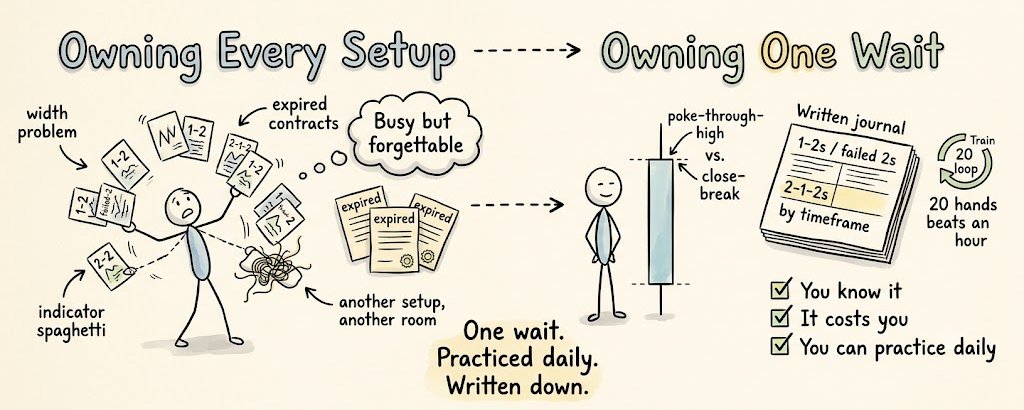
Your favorite setup might be the one costing you money.
Have you checked which setup actually pays you?
I had months of memory and no record by setup, so I kept funding the pattern I liked.
Then I split the page by 1-2s, failed 2s, 2-1-2s by timeframe and I saw a different favorite in the record.
Very quickly I stopped arguing with my own page haha.
Split it like this:
- 1-2s by timeframe
- failed 2s by timeframe
- 2-1-2s by timeframe
- mark nightly: setup, timeframe, took or skipped, what the bar did after
Memory picks what you like while a record picks what pays.
If you cannot name it by setup, you are guessing.
Rob’s FinTech retweeted
You're about to let a $40 premium decide how many days your trade gets.
Cheap is a price while time is what the trade needs.
Match the expiry to the duration first, then pay the premium.
Rob’s FinTech retweeted
Before you set $100 as your target, check the 5 prior highs price has to clear.
Five stacked turns beat one hopeful number.
You're not picking a target instead of using turns the market already left in order.
- rung 1, the first prior pivot above
- rung 2, the next prior high where price stalled
- rung 3, the next prior high where price reversed
- rung 4 and 5, the rest of the list in order
- write the list before you write the number you want
Five or more pivots stacked inside one range is what Strat traders call a PMG.
The break gives you a list, not a vibe.
Write the ladder first. If there is no list, you do not have a target yet.
Rob’s FinTech retweeted
You spent an hour arguing over a price level that only existed on one chart.
This is not another dashboard story.
This is what happens when two careful people read different bars and call it the same level.
They circled a high that held all week.
Then one of them opened the same ticker and the high was not there.
they both pulled up tape and were right on your own clock.
The argument was never about the setup. The cost was hours of confidence spent defending a number the other screen never printed.
Most traders inherit a shared language without thinking about it.
TradingView is that language for this room.
When your bar matches that chart, you can point and be understood.
When it does not, you are speaking a private dialect and calling it a level.
The tape is the same but slicing is not.
One feed starts the day near 4am and folds the overnight into the bar and other starts at 9:30 and treats yesterday as finished.
Same stock, different candles, different highs, different breaks.
That constraint is why matching is hard engineering, not marketing. Feeds arrive close enough until two highs get compared side by side.
Then close enough becomes an argument.
The philosophy that came out of it is boring on purpose. Same bar, or it does not ship.
Three data problems sit underneath every phantom level:
- a level with no clear source on real tape
- candles built from a different session than the one you trade
- feeds that look aligned until highs and lows get circled together
Four honesty rules sit on top:
1. the bot never invents a number
2. every level comes from real tape
3. every fallback is labeled
4. if we cannot verify it, we do not publish it
Mystery levels turn a tool into a church.
A labeled fallback will never impress a screenshot room, and that is the point.
This community needs the same highs because it already shares a language Rob Smith left behind.
He created that language and died in 2023.
I did not create it and I will not wear it. What I can build is a bar you can point to on the chart you already have open.
If your tool's candle is not your chart's candle, keep the mystery off your screen.
Compare the next high on the SPY row and trade only the bar you both see.

Rob’s FinTech retweeted
Your family dinner is worth more than 3 charts that already took your money.
You keep replaying the loss while the evening disappears.
But the evening stays yours when something else watches for you.
Stop paying those charts your whole night.
Rob’s FinTech retweeted
A trading feed shows you the wins. Who's keeping track of the losses?
That's where a ledger helps.
It tracks the entry, the stop, the target and whether the stop was hit
You already know which one taught you more.
1. feed rung: timestamp missing, plan missing, loser missing, confidence rises
2. ledger rung: entry after the alert, stop traded or not, target traded or not, loser stays
A call that never resolves is a screenshot. If the record is bad, you should still see it.
Guides explain what resolved means and what each card state means, so you can run the test on any room including mine.

Rob’s FinTech retweeted
Trading Law:
Every trading rule sounds good until you check yesterday's chart.
If it can't prove itself there, you're buying a story instead of a a rule.
Rob’s FinTech retweeted
You made the call 1 minute ago. Does the chart still agree?
You entered a clean continuation, but the bar is still printing and price is slipping back inside the range that defined the break.
Your ticket still says the old reason.
The chart is writing a new one.
That's where a continuation turns into a failed 2 and you're still holding the original thesis.
The card asks the re-read for you:
- still in force, the break still holds
- coming back inside, the break is failing
Look again and decide. Management is just reading the same bar while it is still open.
Rob’s FinTech retweeted
I needed 3 indicators to take a trade I could already see on the chart.
I was obsessed with confluence.
Even when the bars looked clean, I wanted one more confirmation before acting.
So I built myself a little committee.
One moving average for trend, one cloud for permission and one oscillator to make me feel better about the trade.
Three votes for a decision I was still too nervous to make.
The problem wasn't a lack of information.
Good setups were right there but I kept waiting for every indicator to agree before taking them.
Most of the time, they didn't.
Meanwhile, the break happened and I was still looking for confirmation.
What finally changed my mind was looking at the higher timeframe.
A lower-timeframe break could look perfect, but if the bigger bar was pointing the other way, that setup meant a lot less.
No moving average on the lower chart could make up for a higher-timeframe bar that didn't give the trade permission.
Eventually, I stopped asking the committee for permission.
The read came down to price against the prior bar and whether the higher timeframe supported it.
Try it on 2-1-2 tonight. It takes about ten seconds:
1. Type each bar against the prior range: inside, one side, or both.
2. Wait for the bar to close before calling the third bar.
3. Check the higher timeframe before trusting the lower-timeframe setup.
4. Decide whether to take the trade or skip it, and write down why.
If you need another indicator to take a break you've already read correctly, the problem probably isn't missing information.
It's trusting your own reading.
Try typing a few 2-1-2 setups on a free chart, then check out the setup guide at wherethenext2is.com/learn.
If you can't make the reading with the bars in front of you, adding a fifth indicator won't make the decision any easier.

Rob’s FinTech retweeted
You're about to pay real money for a move that hasn't happened yet.
A poke through the high isn't a break yet, so wait for the close before you type it.
Pay for the close and you skip funding the failed 2.
Rob’s FinTech retweeted
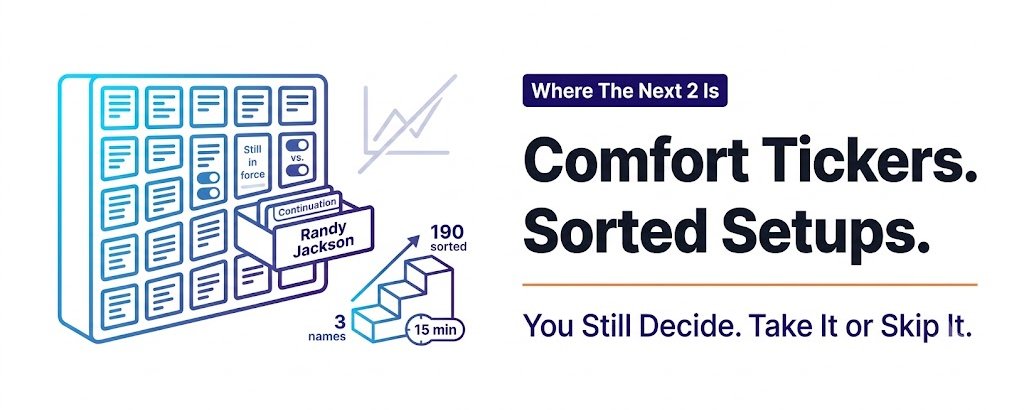
Stop trying to watch 2,000 stocks before coffee.
Start with the 3 you trade and give them 15 minutes of current information.
Premarket should tell you which of yours already moved, not what the internet chased overnight.
Then the same 15 minutes starts covering more of your list.
Then you stop pretending a person can eyeball each name.
1. 3 names, 15 minutes current
2. same 15 minutes, your gaps first
3. same 15 minutes, 190 sorted by setup
Nothing about the decision changes.
You still take it or skip it. The morning stays short while coverage grows.
Rob’s FinTech retweeted
Rob Davis lore 👇
I didn't invent this language.
No trading pit, fund or signal room.
I just got tired of losing my evenings to the same search.
So I'm not the next Rob Smith, and that's not the story here.
Rob created TheStrat language and died in 2023.
His journey was different from mine, and there's no point pretending otherwise.
My background is in IT and software engineering.
During COVID, I ran a YouTube channel called RobFinTech for about a year and a half. Making videos meant going through the same routine every time.
I'd pull the high-volume stocks, check what was getting attention on social media, then open TradingView and narrow around 25 tickers down to 2 or 3 for a video under 15 minutes.
It worked, but the time it took was getting ridiculous. Most evenings went into finding a few charts, leaving less time for my family.
There's more to life than sitting in front of a screen all night.
Spending eight hours searching just to make a 15-minute video didn't make much sense.
Some traders grow up around charts and learn the language early.
They've seen the same setups for years before they ever think about building a process of their own.
I came to it differently. Night after night, it was the same 25 tickers, the same filters and usually just two or three worth keeping.
Eventually, I started wondering why I was still doing all of it by hand.
The process itself wasn't complicated but it was just repetitive.
The chart didn't care who was looking at it but someone still had to sit there and check every name.
That was when it clicked. Most of this workflow could be handled by a program, so I started building one.
It became my first real Python project.
When the bot first ran in late 2022, scanning 750 tickers took over five minutes. Now it takes seconds.
But speeding up my own workflow wasn't the end of it.
The same problem was still eating into the evenings of other traders in the community Rob Smith left behind.
Everyone was looking for a better way to do the same job.
How do we stop hunting through 2,000 names by hand?
How do we get the information we need in minutes without letting someone else make the decisions?
And how do we keep track of the losses instead of only showing the wins?
The problem wasn't one person. It was the tools traders had to work with:
1. Lists that show setups but leave you to figure out the rest
2. Screens that keep you watching all day
3. Screenshots that show winners but leave out the losing calls
4. Black boxes you can't check against the prior bar
5. Streams that expect you to follow someone else's watchlist for eight hours
Those frustrations shaped the product more than any feature list ever could.
The setup needs to point to the bar that triggered it, with a plan attached when the break happens.
Wins and losses need to stay in the record and finding a setup shouldn't be confused with deciding whether to trade it.
Find the setups. You decide. Keep the record.
That's what we're here to build.
The classroom is free at wherethenext2is.com/learn and wherethenext2is.com/trainer.
There's plenty more to come.

Rob’s FinTech retweeted
Your favorite trader won't be there for every trade.
Will you know when to enter and when to walk away?
Practice one read until you can skip it out loud.
If you need a caller, this account will annoy you on purpose.
Rob’s FinTech retweeted
You added 3 indicators because you didn't trust what price was already telling you.
I was obsessed with adding one more line for confidence.
Another average, cloud and vote before I'd type the bar.
The stack kept growing and the read never got clearer.
The cost wasn't missing information.
I never trusted the read until I checked the higher bar first.
Then I checked the higher bar first and the stack went quiet.
Committee stack:
- another average for the doubt
- another cloud for the wobble
- another vote before the close
2-check read instead:
1. wait for the close to type the bar
2. check the higher bar for permission
More lines will not make the bar more honest. If you need another screen to take the same break, you do not have an information problem.