

LA | SF | Berlin - Founder // Builder
Berlin
Joined October 2011
- Tweets3.3K
- Following1.6K
- Followers1.6K
- Likes9.8K




The best results in AI come from domain experts who also deeply understand agent tooling.
Getting those results takes more than prompts and markdown files: the harness, custom tools, compute, and verification software all matter. These setups don't seamlessly port between systems, so the best agent outcomes stay siloed on one expert's laptop.
Workbenches changes that. It's an open standard plus infrastructure for creating, sharing, and running expert agent configurations. Each one is versioned and plugs into any major harness, so anyone can use an expert's setup without changing how they work, and get the expert's results. The CLI is open source; workbenches.dev adds a team registry, an MCP server, and isolated sandboxes or your own machines to run on.

in the actual long-term scoreboard of modern markets, holding gold itself has generally been the winner against the mining equities (picks and shovels).
just saying 🤷♂️
A lot of disciplines need to come together to create a great digital product. This is true at the agent level as much as it is at the human level. The agent version of this often involves jumping between different environments, tooling, models, skills, etc. It's a process that is chaotic, fatiguing, and never ending. But it does produce the best results... so we have endured this pain...until now.
Workbenches is our attempt to fix that. It's an open standard that packages everything behind a certain kind of outcome: model, harness config, skills, MCP, reference files, tooling, and runtime. You might have one workbench tuned for game physics and a completely different one for art direction, and switch between them without rebuilding anything.
The video shows how I use it day to day. I plan in my own harness (Claude Code with Opus), decompose the plan to respective workbenches, they run in the cloud in parallel (close my laptop), and each one comes back on its own branch. I do a light amount of work with CC to assemble them, and it goes up as one PR.
You can also pull down other people's workbenches. A few ones are up now (three.js, frontend, Svelte, Godot), and the goal is that the developers and artists you admire can publish how they get their results, so your product can end up using a blend of their workbenches and your own.
Happy to throw some tokens your way for you to kick the tires, and if you've built product with AI and have a method you think gets better results than everyone else's, I want to talk. We're setting up paid workbenches where creators earn from every run.
Skills, MCP, model, reasoning level, harness, sandbox container, verification tools... are a just a few of the considerations to make when trying to get expert outcomes from agents. As many of you have encountered, staying on top of what to apply to each problem class is fatiguing, chaotic, and evergreen. And it's only getting more cumbersome as the agent tooling ecosystem continues to grow.
You can try and ignore it and just use a harness and model but the reality is that this complementary tooling DOES WORK. It meaningfully improves outcomes. So, if you or your company are in the pursuit of the highest quality outcomes... this is a game you have to play and play well.
The way to play the game is to isolate the unique combinations of agent, harness, and tooling that yield the best token/time to outcome ratio. Getting to this requires rigorous testing and domain expert knowledge of the problem class. Unfortunately, these winning combinations often traverse vendors, model providers, and tooling/saas products. If only there was a way to seamlessly pull in these expert combinations to your preferred harness and just get the results...
Meet Workbenches.
I get that the market is full of 'trust me bro' claims at the moment. We hate that. So, not only did we want Workbenches to come with benchmarks from day one, we wanted the process of benchmarking to be accessible and as easy to replicate as possible.
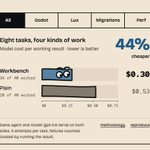
Here's one : A Godot project went from 5/10 to 9/10 working results, at $0.45 vs $0.19 per working result, same model and harness. Links in comments.
Over the coming weeks, I will continue to share the vision and possibilities unlocked with workbenches. But more than anything, I'll be sharing verifiable claims as they relate to the benefits of using Workbenches. We all deserve better in terms of proving out the yield of AI... so we will try and honestly talk about the good, bad, and ugly as it relates to Workbench capabilities. It's mainly good!!
If you're interested in kicking the tires, happy to personally onboard you and throw some tokens your way to get your first couple wins 🫡


Instinct sounds very cool. A year ago we were heads down building something very similar (almost acquired by one of the big labs for it)... Realistically, I still think we are a few model releases away from this truly capturing the consumer market. The holy grail is to get a personable easy to reach for agent in the foreground and a swarm of productive background agents in the background.... All while abstracting anything technical away from the end user.
Instinct seems like it's got a similar approach, as did we, but after extensive testing, cost and quality seemed out of reach by an order of magnitude. You have to realize that this isn't about delivering a wow factor to users, it's about not delivering an 'oh fuck' moment. One 'oh fuck' moment will sour even a solid month or two of wow experiences. Unlike coding tasks where there are tons of guardrails, documentation, and rollback mechanics... many of the real world tasks are awkward and are one way doors. The other issue is the cost was in the hundreds of dollars per month per user for us. Running a 24/7 intelligence army for a user is not cheap! While I think that's more manageable today... consumer needs AI to be priced like Netflix not a mortgage payment (even some of my wealthy friends still only use free chatgpt!).
Rooting for instinct and curious to see how they are solving for the above two issues.

There's a massive opportunity to create an ipad app where you crudely draw video game elements and use some astra magic to bring it life / productize it. In theory this would keep the aesethic unslopped but give game devs the agentic tailwinds.
This is a tough pill for many to swallow but based on the current market, Jack Barker was 100% right to get into hardware and build the box.
The next five years for many businesses is going to be defined by an emerging new ratio : return on token.
Many problems are collapsing into purely a token spend problem. And as more problems become solvable by pointing tokens at it...what it means to be an employee changes.
An employee's value becomes how that employee influences a company's outcome-per-token.