

Ciencia, tecnología, Mujeres en STEAM. Profesora - Investigadora, Universidad de Sonora
Hermosillo, Mex.
Joined September 2013
- Tweets7.6K
- Following1.3K
- Followers1.5K
- Likes20.5K




Pinned Tweet
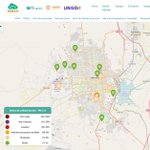
Dejé a mis alumnos una tarea para ver el tiempo que pasa desde que se menciona a un artículo y la aparición de publicidad del mismo. Medios: Llamada x tel, Whatsapp, Telegram, mensaje de voz y HABLANDO EN VIVO CON EL CEL A UN LADO SIN USO. Estos fueron los resultados:
@SoyUnison
Modelo detallado 3D de una célula humana. Qué maravilla.

Scientists have created one of the most detailed 3D reconstructions of a human cell (eukaryotic cell) ever produced.
This groundbreaking model, often termed a "Cellular Landscape Cross-Section Through a Eukaryotic Cell," combines data from X-ray tomography, nuclear magnetic resonance (NMR), and cryo-electron microscopy to map molecular structures in extreme detail.
Por qué tardamos tanto en ponerle ruedas a las maletas? youtu.be/-DqhZBcUVqI?si=6x4L… via @YouTube

La única limitación que tiene Elon Musk es el tener que seguir las leyes de la física.
A la fecha nadie como Tesla para cuidar la supervivencia de sus tripulantes.

Los exoskeleton serán la solución a quienes tienen problemas de movilidad en piernas y cadera. Ahorita cuestan aprox 140mil pesos,.pero el precio irá bajando. Eso sí, pueden provocar pérdida de músculo si no se usan con cuidado.

Muy buena medida. La evidencia científica muestra cómo el uso de los dispositivos reduce la atención, afecta la interacción social y no permite el desarrollo de habilidades esenciales en los niños. Debemos seguir poniendo atención en casa también.

📵 Celulares fuera de las escuelas: Sheinbaum anuncia prohibición desde noviembre
Ni en clases ni en el recreo podrán utilizarse celulares y tabletas en escuelas de nivel básico a partir del 3 de noviembre. La medida fue acordada por unanimidad por los secretarios de Educación de las 32 entidades del país.
@Claudiashein informó que el acuerdo se publicará este martes y entrará en vigor el 3 de noviembre.
Los celulares solo podrán usarse ante emergencias o situaciones particulares y deberán permanecer guardados durante clases y recreo.
📹 @azucenau
Aunque la proporción del tamaño de los satélites y el planeta no es la correcta, sirve para ilustrar. Desde 2020 se observa el pico de lanzamientos.
Niños en clases de música desarrollan (físicamente!) un área del cerebro que da más agilidad mental. El esfuerzo de conviertir los símbolos visuales de las partituras en movimientos, escuchar el resultado y procesar información de varios sentidos al mismo tiempo es maravilloso.

Children who take music lessons develop a larger corpus callosum, the bridge between the two halves of the brain, and the change is permanent. A 2005 review in the Annals of the New York Academy of Sciences found that early music training produces structural brain changes that persist into adulthood, even if the person stops playing.
The review was led by Gottfried Schlaug at Harvard Medical School, one of the leading researchers on music and the brain. He found that children who started instrumental training before age seven had a significantly larger anterior corpus callosum than non-musicians, and the size difference was still visible in adults who had not touched an instrument in years.
The corpus callosum carries signals between the left and right hemispheres. A larger one means faster, richer communication between the two sides, and the effect shows up in tasks that have nothing to do with music: spatial reasoning, verbal memory, and the ability to process multiple streams of information at once. The music built the highway, and the brain uses it for everything.
Schlaug also found that musicians had larger cerebellums, the region involved in timing and motor coordination, and more grey matter in the areas that process sound. The brain had physically reorganised itself around the demands of the instrument, and the reorganisation was visible on a scan.
The age window matters. Children who started before seven showed the largest changes. Children who started after ten showed smaller ones. Adults who took up an instrument for the first time showed the least structural change, though they still showed some. The brain is most willing to be rebuilt by music during the years when most parents are debating whether to sign their child up for lessons. pubmed.ncbi.nlm.nih.gov/1659…


Esta semana platicábamos en clase cómo la IA generativa podía ayudar a crear cine con bajo presupuesto. Hoy me sentí feliz al ver este reel que les dio carne y hueso (porque vida ya tenían) a las tiras de Quino que tanto amé.

Se pasó Ramiro Torres en Instagram, con nuestra eterna #Mafalda, hizo est maravilla!!! Cuando la IA es un SÍ rotundo!!! 🌹
Su cuenta de IG: instagram.com/desdigital?igs…

El patrón de la camisa confunde al algoritmo y así logra que la silueta de "rompa" y la persona no sea detectada. La IA no es magia y a estas alturas todos debemos saber cómo funciona.
Raquel Torres Peralta retweeted

WoooooooooW
Dyson acaba de lanzar un cepillo de dientes con cámara e inteligencia artificial. Se llama CameraJet y cuesta $499.
La cámara macro de 100.000 píxeles analiza 28 imágenes por segundo mientras te cepillas, detecta los huecos entre los dientes y dispara un chorro de enjuague en menos de 100 milisegundos para limpiar esas zonas.
El sistema, bautizado Gap Optical Targeting, se entrenó con 470.000 imágenes dentales y es fruto de seis años de desarrollo. Dyson lo presenta como un 2 en 1: cepillo eléctrico e irrigador dental.
Disponible ya en preventa, en azul y rosa.
No comparemos peras con manzanas. Qué bueno que los jóvenes estén saliendo y conviviendo sin violencia.

Centro de Datos biológico en Singapur usa neuronas humanas cultivadas (requieren menos electricidad y tienen un buen desempeño). Dicen que analizarán uso de medicamentos, alzheimer, parkinson y más. Debemos discutir más sobre los ppios éticos.
On August 17, 2026, Singapore officially unveiled the world’s first independently managed biological data center prototype, integrating 16 million living human neurons with traditional silicon hardware.
The project, hosted at the National University of Singapore Medicine, is a strategic collaboration between the university, digital infrastructure developer DayOne Data Centers, and bio-computing startup Cortical Labs. This infrastructure marks a shift from purely digital architecture to wetware, combining synthetic biology with computational processing power.
The system departs completely from traditional server farms based solely on microchips. The prototype is housed in a single standard rack that contains 20 CL1 biological computing units. Each unit holds approximately 800,000 neurons cultivated in a laboratory from human stem cells. These living neurons sit on silicon chips equipped with electrodes, where electrical impulses from the digital system stimulate the cells, causing them to alter their synaptic connections.
The neural activity is then transmitted back and translated into computational data by a proprietary operating system named biOS. Because these are living cells, the servers require a literal life-support system, which is why technicians feed the neurons every three days with a cocktail of sugars, micronutrients, and pH buffers, while specialized mixers regulate oxygen, nitrogen, and carbon dioxide levels.
The transition toward biological processing aims to solve two of the biggest challenges in the artificial intelligence era, which are energy consumption and learning efficiency. A single CL1 biological unit consumes about 25 to 30 watts, compared to the hundreds of watts required by a conventional silicon data center chip. Consequently, the entire biological rack demands only between 800 and 1,000 total watts, whereas traditional infrastructures consume tens of kilowatts for AI workloads.
Furthermore, the technology offers high data flexibility, delivering strong efficiency with small datasets and unpredictable scenarios without needing the massive data volumes required to train traditional models. This approach drastically lowers environmental impact and intense cooling requirements, aligning with Singapore’s Green Data Center Roadmap.
The prototype does not aim to replace the entire global cloud infrastructure immediately, but focuses instead on specific tasks where biology outperforms current computer architecture. A primary field is advanced biomedical modeling, which uses the neurons to better understand the development of neurodegenerative diseases directly on the integrated hardware-software platform.
Another application involves accelerating pharmaceutical research to test the efficacy of new drugs and molecules, which drastically cuts laboratory testing timelines. Finally, the technology enables the development of predictive AI algorithms that leverage the natural ability of the human brain to adapt to contextual changes without requiring massive computational recycling. This initiative is part of DayOne’s long-term plan to expand next-generation computing capabilities across Asia and Europe, while construction of their first local AI-ready traditional data center, named SG1, is set for completion in early 2027.

Raquel Torres Peralta retweeted

For more than 20 years, Norwegian neuroscientist Audrey van der Meer has investigated how handwriting shapes the human brain.
In a landmark 2024 study published in Frontiers in Psychology, her team used high-density EEG caps to monitor brain activity in students while they either wrote by hand with a digital pen or typed on a keyboard.
The difference was dramatic. Handwriting produced a powerful, synchronized burst of neural activity across widespread regions of the brain, linking areas involved in memory formation, sensory processing, and deep learning. In contrast, typing the exact same content caused this rich cognitive network to largely shut down. Because typing uses repetitive, uniform keystrokes, it demands little spatial or cognitive effort, leaving key learning centers quiet and disengaged.
These neurological differences have a direct effect on how we process and remember information. Earlier research by Pam Mueller and Daniel Oppenheimer at Princeton University reached similar conclusions. Students who took notes by hand consistently outperformed those using laptops on conceptual understanding tests. Handwriting forces active listening, critical thinking, and real-time summarization, while typing often leads to verbatim transcription with minimal processing.
Our brains function as part of an embodied biological system. Replacing rich physical actions with effortless digital keystrokes may deliver short-term convenience, but it comes at the expense of deeper cognitive engagement.
The solution is simple and timeless: pick up a pen.
[Van der Meer, A. L. H., et al. (2024). Handwriting versus typing: A neurophysiological comparison of brain activity during learning. Frontiers in Psychology, 15. DOI: 10.3389/fpsyg.2024.1234567]

Recuerdo cuando uno de los médicos que atendía a mi papá se ofendió cuando quisimos buscar una segunda opinión. Era cuestión de vida o muerte y se enojó al grado de insinuar que no quería atenderlo más por "poner en duda" su capacidad. La locura.
Son los menos.

El narcisismo se caracteriza por la necesidad de admiración y la excesiva auto admiración. Entre los especialistas en medicina, es más común en los cirujanos, lo que puede impedir un buen trabajo de equipo y la atención médica de calidad. nature.com/articles/s41598-0…

