
Research Scientist @GoogleCloud
Sunnyvale, CA
Joined March 2012
- Tweets59
- Following277
- Followers192
- Likes35





Proud to share DuoDiscover! 🚀🚀🚀
For agents on real engineering problems, the scarce resource is evaluation. An agent writes a candidate in seconds, and testing it can take hours.
DuoDiscover lets agents build their own fast tests and save the real eval for promising solutions

AI is cracking math problems. What's holding it back in engineering?
The cost of evaluation. Agents can generate ideas in seconds, but testing them can take hours or days.
💡 Meet DuoDiscover: where evaluation is part of what agents discover 👇🧵
Some highlights:
🏆 #1 on NVIDIA's SOL-ExecBench
🐍 2× the experts on SWE-fficiency
🚀 1.92× on vLLM; 1.44× on FreeToken
🔥 2.68× over production TPU kernels
🖥️ Beats the best human and AI-designed CPU prefetchers
Rui Meng retweeted

Agents let us build systems for different workloads and requirements. But… can we trust what they build?
We release 🌟SkySynth🌟: an engine for synthesizing high-performance, just-in-time (JIT) systems we can trust, by co-evolving formal proofs and tests alongside the code.
Results:
💿 KV stores up to 2.3× faster than Redis and FASTER + formally verified stores with 2.9× Claude Code's pass rate
🚏 Model routers up to 48% cheaper than a general router
⚡ Specialized inference engine with 2.2× the throughput of vLLM/SGLang
🧵👇
Our ScientistOne on this is now live on the Google Research blog!

Introducing the Science One Framework, an experimental autonomous research prototype that builds verifiable evidence chains. We demonstrate how natively maintaining these chains eliminates hallucinated citations and enables reproducible AI science. Read the blog to learn more: goo.gle/4wzlGWU

ALT The Science One Framework pipeline. Problem Investigator grounds literature via retrieved PDFs. Discovery module explores and evaluates solutions. Paper writing & verification module writes and verifies the paper with a Claim Verifier ensuring all claims match their evidence source.
9
1,279
Rui Meng retweeted

AI Can Publish at Top AI Conferences Now!
Today we are introducing Apex Research, and the results are hard to overstate.
Over the past several months, our team has been building an autonomous research system capable of conducting end-to-end machine learning research with minimal human intervention.
To find out how good it really is, we refused to hide behind internal benchmarks. We took it straight to one of the toughest arenas in the field.
We submitted AI-generated manuscripts with only limited non-expert human intervention during the process to ACL Rolling Review, the peer-review engine behind the world's top AI conferences, under the exact same double-blind process used for human researchers. Reviewers evaluated the papers without ever knowing they were written by AI.
The results exceeded our expectations.
Several papers achieved review scores above historical acceptance thresholds, while overall performance approached that of human-authored submissions. In accordance with our experimental protocol, all submissions will be voluntarily withdrawn before final publication.
Beyond the technical results, we hope this work encourages broader discussion across the research community.
As AI systems become increasingly capable of generating original scientific work, important questions remain:
How should AI contributions be disclosed?
How should authorship standards evolve?
How should the research community evaluate scientific contributions in the age of AI?
Today we are releasing our full technical report, including our methodology, evaluation protocol, quantitative results, representative reviewer comments, and a discussion of limitations.
We look forward to engaging with researchers, conference organizers, and the broader community on these questions.
Technical Report: apexin.ai/assets/papers/apex…
Follow our page to stay up to date with future product releases, technical reports, and research breakthroughs.
Interested in experiencing our products? Join the waitlist for early access:
waitlist.apexin.ai/.
We also invite you to join the conversation, what do you think these results mean for the future of scientific research? Share your thoughts in the comments.
🛠️ Expo Workshop — "Agentic Forecasting & Multi-Agent Ecosystems" Jul 6, 4–7pm KST · Hall D2 Forecasting, agent security, and multi-agent orchestration, with the CAIR team. icml.cc/virtual/2026/75710
4
466
🎤 Expo Talk Panel — "The End-to-End AI Scientist" Jul 6, 11:30am KST · Hall D2 ScientistOne + our publication suite (ScholarPeer, PaperBanana, MARS, PaperOrchestra), with Jinsung Yoon. icml.cc/virtual/2026/75728
3
480
Can you trust an AI-written research paper? We checked 75 of them.
The answer is: NOT YET.
So we built ScientistOne — every claim traces to evidence. The only system to lead on all integrity checks, while matching SOTA performance.
Check out papers: scientist-one.github.io

All 21 generated papers and solver code are public:
Paper: arxiv.org/abs/2605.26340
Generated Papers & Code: github.com/scientist-one/gen…


All 21 generated papers and solver code are public:
Paper: arxiv.org/abs/2605.26340
Generated Papers & Code: github.com/scientist-one/gen…
27
[Results]
Integrity: 0 hallucinated refs, 12/12 score verification, 14/15 method-code alignment, ~98% claim provenance rate.
Performance: On par with top discovery agents on ADRS, Gold medals on MLE-Bench, and near-SOTA on Parameter Golf.


34
[Our solution]
ScientistOne maintains evidence chains throughout the pipeline.
A Problem Investigator reads full-text PDFs.
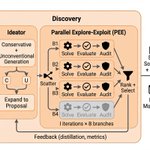
Discovery agent runs a parallel explore-exploit search tree.
Claim Verifier checks every claim against its source before the final paper is produced.

17
[Problem] We built CoE Audit — 4 integrity checks applied to 5 systems.
Every baseline had systematic failures: hallucinated references up to 21%, score reproduction as low as 42%
No existing evaluation checks whether AI-generated papers are actually grounded in evidence.

22


Rui Meng retweeted
Workshop continues with @gneubig ’s talk!


AI Agent for Discovery in the Wild workshop at @CAISconf has started 🏃♀️
Kicking off - we have @Azaliamirh for the first talk!


