

@QuanMed_AI- medical robotics research system by AI and Quantum not big Pharma on @Quan_Chain the only auto-migrating quantum chain. MSc Neuro/AI-Robotics Dev
Exeter
Joined September 2022
- Tweets6K
- Following5.2K
- Followers8.7K
- Likes1.7K



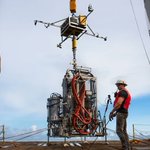
Tesla has started building Optimus on high-volume lines at Fremont, in the space where the Model S and X were assembled. A few hundred a week now, a thousand targeted by year end.
The bodies were never the hard part though. Tesla's own framing gives it away: early units are going to the Optimus Academy for training data collection & the robots reportedly still struggle with anything outside what they have been shown. You can mass-produce a machine. You cannot mass-produce the thing that makes it useful, because the policy has to be learned and the learning material doesn't exist yet.
This is the asymmetry between language models & robots & it's larger than people expect. A frontier language model trains on something on the order of ten trillion tokens, essentially all of it written before anyone decided to train on it. The corpus was free, pre-existing, already digitised.
There is no equivalent for physical manipulation. The largest open dataset of its kind, Open X-Embodiment, pooled 60 separate datasets from more than 20 labs to assemble roughly one million robot trajectories across 22 robot types & 527 skills. Every one of those had to actually happen: a real arm moving a real object through real space, at the speed things move. 🦾
That's the constraint. You can double a factory's output by adding a shift. You cannot add a shift to reality.
Manipulation data gets manufactured at 1x, in the physical world & no amount of production capacity changes that rate.
Which is why the production curve and the capability curve are different curves & why the interesting number isn't how many robots Tesla builds this year. It's how many hours of demonstration they capture & whether 20,000 bodies collecting at once is how you finally build the corpus that doesn't exist.
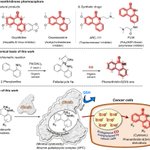
A team at RIKEN built a cancer drug that doesn't exist until the tumor makes it.
They deliver a palladium catalyst and nothing else. The missing ingredient is carbon monoxide, which the cancer supplies itself - tumors under oxidative stress upregulate heme oxygenase-1, the enzyme that breaks heme down into iron, biliverdin and CO. A tumour is a place with a local carbon monoxide flux.
CO is nearly inert by itself, which is why you can't simply weaponise it.
But a palladium centre will take CO and insert it into a bond, and here the molecule then closes its own ring into a phenanthridinone — a scaffold that includes PARP inhibitors. They got a PJ34-type product at 22% yield.
The delivery problem is glutathione.
Cells hold it at millimolar concentrations & it kills palladium on contact. The fix is to hide the metal inside human serum albumin, anchored at Sudlow site I by a coumarin tag, which shields it from thiols & gets the whole assembly taken up by endocytosis.
Then the two experiments that make the paper. Block heme oxygenase with ZnPPIX & the IC50 in liver cancer cells climbs from about 14 micromolar to 34 — remove the CO source & the drug stops being made.
Pre-activate the complex with CO gas before adding it to normal fibroblasts & their IC50 drops from 38 to 15, matching the cancer cells. The selectivity was never about the cells. It's about which cells have the reagent.
That 14 against 38 is also the honest limit & the authors say so: a roughly threefold window, with cytotoxicity they call modest.
Cell lines only. Animals next.


Keystone's hardware wallet business was breached this week & no keys were taken. No recovery phrases, no payment details.
What leaked was names, addresses & what each customer had ordered. Which is the better prize & it usually is.
There's a result in privacy research people find hard to believe the first time they meet it: the facts surrounding a secret are frequently sufficient on their own.
Latanya Sweeney showed in 2000 that 87% of Americans could be uniquely identified from 3 fields - five-digit ZIP code, gender & full date of birth. None of those is secret. None would be redacted from a dataset.
Together they're a name.
A later re-analysis on 2000 census data put it nearer 63%, which changes the number & leaves the conclusion standing.
In 2018 Strava published a global heatmap of anonymised fitness tracks. No names, no accounts, just aggregate lines showing where people had been running. Analysts used it to locate military bases that appeared on no map, because soldiers jog the perimeter.
The same structure applies here. A shipping list from a hardware wallet vendor holds no cryptographic material whatsoever.
What it holds is a set of people known to possess something worth protecting, plus the address where they sleep, plus a device model that implies roughly how much. Nothing on that list is secret, and the list is the entire attack. CertiK logged 52 verified physical coercion attacks on crypto holders in the first half of this year, against 39 in the same stretch of 2025.
Which makes it a threat-modelling failure rather than an engineering one. These devices were designed against a remote adversary with network access & against that adversary they performed exactly to specification.
The specification just never included someone who knows where you live.

A 15 year old Reform UK supporter posted an AI-edited photo of a local councillor with bunny ears and whiskers. Police turned up, pulled him from his bed in his pyjamas, arrested him, seized every device in the house and took his DNA sample. The formal charge was a hate crime, on the basis that he'd also called the man a 'rent boy'.
Observe what the state chooses to resource here. A teenager's meme now sits permanently as a biometric record on a national database. Burglary, fraud, actual violence against the person: chronically under-resourced by comparison, year after year.
This is the logical endpoint of treating speech as the threat and data collection as the remedy. It's precisely why encryption and anonymity aren't luxuries, they're the only defence against institutions that behave exactly like this the moment they're given the tools.
What happens to that DNA sample now it sits on a database forever?
Heatbit announced a water heater element that mines Bitcoin.
$899, screws into the electric tank you already own & the pitch is that the mining comes thermodynamically free.
It mostly does & the reason is worth understanding.
A resistive heating element converts electricity into heat at essentially 100% efficiency, because there is nowhere else for the energy to go.
What's less obvious is that a mining chip does exactly the same thing. Computation doesn't consume energy, it dissipates it - the answer leaves as a handful of bits & every joule that went in leaves as heat.
Run 600 watts through an ASIC submerged in your tank & the water gets precisely as hot as it would from 600 watts of plain nichrome wire.
So the hashing costs nothing extra. You were buying the heat anyway.
The clever part is the wattage. A standard US element runs about 4,500 watts, which blasts the tank to temperature & then shuts off, leaving a miner idle most of the day. Bitwater draws up to 600 and heats slowly, which means it runs almost continuously.
Heatbit claims above 80% duty cycle, with the tank's upper element left in place to cover demand spikes.
And the water solves the problem every miner has. 20 Bitmain BM1370 chips, 34 terahashes a second, no fans and no noise, because they are sitting in a tank of coolant.
One catch worth naming. The argument holds against a resistive tank. Against a heat pump water heater, which moves heat rather than making it and returns three to four units of heat per unit of electricity, you'd be paying several times over for the same hot shower.
The more interesting claim is the one in their own announcement: physically decentralised mining.
Hashrate concentrates today in industrial sites across a handful of jurisdictions, where it can be regulated, taxed, or switched off at a single point.
Hashrate dispersed through domestic water heaters, attached to a load that exists regardless, is a different kind of network to come after.
A San Francisco startup says it turned mercury into gold last month & beat CERN's record by a factor of ten.
CERN's record is 29 picograms.
That's the entire yield of 86 billion gold nuclei created across four LHC experiments between 2015 & 2018, about three hundredths of a billionth of a gram, and it didn't survive. The nuclei flew off, struck the beam pipe and shattered within a fraction of a second. CERN wasn't trying to make gold either; it was measuring how lead nuclei shed protons during near-misses, because those losses limit how hard you can run a collider.
The physics Marathon is using is more interesting than the headline, though.
Natural mercury is about 10% mercury-198. Hit one with a fast enough neutron & it ejects two, leaving mercury-197. That isotope is unstable & here's the part worth pausing on: it doesn't decay by spitting anything out. A proton inside the nucleus captures one of the atom's own orbiting electrons and turns into a neutron. The nuclear charge falls from 80 to 79. Half-life, about 64 hours.
Element 79 is gold. And gold-197 is the only stable isotope gold has, so what's left is permanent, ordinary gold - made by an atom quietly swallowing one of its own electrons.
This needs fusion specifically.
Knocking a neutron out of mercury-198 takes something above roughly 8.5 MeV & fission neutrons average around 2. Deuterium-tritium fusion throws them off at 14.1 MeV, comfortably over the line. The gold is downstream of what fusion already does anyway.
And gold was never really the business. The same neutron flux makes copper-64 & other medical isotopes, where the shortages are real & the customer isn't the bullion market.
A startup raised $45 million yesterday to put a coin-sized implant in people's heads that listens to their brain tumour & talks back.
Founders Fund & the OpenAI Startup Fund co-led it.
That sounds like science fiction until you know what happened in 2019. Michelle Monje's lab at Stanford found that glioma cells form real synapses with healthy neurons - AMPA-receptor-mediated, electrochemically functional, the same machinery neurons use to talk to each other.
The tumour isn't sitting in the brain. It has wired itself into the circuitry. And it feeds on the traffic. When the neurons fire, the glioma cells depolarise & that depolarisation drives them to divide. The more active the surrounding circuit, the faster the tumour grows. Monje shared the Brain Prize last year for opening up the field this created, which is now called cancer neuroscience.
Which is what makes an implant a coherent idea rather than a gimmick.
If a tumour is electrically active, it has a signal worth recording. If its growth tracks neural activity, then changing that activity is a lever.
There's already precedent for the physics - tumour treating fields, alternating electric fields that disrupt cell division, have been FDA approved for glioblastoma for years.
What exists so far is 3 recordings of 30 minutes each, taken during operations that were happening anyway. The premise is real; the device is barely born. And the thing to watch isn't the funding but whether an implant can keep hearing a tumour for months, because the brain answers foreign objects by walling them off in glial scar. Which would mean a device for treating a glial tumour being slowly blinded by glial cells.
Unitree released a video yesterday of its new H2-X denting scrapyard cars with kicks & elbows, stepping between a woman & a man with a knife & shoving someone clear of an oncoming car. They're calling it the Kung Fu Legend Guardian. 🦾🦿🤖
The kicks are choreography. The moment worth watching is the backflip off the car roof & specifically the landing.
70 kilograms coming down from roof height arrives carrying about a kilojoule & all of it has to disappear inside one crouch. Absorb it over a quarter of a metre & the legs take close to five kilonewtons - 7 times the machine's own weight -while simultaneously arresting the rotation from the flip, which has to stop at the same instant.
Which is why landing is harder than jumping. A motor resisting a fall is being driven backwards; it's a generator. That energy goes either back into the battery through the drive electronics or into the windings as heat & it has to go somewhere inside a couple of hundred milliseconds. It's a thermal & power-handling problem before it's a control problem.
Then it's a control problem too. You have the flight time to work out exactly when the foot meets the ground and how stiff every joint should be at that instant. Too stiff & the shock goes through the frame. Too soft & it folds. The energy scales with the height of the drop, so every extra metre makes the same problem harder fast.
Which is the thing to watch for in these videos. Jumping is a motor problem and plenty of machines manage it. Landing repeatably, on ground nobody surveyed first, without a tether, is what separates a demo from a product.
Sophont released a model yesterday that reads which genes a tumour is switching on, from a slide stained with two dyes invented in the 1800s.
Hematoxylin binds nucleic acids & turns nuclei blue-purple. Eosin binds proteins & turns cytoplasm & collagen pink. That's the entire chemistry & it's been the default pathology stain for about 150 years - every biopsy taken anywhere gets one.
It carries no molecular information whatsoever. It tells you where things are and what shape they are & nothing else.
Spatial transcriptomics tells you which genes are being transcribed at which coordinates. It costs thousands per slide, takes weeks & needs tissue handled a particular way from the moment it leaves the patient.
Holon-S1 claims to predict the second from the first. Which sounds like reading information that isn't there, except that it is.
Expression changes shape. A cell running a proliferation program has a larger nucleus, looser chromatin, a more prominent nucleolus. A tumour recruiting fibroblasts rearranges the stroma around itself in ways that are visible. Morphology is a lossy readout of the transcriptome & pathologists have been reading it crudely for a century - "high grade" means "I can tell from the nuclei that this thing is dividing fast."
The model is running that same inference across more dimensions than a person can hold at once.
Sophont evaluated it on 16 organ types, more than 15 scanner models, and both FFPE and frozen tissue. In a retrospective osteosarcoma case, a cancer it was never trained on, it flagged a fibroblast program containing FAP - which happens to be the target of the therapy that patient responded to.
The limit lives in the word predict. The model infers what expression usually accompanies this appearance. That should hold up well on ordinary tumours & worst on strange ones & strange ones are precisely when someone orders molecular testing in the first place.
The Navy just quadrupled its contract with Gecko Robotics to $300 million, for robots that crawl around ships measuring how much steel is left.
The problem is specific. A carrier deck is covered in non-skid — thick, gritty epoxy that stops aircraft sliding off. To check the steel underneath with a conventional gauge you have to strip it, then put it back, which is most of the cost and all of the downtime. So the condition of the deck stays unknown until the ship is already in drydock and torn open.
Ultrasonic thickness measurement works by timing an echo. Send a pulse into the steel, catch the reflection off the far side, multiply by the speed of sound in steel — about 5,900 metres per second — and halve it. A twelve-millimetre plate returns its echo in roughly four microseconds.
Coating wrecks that, because the pulse crosses the epoxy twice & nothing tells you which part of the delay belongs to which layer.
The fix is to stop timing from the pulse and start timing between two successive back-wall echoes. Both carry the same coating delay, so subtracting one from the other deletes it. You get the steel alone, through the paint, without touching it.
What actually changes, though, is the sampling.
A technician with a handheld gauge takes readings at marked points - hundreds across a whole ship.
Corrosion doesn't distribute itself evenly; it pits & it concentrates at weld heat-affected zones, around drains, under fittings.
A sparse grid will quite happily miss the thinnest spot on the hull.
A robot that crawls the entire surface takes millions of readings. That stops being an inspection & becomes a map. And once you have the same map twice, the difference between them is a corrosion rate per square inch, which is where you stop finding problems & start forecasting them.
Most of Earth's heat doesn't come out through land.
A square metre of ocean floor gives off 105 milliwatts of the planet's internal heat. A square metre of continent gives off 71. The ocean covers roughly seven tenths of the surface, and the mid-ocean ridge system, where that heat concentrates, runs about 65,000 kilometres, the longest mountain chain on the planet.
Every geothermal plant ever built sits on the cooler, smaller share, because that's the part you can drive to.
Last month a Seattle company went after the other one. Endurance Energy put a three-ton power plant on an active volcano 300 miles off Oregon, five thousand feet down, and ran it in real time from a room on shore. It produced more power than it consumed for 8.7 seconds, peaking at 16.5 kW.
The number that explains the whole effort is sixteen meters.
That's how deep they drilled.
Enhanced geothermal on land means boring three to five kilometres to reach rock hot enough to be worth anything, then pumping water down and hoping it comes back up. At a mid-ocean spreading centre the heat is already at the seafloor - 281°C fluid arriving under its own convection, no stimulation, no pumping. You aren't drilling to find the resource. You're drilling into something already pouring out.
The cold end comes free as well. A land plant rejects its waste heat into the air, which buys you cooling towers, fan loads, water consumption & worse output on hot afternoons. At that depth the seawater sits near 2°C year-round and there is an ocean of it.
The hottest ground on the planet is underwater, and until last month nobody had ever taken a watt out of it.

Viggle AI has released JST-2 today & is calling it the world's 1st full-stack physics-native world foundation model.
Joint Space-Time is a successor to the model that earned them a $19M Series A from a16z in 2024. It generates a 3D scene in seconds & expands it in real time, with character motion built in, all from one architecture.
Most world models work in pixel & video space; Viggle built the entire stack in 3D instead.
That difference sounds like a technicality until you try to add physics. A video model has no chairs in it.
Pixel-space world models - the ones predicting each frame from the last - represent a chair as a pattern that keeps recurring. Nothing stores it.
Walk out of the room & back & the model regenerates it from context, which is why objects in these systems drift, morph & quietly change shape when something passes in front of them.
A physics solver can't do anything with that. It needs objects like mass, position & a contact surface. There is nothing to push on in a field of pixels.
So building in 3D isn't an efficiency trick, it's what makes physics expressible at all. Store geometry & the chair is a thing with coordinates - occlusion stops rendering it, not existing.
The real-time expansion is the part that follows from the representation. You can extend a scene that exists as geometry, because the room you already made stays where you left it.
A video model doing the same walk has to keep re-deriving what's behind you from what it just showed & it has no stake in getting it right twice.
Anthropic said it would put 5% of its equity into a fund for the public. Musk replied that you should skip the fund & hand the shares straight to people - then said that's what he'd do & pledged one SpaceX share to every kid in America next year.
At Friday's close of $146.03 and just over 72 million Americans under 18, that's about $10.5 billion. Musk disclosed a 48.4% SpaceX stake in an August filing, putting the giveaway somewhere near 1% of what he holds.
The two approaches differ less than the exchange suggests. Anthropic's own announcement lists direct distributions to specific populations as something the fund might do.
SpaceX has already run the play - Gwynne Shotwell pledged a share to each of 2 million Trump accounts in July, which is the obvious vehicle here.
What's unsettled is who counts. Musk hasn't said whether "kid" means every minor, only citizens, or only children already holding an account & he hasn't said how or when shares arrive.
Anthropic's 5% still needs stockholder approval & the mechanism that grows it - 2% more per 50% rise in company value - is pegged to a baseline they haven't defined yet.

Musk says it's time for Zelenskyy to go, as Ukraine's war grinds into its fourth year and Kyiv asks Europe for another €70 billion. Zelenskyy blames the fuel price spike on the block in Hormuz, not the war he's fighting.
The part nobody's joining up: the same week, Trump waived the tariff law designed to restrict Russian energy exports, and his own party in Congress is furious about it, arguing it directly funds Moscow's war effort.
You cannot demand billions more for Kyiv's defence while quietly easing the sanctions regime meant to starve the other side of money. Sovereignty rhetoric only means something if the policy matches it, and right now it doesn't.
Who actually wants this war to end, and who's just managing the optics around it?
Mercedes-AMG revealed its first standalone SUV this week.
The top GT 63 makes 1,153 horsepower from three electric motors and takes on 282 miles of range in 10 minutes at a charger. European orders open Monday, US deliveries summer 2027.
What makes it work is a motor layout that has been understood for decades & hard to manufacture for just as long. Turn an electric motor on its side and its torque starts scaling with the cube of rotor diameter instead of the square.
That's the case for axial flux.
A conventional motor is two concentric cylinders with flux crossing the gap radially, outward from the shaft. Make the rotor & stator flat discs facing each other instead, flux running parallel to the shaft, and the active area grows as r² while the lever arm grows as r - widen the disc & torque climbs as r³. In the cylindrical layout the only thing you can stretch is length, which adds force at the same radius.
Mercedes got past the manufacturing problem by buying the company that hadn't been beaten by it: YASA, out of Oxford, whose name is the design — Yokeless And Segmented Armature. Delete the stator back-iron and you lose its mass and its iron losses together. Their production motors clear 5 kW/kg and a demonstrator last year hit 42. Lucid's drive unit, among the densest conventional ones in production, makes 16.
The charging is the better number though. 710 kW into a 128 kWh pack is a 5.5C peak & the 10-to-80 window averages about 3.5C - 12 minutes. At 800 volts that's roughly 890 amps. Resistive loss goes as the square of current, so pushing the same power at 400 volts would mean 1,775 amps & 4 times the heat in every conductor between the dispenser and the cells.
The Cayenne Turbo Electric peaks at 400 kW.
GPT-6 Astra just broke a German Enigma message that sat unsolved for 85 years. Carter Leffen, a Bloomberg product coach with no cryptography background, picked an unsolved cipher off Frode Weierud's Crypto Cellar Research site, nudged the model a few times, went to bed. By morning it had the plaintext.
Enigma's rotors and plugs could route the alphabet up to 103 sextillion ways. That complexity was the whole point, only trained specialists with purpose-built kit were meant to touch it. Elonka Dunin, who wrote the standard references on this, is now fielding a deluge of false positives from people who, in her words, "don't really understand cryptanalysis."
Read that the other way round. Cryptanalysis was never impossible, it was expensive and gatekept, and the credentialing made it look sacred. A free evening and an open model did what institutions couldn't manage in eight decades.
If a hobbyist with a chat window can do this to Enigma, what exactly are governments still betting on when they talk about controlling who's allowed to use AI for cryptography?

Four Gemini 4 Argon agents beat Minecraft in 27 hours & 14 minutes. They never saw the game.
No pixels, no keyboard. The agents wrote JavaScript against the Mineflayer library & read back text for position, inventory, error messages.
Minecraft as an API, not a screen.
That changes what the achievement is & the authors say so themselves.
Mineflayer hands you exact coordinates & built-in pathfinding, so the things that make Minecraft hard for a person like seeing, aiming & finding your way back, are all function calls here. What's left is planning across 27 hours, dividing work between four agents & debugging your own code when it breaks.
It broke constantly. 2,783 programs written before the win, 22% of them ending in errors. 605 deaths. The server restarted 6 times. 😂
The End fight alone ran nearly 14 hours where more than half the total run was the final boss.
Coordination was 229 chat messages & a shared memory file. Nobody assigned roles; they sorted it out between themselves, one handling food and supplies, another making tools, recovering each other's dropped items after deaths. A fifth agent watched the entire run & never played.
Java Edition 1.20.4, survival, Easy difficulty, random seed, cheats disabled.
The authors call it the first end-to-end autonomous completion of Minecraft by AI agents & note it's a single run, so it says nothing yet about how reliably it repeats.

Ledger's new device separates the display and touch controls from Android entirely. That isn't a coincidence of timing.
5 days ago Ledger Donjon published how the CryptoBilis implant worked: a microcontroller inside the enclosure reads the recovery phrase off the screen during setup and transmits it over LTE through an embedded SIM.
It never touches the Secure Element, the OS, or the signatures. It reads the display.
Atom, announced Wednesday in Paris, runs AOSP alongside an EAL6+ Secure Element running Ledger's own OS, with screen & touch input wired to the secure side rather than the Android side.
Signing happens in Secure Mode, where Android can't reach it. Sold only through Ledger's own site, with tamper-evident features that reveal whether the enclosure has been opened.
The policy changes matter as much as the hardware. Resellers must now keep devices off shelves until purchase, and returned units can't be resold at all. That second rule closes the vector directly as Ledger says a criminal group bought genuine devices, modified them & sent them back.
Cost: $849 to reserve a Founders Edition on a $100 refundable deposit, $899 regular, estimated delivery Q2 2027. Still in development & Ledger says specs & price may change.
Loss estimates keep climbing. Yfarmx now traces roughly $103.4 million across 530 addresses. Ledger still hasn't confirmed a total.
Tesla ran a Roadster up a halfpipe last night & flipped it in mid-air. The number that explains it is 80 kilonewtons of thrust.
The car is around two tonnes, so roughly 19.6 kN of weight. The thrusters are putting out about four times what the car weighs. For scale, a Falcon 9 leaves the pad at a thrust-to-weight ratio near 1.4. A fighter jet in afterburner is barely above 1.
It's cold gas, not combustion, so that’s air or nitrogen at about 10,000 PSI in a composite-overwrapped tank sitting where the rear seats would go, 260 kg of it, vented through nozzles around the body. No fuel, no flame & an onboard compressor refills it. The constraint isn't energy, it's how long the tank lasts.
The upside-down driving is a separate trick and arguably the better one. Aerodynamic downforce scales with the square of speed, so a wing gives you nothing when you're slow.
The Roadster uses suction fans instead, actively pulling air out from under the car, which works at any speed including zero. Musk claims over 2 G of cornering grip from it.
That idea has a history. Chaparral's 2J ran fans in 1970. Brabham's BT46B won its only race in 1978 & was withdrawn immediately afterward.
Production is now 2028 which is the sixth date since the car was announced in 2017. The demo car was remote-operated & the FAA treats anything that leaves the ground as an aircraft, so there were airspace restrictions over McGregor last night.
Amazon's Bee launched yesterday at $74.99. It's a wrist-worn microphone that listens all day & turns your conversations into summaries & to-do lists.
The privacy engineering is better than you'd expect. Bee Private Compute processes raw audio in real time inside an isolated environment and then deletes it, keeping only an encrypted text transcript.
The encryption keys are generated & held on your own device. Amazon says it has no master key.
That's a genuinely good design & it protects exactly one person in the room. Everyone else is an input. They can't read the transcript, can't delete it & can't switch the thing off, only the wearer can.
There's an LED for active listening, which assumes a stranger knows what a Bee is & what its light means.
The threat model has one principal & it isn't the person across the table.
Specs: IP67, 7 days per charge, dual mics with noise filtering. The $99.99 Eclipse magnetically attaches to your phone & runs 21+ days.
Amazon's reviews include buyers saying it's illegal to record people without permission.
Mostly it isn't. Federal law & 37 states plus DC are one-party consent - if you're part of the conversation, you can record it. 13 states require everyone's.
Bee has a better argument than that, too. It doesn't keep audio.
Wiretapping statutes are written about intercepting oral communications & a device that transcribes & then deletes is legally closer to taking notes than to recording. That's more untested ground, not settled illegality.
Which is the actual problem. Nobody objects to you taking notes because your memory is lossy & your handwriting is slow. What makes a transcript different isn't that it's illegal. It's that it's complete.