







A single weather delay on a construction site can cascade into a dozen rescheduled subcontractor visits, each dependent on the others.
Doing that re-sequencing manually eats a project manager's entire Monday.
Agentic scheduling tools now read weather, crew availability, and task dependencies automatically, handling the routine re-sequencing and flagging only the exceptions that genuinely need a human decision.

A construction firm's project manager used to spend Monday mornings manually re-sequencing subcontractor schedules after weekend weather delays.
An agentic scheduling system now reads weather data, crew availability, and dependency chains automatically, and only flags the manager when a decision actually needs a human call.

A customer support team used to route every incoming ticket manually before anyone could even start solving the problem.
An agent now classifies, prioritizes, and drafts a first response, leaving the person to review and send rather than write from scratch.

Compliance-sensitive workflows carry a sharper version of centralization risk.
If the one AI provider a firm depends on changes its data handling policy, that firm can find itself out of compliance through no decision of its own.
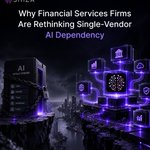
Financial services firms are increasingly asking a question that used to sound overly cautious: what happens to our obligations if our AI vendor's policies change without warning.

A feature is something bolted onto an existing product to make it feel more current.
Infrastructure is something a business actually depends on to run.
The distinction matters because features get deprecated casually, vendors kill underperforming add-ons all the time, while infrastructure decisions get made with more caution.
The mistake many businesses make is treating AI like a feature when it's already functioning as infrastructure underneath their operations.

A regional airline builds its route optimization workflow around a single AI provider. Eighteen months later, the provider changes its pricing structure and discontinues the feature tier the airline relies on.
The airline is left with two options: absorb significantly higher costs or rebuild a critical business workflow from the ground up. Neither was part of the original plan, but both are consequences of relying entirely on a single provider.

Imagine a retail business that relies on one AI provider for all its inventory forecasting.
If that provider goes down during a busy holiday weekend, stores are suddenly left without the information they need to restock.

This doesn't mean giving up the best AI models available.
It means having the freedom to switch models without losing your data, your memory, or the systems your business depends on.
So instead of asking whether your AI is good enough, ask yourself this: What happens to your business if your AI provider goes down tomorrow, changes its policies, or decides to stop supporting you?
If the answer is that everything stops, you have a bigger problem than your choice of AI model.
🤖 Made with AI

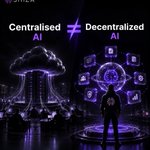
These two terms get treated as roughly interchangeable in most conversations about AI infrastructure. They aren't.
Centralized AI means one company controls the model, the memory, and the access all at once.
Decentralized AI separates those pieces, so no single vendor decision can freeze an entire operation. The distinction sounds abstract until a business actually experiences what happens when the one party in control changes the terms.

Most businesses never chose to rent their AI. They defaulted into it, because that is how AI products are sold.
Renting: the vendor keeps what it learns.
Owning: you do.
Own Your AI. Before AI Owns You.

The more your AI knows about you, the more there is to protect.
How we’re designing the SHIZA Companion to work from patterns, not your raw memories, and what’s still undecided. 👇
Own Your AI. Before AI Owns You.

