

Cross Border Business Evangelist Co-Founder & COO @Ekaga_India
Mumbai, Maharashtra
Joined November 2015
- Tweets409
- Following758
- Followers188
- Likes155



I think a conversation can reveal that two organisations want different things from a partnership. It can make a boundary clear, or bring an unspoken concern into the open.
Those are useful outcomes, even if the immediate answer is no.

Taking responsibility for an earlier decision, especially as a leader, includes being willing to revisit it.
This is something I connect with Strategic Stillness: staying attentive to what the situation now requires, even when we feel attached to our first answer.

Someone challenges your decision. What do you hear first?
“I’m not convinced this will work.”
You’ve explained the thinking, the team needs to move, and someone has questioned the direction in front of everyone.
It’s easy to hear a challenge to your judgement, but the same

1
3
sentence could come from someone who has noticed a risk, misunderstood part of the plan or needs more information.
Your interpretation starts shaping your response before you have asked what they mean.
I’m interested in that moment. The decision may still stand, but
1
1
One of the less visible responsibilities of leadership: being aware of what we communicate while we are still working things out ourselves.
This is where Strategic Stillness matters to me. We need to stay clear enough to give direction while feeling the pressure ourselves.

1
A reasonable question can feel like criticism when you are under pressure. A team looking for direction can make uncertainty difficult to admit.
I'm exploring those moments in my forthcoming book, Strategic Stillness: The Power Behind Every Bold Decision, planned for November.

I like this sentence because it says one thing.
Not a twelve-step morning routine, or another list to complete. Just one thing that returns you to yourself.
Leadership can turn even wellbeing into something to optimise, but being centred is not another performance target.

3
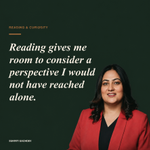
Reading gives me room to consider a perspective I wouldn't reach alone.
I find that books can give us another way to understand a decision or an experience we thought we had already made sense of. Sometimes, the idea that stays with us is the one we initially resisted.

3
There's s a difference between moving quickly and being carried by speed.
This is where Strategic Stillness becomes practical for me.
We can move quickly and remain aware of the assumption we are relying on, the risk we are accepting and what would make us reconsider.

5
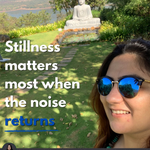
Images like this are what many of us associate with stillness.
But while writing Strategic Stillness, I kept returning to a harder question:
What if the world around the leader cannot slow down?
Stillness cannot depend entirely on calm external conditions.

4
I’m always careful about assuming that an approach which worked in one market will work in another. People need to feel comfortable explaining how things work, including where your assumptions need adjusting. That understanding belongs in the market-entry plan from the beginning.
6
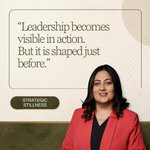
Leadership becomes visible in action. But it is shaped just before. Unexpected delay. The team needs direction.
You interpret, decide: What's first? What do they need to know? These unseen moments shape the clarity or uncertainty you bring. They define the leadership others see.

4
Our first interpretation of an interaction can feel remarkably convincing; however, leadership sometimes asks us to examine it before building a response around it.
One line from my upcoming book captures this:
“What feels like clarity may simply be what arrived first.”

3
I believe leaders need at least one space where they do not have to reassure anyone. Where uncertainty can be spoken without immediately becoming weakness.
The problem is not that leaders experience doubt.
It is when they have nowhere honest to put it.

4
One of the lines from my forthcoming book.👇
There is a difference between moving quickly and allowing the pace around us to determine how we think.
Strategic Stillness asks whether we can preserve enough internal steadiness to see what is actually happening before we act.

1
I've become much more comfortable with saying "I don't know yet" as a leader.
Earlier in my career, I sometimes felt that leadership meant having the answer. But at the end of the day, people can handle uncertainty when you are honest about it.

If I walk into every conversation rushed, distracted and ready to move to the next thing, people feel it, and eventually, they adapt to it.
Strategic Stillness has made me much more aware that presence is not passive. It is something you actively bring into the room.

7
Sometimes, when I'm stuck on a decision, my instinct is to think harder.
More analysis, more conversations, more scenarios, more information...
But over the years, I've learned that more thinking doesn't always create more clarity. Sometimes, it creates more noise.

14
