

Real estate developer. Strategist. Thinker. Doer. Founder @WestEggDev
New York, NY
Joined May 2012
- Tweets6.5K
- Following2.3K
- Followers6.8K
- Likes22.4K






RunEnvelope is now open to every owner, developer, broker and lender.
Type any NYC address. Every legal scenario modeled as a building, every floor drawn, every number cited. Free to check.
The part I care about most: before every release it is checked against licensed professionals' studies and hundreds of DOB-approved filings. If it scores lower, it does not ship.
runenvelope.com

There should be a study/documentary of Jon Neidich and how he has captured the minds and hearts of NYC’s downtown F&B scene. Not yet though. Still many chapters of this story seem to be unfolding
This is RunEnvelope.
You will never pay for an architect's zoning report again.
Developers: underwrite every lot guilt-free for a fraction of the cost.
Brokers: know what a site is worth to a builder before you pitch the seller.
Lenders: know the plan is legal before you fund it.
Architects and zoning attorneys: fast track your analysis.
Open to everyone later this week. @runenvelope

I've been building something exciting. I'm launching it this week. It answers the first question on every NYC development deal: What can legally be built here?
You will never pay an architect thousands of dollars and wait for a zoning report again.
Sam Eshaghoff retweeted

If you’re between the ages of 16-35 and find yourself:
• Demoralized
• Struggling financially
• Feel the “system” has betrayed you
• Are trying to make sense of why
This is an essential post that you need to digest so you can identify the true villain in this grand story. You must use your eyes and God-given ability to think for yourself.
You see, boiled down, it’s all a simple story of incentives, and it’s going to take the young generation’s reason, awareness, and bold action to unwind it.

On my way to the office this morning, I passed a group of young people protesting, a Palestinian flag draped over their shoulders.
And I asked myself a question I can't shake: why does this generation always fall into the same trap? No matter the history. No matter the context. Even the ones from wealthy families, who went to the best schools, who were dealt every good card. Always the same trap.
I don't think it's stupidity. I think it's a mechanism. And a mechanism can be taken apart, piece by piece.
A. The observation: everything the state touches becomes unaffordable.
Look at economist Mark Perry's famous chart, the one people call "the chart of the century." It tracks US prices since 2000.
At the top, what explodes: hospital services, college tuition, textbooks, childcare, housing. Increases of +100%, +150%, up to +250%, far above general inflation.
At the bottom, what collapses: TVs, software, phones, toys, clothing. A TV today costs a fraction of what it did in 2000, for an infinitely better product.
Look at what separates the two groups. It isn't technology. It isn't complexity. It's one variable: how much the state is involved.
At the top, sectors that are subsidized, regulated, shielded from competition, where the state funds demand and blocks supply. At the bottom, sectors where companies fight every single morning to serve you better and cheaper.
B. The mechanism: why it's systematic.
When the state subsidizes demand without freeing supply, prices rise. Every time. Guaranteed student loans, and universities raise tuition. Housing aid plus blocked building permits, and rents skyrocket. Administered healthcare, and bureaucracy eats the budget before it ever reaches the patient.
In France it's even more vicious, because the price doesn't disappear: it hides. You never see the hospital bill, you pay it through payroll contributions. You never see the cost of school, you pay it through taxes. Public spending at 57% of GDP, one of the heaviest tax burdens in the world, more than €3.4 trillion in debt. And the result? Overflowing ERs, falling PISA scores, young people who can't afford to live in the city where they work.
The market didn't fail in these sectors. It was never allowed in.
C. Suffering demands a culprit.
A 22-year-old lives all of this in their bones. They can't find a place to live. Their degree either buries them in debt or opens no doors. The future feels blocked. That suffering is real, and I don't deny it for a second.
But human beings can't stand suffering without a culprit. They need a face. A scapegoat.
And this is where everything is decided: who taught them how to read the world?
D. Whoever tells the story picks the villain.
Schools are public. Universities are public. Culture runs on grants. Film goes through funding committees. Public broadcasting shapes the narratives. The people handing down the interpretive framework are, overwhelmingly, paid by the very system that creates the problem.
Do you really think that system is going to name itself as the culprit?
No. It names the capitalist. The boss. The landlord. "The rich." The multinational. The commercial West. Same role, same casting, every time.
E. One lens, a thousand causes.
And this brings me back to that flag. A generation taught to read every situation through a single lens, oppressor on one side, rich, Western, capitalist, oppressed on the other, will apply that lens everywhere. To housing. To climate. To conflicts on the other side of the world. The cause changes, the lens stays. That's why the trap is always the same: it's not the cause that draws them in, it's the way of thinking that was installed in them.
F. The perfect inversion.
Here's the irony. Capitalism is the force that drove down the price of almost everything it touched. The state is the force that blew up the price of almost everything it captured. And young people blame the first for the crimes of the second.
It's like blaming the firefighter for the fire because you saw him at the scene.
G. The ballot box confirms it.
In the US, a few weeks out from the midterms, a large share of urban young voters is getting ready to vote Democrat for more state, more spending, more regulation. New York elected a self-described socialist mayor, carried by young voters, on promises of rent freezes and city-run grocery stores. Rent freezes, the policy that has made housing scarcer everywhere it's been tried. The cure that worsens the disease.
In France, it's the same play in two acts. Part of the youth votes for the radical left, which promises more state. Another part votes for the center, which promises to "manage" the state well, and has dug the debt deeper than ever. Two different ballots, one shared assumption: the problem is the market, the solution is the state.
H. The way out.
These young people aren't stupid. They're right to be angry. They're just aiming at the wrong target.
The day they understand that their rent, their tuition and their hospital are expensive precisely because the state runs them, their anger will change direction. They'll stop protesting against those who create. They'll start protesting against those who capture.
That day, the greatest intellectual scam of our time will be over.

Was gonna ask my neighbor if he wants to be on the building trick or treating list but I’m not sure if he celebrates

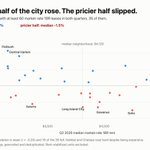
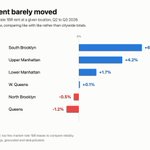
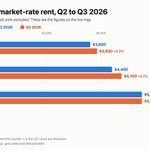
Quarterly drop of the NYC rent heat map. Q3 peak season. Insights below.
As always, available at:
westeggdevelopment.com/heatm…

Underneath that, the city pulled apart by price.
The cheaper half of neighborhoods rose a median 3.2%. The pricier half fell 1.5%.
Flatbush +10.7%, Central Harlem +9.1%
Nolita -9.1%, Soho -7.5%, Long Island City -6.6%
A tendency, not a rule. NoMad and Chelsea both rose hard.

How it is built: every rented listing on StreetEasy, geocoded to the building, deduplicated, filtered to market rate.
westeggdevelopment.com/heatm…

In development, you have many adversaries, but none sting as consistently as time itself. Every day wasted is interest to the bank and degraded returns.
And at the same time, in his project the developer must weigh and make between 1,000 and 10,000 individual decisions, most of which hinge upon a previous decision already having been made.
For that reason, failure to make quick and accurate decisions will be the death of you. Conversely, if you can process, synthesize, and make good judgments without delay, you have a fighting chance.
“You see this? I did the first J. Crew in Noo Yawk. 1988. Back then I drew all these lines by hand. You see this?”

Sam Eshaghoff retweeted

Every real estate developer aspires to leave a permanent mark on the world - by creating or renovating or operating places for people to live, work, or play.
And almost all of us aspire to be making a net-positive impact on the lives of the people who live where we work.

Third quarterly drop of the NYC rent heat map.
First one where you can see a real trend.
Q4 2025 → Q1 2026 → Q2 2026: two consecutive quarterly moves per neighborhood. Enough data to tell momentum from noise, correction from crash.
And one region's move is unbelievable.
westeggdevelopment.com/heatm…
Q4 2025 map (v1): a snapshot.
Q1 2026 map (v2): a snapshot + first change.
Q2 2026 map (v3): first time you can see rate-of-change.
Momentum, correction, reversal — those all require two consecutive intervals.
That's why the third one is the one that starts actually predicting things.