

Founder, Silverman Strategy Group. Writing at The Translation Problem. Prev: @PatRyanUC, @ConorLambPA, @KekstCNC
DC/NYC
Joined June 2025
- Tweets436
- Following1.4K
- Followers403
- Likes6.5K





That makes the comms point even more important.
When building a technology with the goal of bringing about the largest economic/social change in history, one doesn't have the luxury of hoping to get the benefit of the doubt. Because you never will. The options are to either be unhappy about that, or to do something about it.
Generally, the labs have chosen the secret third option, which is "be unhappy about it, and take actions that make them even more unpopular."
One (of many) problems with that is that you are always more prone to “unfair” attacks when the accusation lines up with someone’s priors.
In this case, the accusation will be that a handful of billionaires unleashed havoc with a technology they couldn't control in their rush to an IPO.
Maybe not everyone who echoes that will be arguing in good faith. But it'll be hard to look at the track record of the frontier labs and argue that it's not (at the very least) directionally correct. And it'll be even harder to argue they’ve earned the trust to manage the risks.
Too often, they choose to portray themselves as innocent bystanders stuck on a preordained path with inevitable risks. When you’re valued in the trillions and wield the power of a nation-state, that's just never gonna pass the smell test.
One of those times where you see the true value of “morally binding” accords.
Trump and Silicon Valley set the terms. Then the lab expects the public to take its word for what happened.
That’s two remarkably unpopular entities asking an awful lot of the American people.

Based on this article, OpenAI has made false accusations about me. The three researchers fired from OpenAI were told I facilitated architecture leaks to The Information. This is false.
A journalist from The Information did reach out to me shortly before that article came out. I did not comment at all beyond asking the journalist to make it clear that a blog post I wrote which was referenced in the article was preexisting and public.
The article also mentions an internal OpenAI monitorability proposal. I have heard that this memo contained highly sensitive architecture information, and that OpenAI accused me of accessing and reading it. This accusation is also false.
As reported in the article, I viewed a version of the proposal that did not have sensitive IP and was approved for sharing with me. I believe OpenAI now knows this accusation was based on a conflation of these two documents, though I do not know if they have clearly retracted that accusation.
I do not and have never solicited proprietary information, and the three employees who were recently fired from OpenAI never leaked IP to me. As the article mentions, I did have Signal chats with them that had disappearing messages on; they’re professional contacts that I’ve had on Signal for a while, and use of Signal is common in the tech industry. During the Hugging Face investigation, I was careful to avoid sending Signal messages with confidential information, though I did sometimes discuss high level things on Signal calls. As far as I understood, this was normal.
To expand on the comms point — “this was all going to happen anyway” is just about the least compelling message.
When you're chasing trillions and saying the downside was inevitable, don't expect gratitude.
Expect people not to trust you to manage the risks.

(1) A lot of the current AI cybersecurity risks probably were gonna happen no matter what Anthropic did and many of Anthropic's prior warnings do look prescient there (though Anthropic having poor protections against distillation despite being warned did accelerate the capabilities on some of the Chinese open-weight models that are being used in current attacks)
(2) This sort of sentiment does not apply to RSI risks, where Anthropic really is intensifying the race and is counterfactually contributing to risks much more (and where saying "it was always going to be this way" is much less credible)
(3) Regardless of the merits, as a comms approach, I do not predict that this angle (it was inevitable, its not our fault) is going to resonate with the general public as people blame AI companies for AI related harms
Poll this tweet against your choice of Trump's AI message.
It's not even close. We're in an exceptionally populist moment – anyone but Trump will struggle to capture that energy while still catering to industry.
A real advantage for DeSantis/Hawley vs. Vance/Rubio ahead of '28.

Imagine a rogue AI agent liquidating your bank account and investment portfolio.
If you are the only victim, I suppose you could get made whole by the AI company responsible.
If rogue agents liquidate hundreds of billions across millions of accounts, the AI company would go bankrupt and you wouldn’t get made whole.
Imposing criminal liability on AI executives might help mitigate it at the front end, but once the crime is complete and you lose everything criminal responsibility will be necessary but completely insufficient.
Indeed. Just wait until January, when Senate Banking Committee Chair Elizabeth Warren starts asking why the current policy solution for agents is a bank's Terms of Service.

But don't people know how cute Muse is?

Breaking News: Meta must pay $25 billion, one of the largest penalties levied against the tech giant, for deceiving users about data privacy. nyti.ms/4yvv5yZ

The political credibility Anthropic earned with Dems (in large part due to negative polarization from the Pentagon dispute) goes away quite quickly if they aren't seen as the reliable "safety-focused" company.
Now, they might decide it makes the most business sense to just be lumped in with OpenAI (and public opinion wise, they might not have much of a choice).
But if they truly believe that safety is their moat, they will have to do more work actually proving it.

Losing a few accelerationist allies when you're still pushing the frontier is one thing.
Alienating your core safety coalition leaves you exposed to accusations of regulatory capture (from both sides), without the benefit of having the coalition to actually pass legislation.
Flip side of last week's accelerationist anger at OpenAI is this week's safety anger at Anthropic.
Coalition calculus is easy for everyone when it's just pro or anti the idea of regulation.
Gets a lot harder when you layer in IPOs, changing power in DC, and actual bill text!


Look at Google/Spirit. Then read this. Add in Flock backlash & Americans' data getting sold to Chinese labs.
Meanwhile every other tweet is about another billion for proprietary data.
Put it in the column of accepted SV truths on a collision course with public opinion.

Did Cursor leak confidential user information to SpaceXAI/SI? We may never know. And that is AI folks!
@graceihle
theinformation.com/articles/…

I can see why it's appealing to analyze AI politics through a "left vs right" frame.
It's also a gigantic mistake, because you miss the actual coalitions forming.
And if you need convincing, look up the party IDs of these AGs.

OpenAI sued by 8 states over ChatGPT safety concerns cnbc.com/2026/10/14/openai-s…


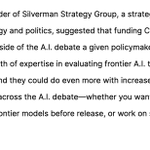
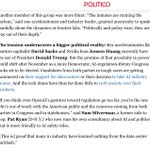
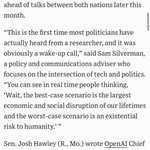
China hawks, accelerationists, and safety advocates all have reasons to fund CAISSI.
You can disagree about where AI should go and still fund the expertise to understand what it can do.
My comments to @IKrietzberg in Puck:

OpenAI/Anthropic going public will do incredible things to equity research:
“Management cited the cost of allocating more compute to safety as a headwind and the continued existence of customers as a tailwind.”


Actually a fascinating set of comms/politics lessons to be taken from this short piece, particularly from the anonymous executive’s quote. To name a few:
1) It’s “when” Dems take back power, not “if.” That’s how a two-party system works. In this case, the answer is ~2 months from now, and that should have been baked into your bet long ago.
2) Focusing on “downside protection” is better comms than “1789 is our moat,” but even that framing accepts that you’re doing business with the President’s family to secure favorable treatment. Not optimal.
3) On that point, it is not a question of “whether it hurts you later.” Having already conceded that your best current framing is paying protection money, it obviously hurts you with Democrats who are increasingly focused on corruption. The real question is how much.
4) Perception does not happen in a vacuum. Companies are often judged by their larger ecosystem, and Defense tech (on the whole) made the conscious choice to be exceptionally Republican-coded. Looking at current valuations, that feels hard to argue with. But it also ignores the reality that reconciliation is dead, the topline will be lower next year, and competition for funding will be fierce. That fight is even harder if you’re a political football.
5) As tough a spot as some of those in defense/energy will be in vis-a-vis corruption allegations, it is nothing compared to what AI companies will deal with. If your sole customer is the government or you are a regulated monopoly, the anger of regular people matters only to the degree to which they can put pressure on politicians. For AI companies trying to earn the trust of the entire country, everyone hating you matters a whole lot more.

How companies are thinking about taking money from Trump-linked 1789:
“Do I let these guys on my cap table now in the event something random comes up and I need Trump universe aligned? Or does that hurt me later if Dems take back power?”
semafor.com/newsletters/busi…

Big move, but a necessary one for someone who wants to play in the 2028 Dem primary.
Bigger question is what we see from non-traditionally Dem-aligned donors.
Is closeness to Trump worth more than public opinion + hostility from one party? How low do his numbers need to go – or how many Republicans need to jump ship – for that calculus to change?
And finally, how much of this is a natural reorientation around what are now divergent economic incentives for different layers of the AI stack?

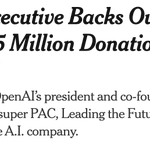
NEWS: @JayCarney told me that his new boss, Democratic megadonor and venture capitalist @RonConway, regrets his previous donation to the AI industry Super PAC Leading the Future.
