

Former FNMA/FMCC Equity Analyst/Trader on the sell side thru Aug 2025. Currently Managing DIrector of ReorgTrader LLC & Part Time Bagholder Exorcist
NYC
Joined September 2024
- Tweets2.1K
- Following19
- Followers207
- Likes358




$FNMA $FMCC
The Housing and Urban Development Act of 1968 was transparent and enacted through legislation. But that doesn’t erase a parallel with Enron’s strategy: moving obligations off the balance sheet and understating risk. The legal methods were very different, but removing Fannie Mae’s obligations from the federal budget was part of the rationale for its privatization.
What emerged was hardly an ordinary private company. Fannie Mae’s leadership included prominent political insiders (mostly democrats) who collected substantial private-sector compensation, while the company benefited from government privileges that weakened market discipline. Those privileges included access to a Treasury line of credit, exemptions from securities registration requirements, and diminished reporting requirements on internal operations that applied to ordinary public companies.
The arrangement was politically convenient: Fannie Mae could continue serving public-policy goals while its obligations remained outside the federal budget. Calling that a private-capital model glosses over how much the model depended on its government relationship.
Yes, the model is flawed, and it’s hard for me to imagine guardrails or reforms that would resolve its fundamental contradictions. If it depends on a sovereign backstop to function, calling it a private-capital model obscures how much of the risk ultimately rests with taxpayers. Private investors can supply capital, but that doesn’t make the government’s support disappear. In my view, it should be wholly government-owned.
We’ve discussed guarantee fees and mortgage rates before. A wholly government-owned entity could potentially charge lower guarantee fees because it wouldn’t need to deliver private shareholders’ required returns and could operate under a different capital framework. The underlying credit risk would still need to be covered, but eliminating the private profit requirement could reduce fees. How much of that reduction would reach borrowers through lower mortgage rates is a separate question.
If this ends up the path we go down, shareholders would ultimately get bought out (how coercive that process would be, remains to be seen)

How would you feel about fully nationalizing these and taking G fees down to break-even after 2.5% Scott?
They could put hard caps on MBS portfolio purchases so Presidents didn’t try to overheat housing by buying down rates, force a transparent accounting of any changes to subsidy and low income programs, and eliminate agency credit for any second homes or investment properties.
That solution is most consistent with everything I’ve seen you advocating for this last year.
If you don’t like this why? It retains sound credit and would likely have the most effect to stimulate primary homeownership.
@AveryGisme I can answer those questions, and you raise legitimate points. But I think the bigger question is how realistic an IPO or secondary offering remains after Bessent’s comments on Thursday effectively pushed the process onto the back burner:
-New investors would be asked to buy voting shares with little practical influence over the company for an indefinite period while the government retains control. I would expect that to warrant a potentially significant discount.
-If the guarantee remains implicit, investors would face uncertainty about its credibility as government ownership declines, particularly below 50%. Another uncertainty for investors being asked to commit fresh capital.
-If the guarantee becomes explicit, its pricing and conditions could create a substantially different—and potentially less profitable—business model. Yet another unknown investors would need to price.
-In my view, the SPS would need to be canceled or otherwise resolved on terms that leave a workable ownership structure. In hindsight, there is a case that the bailout should not have taken the form it did and that legacy securities were unfairly subordinated. That supports an argument for canceling at least some of the SPS. Yes, my views on that have evolved. What hasn’t changed is my belief that cancellation remains politically unlikely. Meanwhile, an outcome giving the government roughly 95% ownership would likely make divestiture extraordinarily difficult, if not impossible
-This process would take years. If, as Bessent suggested, it might not even begin until 2028, completion could easily fall to the next administration, introducing still more political and policy uncertainty.
That is why I see his comments as a potentially the coup de gras to the near-term privatization thesis. It’s difficult enough to attract new capital when investors understand the business model, ownership structure, and path forward. Here, they would be asked to price uncertainty in all three.
I really hesitate to put this out there since I think it is very unlikely but I noticed in this report from 2019 there was a suggestion of an SPS cancellation:
home.treasury.gov/system/fil…
@amuuhasuo Like what making it easier to get a mortgage? Give us an example of how F2 could be "weaponized" against the Republicans????
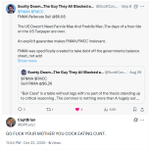
<blockquote class="twitter-tweet"><p lang="en" dir="ltr">Regarding hard caps, I think it’s nearly impossible to make Fannie and Freddie apolitical. Even before conservatorship, when they were privately owned by shareholders, their public mandate to expand U.S. homeownership subjected them to strong political pressure. At the same time, Fannie Mae wielded its own considerable political influence to resist tighter federal regulation. Hard caps might constrain specific activities, but they wouldn’t eliminate the political incentives embedded in the model.</p>— Scotty Doom...The Guy They All Blocked at $14 (@ScottCoverleyJr) <a href="xitter.cf/ScottCoverleyJr/status…">October 24, 2026</a></blockquote> <script async src="platform.x.com/widgets.js" charset="utf-8"></script>

Regarding hard caps, I think it’s nearly impossible to make Fannie and Freddie apolitical. Even before conservatorship, when they were privately owned by shareholders, their public mandate to expand U.S. homeownership subjected them to strong political pressure. At the same time, Fannie Mae wielded its own considerable political influence to resist tighter federal regulation. Hard caps might constrain specific activities, but they wouldn’t eliminate the political incentives embedded in the model.
$FNMA $FMCC
In these days of financial repression and what are still historically very low rates, its important to keep in mind what returns were over the period under discussion:


For those less familiar with the history of $FNMA and $FMCC in the interview when Bill says F2 has more than repaid their debt, he means this:
In 2008 the government put the companies into conservatorship and advanced them roughly $191–193 billion in senior preferred stock (the “bailout”). Under the original deal the companies owed a 10% dividend on that money.
They have since sent the Treasury about $301 billion in cash dividends and sweep payments. That’s the full principal back plus roughly $25 billion more than the original 10% contract required. It amounts to an ~11.6% IRR for taxpayers. In short, the cash that went out has come back with a large profit.
This morning I saw some great supporting data on this from @FreedomDayna, who laid out the numbers side by side with other major bailouts (GM, Chrysler, banks, etc.). F2 is one of the clear success stories where taxpayers got their money back and then some:
xitter.cf/FreedomDayna/status/21…
The companies are highly profitable today. The debate is no longer about whether the original bailout was repaid. The numbers show it was, and then some. It’s about how (and how quickly) to end the conservatorship. Emphasis on quickly before these companies become politically weaponized.
@CaliRefugee1 One last point: In hindsight, one can make a case that the “bailout” should never have occurred in the form it did and that legacy securities were unfairly subordinated. From that perspective, there is an argument for canceling at least some of the SPS.
I haven’t made that point before because I expected it to be conflated with my assessment of the likely outcome. What "should be done", "what can be done", and "what is likely to be done" are separate questions. In this situation, the answers are probably very different.
@CaliRefugee1 The government decision on litigating the NWS for years couldn't be a better example b/w what "should be done" and "what is likely to be done"
@CaliRefugee1 One last point: For over a year now the one issue I have consistently called bullshit on is the widespread assumption held by legacy security holders that an 11.6% return should constitute “full payback” on a perpetual preferred stock.
I think people need to spend more time explaining how cancellation aligns with the incentives and stated goals of those who will influence the outcome. At a minimum, I see three major issues that proponents need to address:
1) Following Bessent’s recent comments on Monday, it now seems reasonable to assume that cancellation would require a clear public-policy justification.
2)Bessent has explicitly emphasized maximizing taxpayer value as a core principle guiding the outcome for Fannie Mae and Freddie Mac.
So regarding 1 & 2, I think we need to make the case that either a cancellation might be consistent with these policies or for some reason these policies end up not being a consideration when the time comes.
And thirdly, Regardless of whether cancellation is warranted or not, the optics matter. Like it or not, Bill Ackman—a billionaire hedge fund manager—is the public face of Fannie and Freddie shareholders. Democrats would have an obvious opening to frame cancellation as a handout to wealthy hedge fund managers. Maybe the question would boil down to Trump willingness to spend the political capital required.
Arguing that taxpayers have earned enough is one thing. Explaining why the people making the decision would find that argument persuasive is another.
@CaliRefugee1 With “high-yield” bonds yielding as little as 6% today, I can understand the lens some people are viewing this through. Others may be thinking, “It’s the government—it doesn’t really need to earn a private-sector market return.” Unfortunately there's a new sheriff in town named Scott Bessent…
$FMCC $FMCC
Guys I want to pay tribute to Bill Ackman.. A TRUE AMERICAN HERO!!!
Bravely agreeing to put his portfolio between America and AOC!!!!!
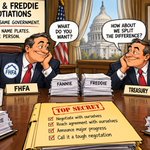
What a complete crock of shit...You'd really think that the last line of defense against the Democrats is Bill Ackman’s cost basis...Under no circumstances can we let affordable housing fall into the hands of people who, well, campaign on affordable housing and instead we will remove politics from FNMA before the other guys get control! Really glad to hear that Bill Ackman is willing to accept enormous personal profits to prevent this national tragedy! This couldn't be more transparent...But apparently there's no shortage of those here who are taking it at face value!!
@Wize_Markets how do you foresee the "weaponization" going down???


Bloomberg headline says it all.
If $FNMA $FMCC aren't released before Trump admin ends, Dems will weaponize them.
This is why @pulte @SecScottBessent must lay out roadmap + NYSE uplist NOW, before midterms. Executive action. One day. Done.
@Final_Boss79 your are conflating two different things. I am just calling out what is obviously (to some at least) a manufactured threat designed by a billionaire to enrich himself. That isn't the way to get this to the finish line...

