

frontier AI and China @CarnegieEndow
London
Joined August 2019
- Tweets1.5K
- Following1.1K
- Followers2.4K
- Likes2.5K




Pinned Tweet
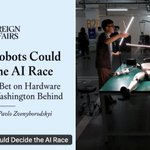
In August, the Chinese humanoid robot Tiangong Ultra bested Usain Bolt's 100 meter record. These robots still have serious (though sometimes pretty funny) flaws; this one crashed into a wall.
But make no mistake. As Pavlo Zvenyhorodskyi and I write in @ForeignAffairs, AI-powered robotics are going to change the physical world. China is investing substantially in these robots while the U.S. lags behind.
In the U.S., the top frontier AI companies are betting that they'll be able to automate just about everything humans can do on a computer in a few years. But that leaves a lot: everything that requires real-world interaction. Some people assume that rapid advances in software will easily diffuse into physical spaces. That's a big assumption to make given how important this technology might be.
China has invested in AI-powered robotics for several domestic reasons, including creating robotic caretakers. But robotics could just as well become a source of geopolitical advantage in supply chains and in the military. Many robotics companies in China are struggling to make a profit, but there's serious progress in the underlying technology. There significant parallels to China's playbook in EVs and solar.
Clearly, the U.S. needs to rapidly build up its robotics industry. But doing so will require a tough balancing act: decoupling is impractical given the deeply integrated nature of the supply chain. One of the key answers will involve working with allies and partners in Europe and Asia who have advantages in areas like industrial robotics as well as novel data sources, such as Ukraine's battlefield data.

Scott Singer retweeted

“The Chinese government is determined to lead the transformation toward a world of AI-powered robots.”
Read @Scott_R_Singer and Pavlo Zvenyhorodskyi on Beijing’s bet on embodied AI—and how Washington should respond:
foreignaffairs.com/china/chi…

China is a generally techno-optimist country, but even for the CCP, that techno-optimism has limits. For example, virtual AI companions are a problem if you're worried about a low birth rate and want your 20 and 30-year-olds (the generations after that) to reproduce. AI turbo-charging the economy is all well and good until SOEs become pressed to fire workers whose jobs have been automated (not there yet but may soon get there). AI offers new opportunities for education until your top mathematicians and software engineers struggle to find work (similar story). Right now, the party line is that it can reap the benefits and minimize the risks –– not so dissimilar from what we see in the U.S. But with the technology moving so quickly, it might cause really challenging short-term disruption (not uniquely so), even if there are substantial long-term benefits.
Good to chat about this stuff and more with @nytimes


Scott Singer retweeted

The American AI industry needs a lot more datacenters than it can build at home. If US allies host these datacenters, they might be able to secure access to frontier AI in return.
New for @ForeignPolicy with @SamWinterLevy, on getting compute-for-access right:

Scott Singer retweeted

Despite a dominance in computing power, U.S. frontier AI models are still only six to nine months ahead of China’s. @mattsheehan88 explains why Chinese models are able to keep up.
Watch the full interview here: foreignpolicy.com/live/sheeh…
Scott Singer retweeted
Today on FP Live: @mattsheehan88 joins FP’s @RaviReports to discuss why the U.S. and China govern AI so differently and what the competition means for the future of geopolitics.
Tune in here at 11:00AM ET: foreignpolicy.com/live/sheeh…

Scott Singer retweeted
Most countries won't do what it takes to build their own frontier AI. But they don't want to be dependent on foreign AI without a backup.
@SamWinterLevy and I argue there's a middle path: AI middle powers could retain 'AI Breakout Capacity'.
There's precedent: Japan doesn't have a nuclear weapon, but always retains the capacity to build one on short notice.
Middle powers can make strategic choices today to ensure their ability to build frontier systems tomorrow: onshore compute, secure chip purchasing rights, sustain pre-training expertise, and create the right legal basis and private-sector vehicles for a sprint.
They'd still have to spend big to build frontier systems later on. But the longer they retain breakout capacity, the longer they can afford to wait: to see if interdependence with America can work, or until their electorate will let them go all-in on an AI moonshot.
Until then, the middle path is their wisest choice: hope that U.S. alignment works out, but retain the capacity to deal with being cut off for good.
Read more in our latest for @CarnegieEndow's @CEIPTechProgram: carnegieendowment.org/resear…

Scott Singer retweeted

AISI IS HIRING!
It was less than a month ago that I became Director. I joined with the belief that AISI is a world-leading organisation, and living proof that government can build things that work.
One month in and I'm even more bullish about the vital role @AISecurityInst plays in frontier AI security. I'm astounded daily by the talent, focus and commitment of the brilliant team I get to work with.
There has never been a more urgent time to work on frontier AI security - independently, in the public interest. We have a lot of urgent work to do, our team is growing fast, and we need more brilliant people to fill those roles.
Our Red Team uses adversarial machine learning techniques to find failures in alignment measures, control monitors, and misuse guardrails. They are massively scaling up all parts of the team:
Alignment: job-boards.eu.greenhouse.io/…
Control: job-boards.eu.greenhouse.io/…
Misuse: job-boards.eu.greenhouse.io/…
AI capabilities in cybersecurity and autonomy are advancing faster than ever. Our Cyber & Autonomous Systems team assesses what frontier and open-weight models can really do - across cyber, autonomy and AI R&D. We're hiring a Cyber Security Engineer and Software Engineer to build the evaluations behind that work:
CSE: job-boards.eu.greenhouse.io/…
SWE: job-boards.eu.greenhouse.io/…
Our Human Influence team studies how AI can shift human decisions and behaviour, using everything from RCTs to multi-agent studies. We're hiring an Engineering Lead to help us grow the ambition and pace of that research:
job-boards.eu.greenhouse.io/…
We're also hiring exceptional Software Engineers at all seniority levels to join our Core Technology team, which works closely with researchers to build performant tools and infrastructure that enable and accelerate AISI's world-leading AI safety research:
job-boards.eu.greenhouse.io/…

Scott Singer retweeted

Could automating AI R&D radically accelerate AI progress in an “intelligence explosion”?
Preliminary evidence suggests that it could.
In a new paper with authors across academia, civil society, and frontier AI companies (including @dawnsongtweets @merettm @jackclarkSF @Yoshua_Bengio @geoffreyhinton ), we assess the evidence & offer policy recommendations 🧵

Scott Singer retweeted

The US and China are competing to lead the AI race. But can they realistically cooperate on AI safety at the same time? I ask @Scott_R_Singer:
Scott Singer retweeted

Ahead of the Trump-Xi meeting, we (Amodo, Lucid, SASH) spoke to the South China Morning Post about the emerging technologies that could enable international AI deals. Lots of progress; DM for details! scmp.com/news/us/article/336…

Scott Singer retweeted

The U.S. and China are looking to reopen dialogue on AI. As “pacing the frontier” on AI competition hangs in the balance, the competition for the talent behind the technology continues apace.
Today, Carnegie China launches Who’s Ahead in the Global AI Talent Race?
Our continuous longitudinal study tracks how countries stack up in producing, retaining and attracting the world’s top AI talent.
So who’s ahead? Follow along as we dig deeper into the findings 🧵

Great to see the U.S. and China begin to build their AI diplomacy muscles by moving toward an official, permanent channel and an information-sharing channel on critical incidents. Gives us real substance to build on. As I wrote earlier this month for @ForeignPolicy, domestic incident reporting will be necessary in parallel for this bilateral sharing to have structure.


EXCLUSIVE: Read my interview with Treasury Secretary #ScottBessent and USTR #JamiesonGreer after meeting Chinese vice-premier He Lifeng in New York 👇
Separately, senior US official told me the two sides did not reach agreement on extending the Busan truce.
ft.com/content/d29d769e-039c…


Scott Singer retweeted

In New York City, Vice Premier He Lifeng and I are continuing our discussions on the U.S.-China economic and trade relationship ahead of @POTUS’ historic summit with President Xi in Washington. These talks help lay the groundwork for President Trump to advance America’s economic interests and deliver results for the American people.

Well-crafted policies don't hinder our competitiveness with China; they engender trust that the technologies we are building are trustworthy and safe. As @mattsheehan88 often reminds us, China has the world's most extensive AI regulation in the world and managed to catch up. Designed well, governance supports innovation.
Great talking about this stuff earlier today on @CNN with @KateBolduan
Scott Singer retweeted

Also, everyone should follow @ZilanQian. Considering the import of China AI issues and the quality+depth of her analysis, it is criminal that she has <1k followers on here!
Two bangers:
(way ahead of the distillation forwarding issue) chinatalk.media/p/how-to-buy…
(what does Xi mean when he says loss of control?)
oxfordchinapolicylab.org/res…


.@ZilanQian is right on this underrated explainer of different sense of AI risk in China. The gap between released models of as low as 4 months might make one think they are seeing virtually the same things.
They are not.
US models go through much more rigorous pre-release testing, taking months, while Chinese labs just ship them quickly. So internal US models are much further ahead than public gap suggests. They are seeing more frontier risks than Chinese labs who can argue there is no reason to slow down until they catch up.