

Co-founder & CPO @offerlabHQ. Previously ESPN and Rotten Tomatoes, so I have opinions on sports and movies. WSET 3, so also wine. Building Pocketsomm.
Los Angeles, CA
Joined June 2009
- Tweets16.4K
- Following3.1K
- Followers698
- Likes9.9K





Sweetgreen ordering inside Claude and ChatGPT is a product built for people like me.
I time-block my whole life except lunch. I won't eat the same thing twice, I don't do leftovers, and most days that ends with me drinking a smoothie.
One order through a chatbot is cute, but what I actually want is my agent building me a different bowl every day of the week and placing the orders while I'm in meetings. Sweetgreen tried a subscription in 2023 and it didn't land because customers found the tiers too complicated. My agent reads the fine print so I don't have to.
Whoever gets onto people's weekly agent plans first is going to own weekday lunch.

We started sweetgreen to connect people to real food. Today we're taking that somewhere new.
You can now order sweetgreen inside Claude and ChatGPT. Tell it your goal, whether that's a protein target, a dairy-free dinner, or something new to try, and it builds your bowl. Tap to add it to your bag and check out in the app with your rewards.
A first for our industry 💪🏼
3
145
Same week my feed decided Code Mode killed MCP, Pi, a coding agent that spent a year roasting MCP, made it a core feature. Honestly, that tracks.
I run my whole workday from one agent harness, and the worst part is still connectors. Every app wants me to find its server, install it, sign in and pick scopes. It's configuring a printer, in 2026.
Code Mode is great. Letting the agent write a program against typed APIs is how Cloudflare took 2,500+ endpoints from about 1.17M tokens to about 1,000. But it fixes how agents use tools, and connecting to your apps is a whole separate layer.
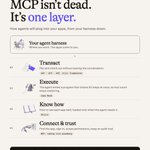
The image is how I see the stack settling. My bet is the race that matters is agent identity. You authorize your agent once, it finds your apps on its own, and setting up a connector becomes a consent prompt. Whoever makes that boring wins.

1
56
A $150 advent calendar that's mostly hair ties is the kind of thing I take personally (looking at you Skims 😭), because @brunotorious and I at OfferLab spend all day tracking which brand collabs and bundles actually sell.
So ahead of BFCM, I pulled this year's numbers and built the bundle the data suggests would crush.
- A NeeDoh, with squishy sales up about 6x this year
- An Instax camera, after searches for Instax bundles jumped 190%
- An LED face mask, as interest in anti-wrinkle devices climbs 75%
- A 20g+ protein snack, a category up 19% in dollar sales
- A fragrance mini set, with mass fragrance up 15%
It's the perfect gift for someone anxious, nostalgic, aging and hungry, which describes everyone I know.


I'm back in registry mode with baby #2 due in December, and looking at it with product eyes, a registry is just a bundle nobody tested before it shipped. Babylist surveyed 6,700 parents and the most-named best item was a countertop bottle washer, ahead of luxury strollers and smart bassinets. Nearly 1 in 5 said their worst item was never used or a waste of money, mostly wipe warmers and sterilizers. 15% already let AI build theirs, and honestly I think the registry AI that wins will be the one willing to talk you out of the wipe warmer.

47
Hailey Bieber set her floor at a billion and told Sorkin like she was reading off a grocery list.
Hard truth: Every founder needs that much delirious conviction, because nobody else is going to believe your vision before you do. Gotta manifest it.

Was a $1 billion on the bingo card for Rhode? "$1 billion was the number that I said I would, I would not sell it for less than that," Hailey Bieber tells @AndrewRossSorkin.
Dunking on NVIDIA's interim CEO is the laziest take on the timeline right now.
For all his mistakes, Jensen was one of one, and there isn't a single CEO in the world who could steady that right now, because of what Jensen means to NVIDIA. Some of the people who followed him personally were always a flight risk, and no comp plan fixes that. Her job is stability, and pulling raises and stock into December is a reasonable piece of it. Per WIRED, employees' next question after pay was board transparency, and that one matters just as much. Jensen wasn't designing the chips himself. World-class teams were, and it’s those folks who are going to tell the next chapter of NVIDIA.
I’m very curious to see where it goes.

JUST IN: Nvidia ($NVDA) interim CEO Colette Kress promises company-wide pay raises and additional equity grants months ahead of schedule as the chipmaker scrambles to retain employees following Jensen Huang’s departure, according to WIRED.
47

Andddd here we go

We’ve priced our IPO at $83 per share, with trading expected to begin on Nasdaq tomorrow.
anthropic.com/news/anthropic…
Legal disclaimer: A registration statement relating to the Class A common stock was declared effective by the Securities and Exchange Commission on November 18, 2026. The offering is being made only by means of a prospectus. Copies of the final prospectus may be obtained, when available, from: Goldman Sachs & Co. LLC, Attention: Prospectus Department, 200 West Street, New York, NY 10282, by telephone at (866) 471-2526, or by email at [email protected]; or Morgan Stanley & Co. LLC, Attention: Prospectus Department, 180 Varick Street, 2nd Floor, New York, NY 10014, or by email at [email protected]

1
64
Muse's head of product told Lenny her husband called about seven packages on the porch. She'd asked her agent for kids' sweatpants, and instead of one bulk order from one brand, it split the buy across five stores based on her spec.
That porch is the future of commerce. Brand loyalty doesn't survive an agent that shops by spec. You stop getting the whole cart and start fighting for line items, while most brands are still polishing a homepage the agent will never look at.

In late January, @natfriedman pinged a few people at @Meta. He’d been using OpenClaw, and told them they needed to try it.
Mona Sarantakos couldn’t find a Mac Mini, so she spent the weekend setting it up on a Raspberry Pi and gave it access to her email and calendar. Her husband told her, “That is so not safe.”
But by Monday morning, it had pulled together everything her kids had going on at school that week. She pinged Nat back: “This is it. I’m in.”
The team spent the next seven months building something safe and simple enough for everyone. They called it @Muse. It became the fastest-growing AI consumer product ever.
Mona is head of product for Muse and VP of product at Meta Superintelligence Labs. In her first podcast interview, she shares the inside story of how they built and launched Muse.
We discuss:
🔸 Why they waited seven months to launch, despite getting started before all of their competitors
🔸 The two levers that actually move activation for an AI agent
🔸 How @natfriedman, @alexandr_wang, and @finkd each left their imprint on the product
🔸 Why the Muse team relies on "agent swarms" more than dashboards
🔸 Why taste is now the most important PM skill
Listen now 👇
youtube.com/watch?v=WY0cdD4g…

3
863
Google launched its agent shopping protocol with Shopify in January, and now Gemini shops a totally different way that plugs into the first one later.
This is the most Google thing of all time 🤣.
I've tried buying through almost every agent and no two feel alike, so I think the protocol race is backwards. Shoppers don't care which acronym paid for their socks. Whoever makes it feel the same twice in a row wins, and it won't be a protocol IMO.

Now Gemini can check out securely with Google Pay, using the Agent Payments Protocol (AP2). Just set a spending limit and pick which stores it can use. Gemini checks with you before it buys, or you can let it go ahead on its own, within your limit.
You’ll still receive all your card benefits, and we’ve partnered with Visa, Mastercard, and, soon, American Express, to secure your purchases using digital tokens on supported cards.
Afterward, your receipts, order confirmations, and delivery updates will all be in your Google Wallet, which is expanding to iOS starting today.
Tasks in Gemini will soon integrate with the Universal Commerce Protocol (UCP) for an even easier shopping experience.
1
76
Mira Murati's interaction models got me thinking about what work looks like once a model is actually in the room with you, hearing and seeing everything as it happens instead of waiting for its turn.
An architect is walking a site with a client. The client says the kitchen feels cramped, and before they've left the room it's pulled up the plans and shown exactly where the wall drifted from the drawings.
A platform PM is on an escalation call with one of their biggest merchants, whose conversion dropped after last week's checkout update. While the merchant shares their screen, it spots a third-party app fighting the new checkout, checks how many other stores run that same app, and has the fix and a note to the app's developer drafted before the call ends.
A wedding planner walks the venue with the couple. They point to where they want the dance floor, and it catches that the band needs power right there and the only outlet is across the room.
None of them stop to write a prompt. They keep doing their thing and the model keeps up. I think that's the real shift, from AI you have to brief to AI that's already paying attention.

Mira Murati says human-AI collaboration needs models that can listen while they think:
"The types of models that we work with today, they're very turn-based. You talk, they talk, then they go off and think."
"While they're thinking, it's almost like they're deaf and blind. They cannot perceive anything else about what's going on."
"By contrast, our interactions with each other are very rich. There is a lot of information in our interactions when we are silent, when we're thinking, when we're interrupting one another."
"Interaction models are able to capture all of this nuance. They're not turn-based. They're more like time-based interaction, where they're continuously taking in audio, text, video, and continuously providing output."
"This enables you to catch things like interruptions and simultaneous speech, and really create a rich, high bandwidth interaction between humans and machines."
@miramurati at Bloomberg Tech live with @emilychangtv
1
1
53
My daughter is two, so she's not getting a Coinbase account anytime soon, but she's absolutely ready for a book about finding a penny. I worked on financial literacy for kids with UWish, teaching money skills through play, and I'm hugely passionate about this space, so I love seeing Coinbase take it on. They put the story first and left the account to the parents (right call IMO), because in kids' money the parent is the real first customer.

Money is changing. How do you explain it to your kids?
Start with a story.
One year after the last penny was made, we made our first children’s book - giving parents a new way to talk about money.
Each copy includes $50 in bitcoin to put toward their financial future.
1
40
Love the bull case, I just think Napster is the wrong analogy. Napster lost, and the licensed deals that came after it won. Napster also gave the music away, while an agent hands United a paying customer.
The tell is that United bans the booking even when a human approves it. A real safety rule would let the agent book and keep the person for the bag attestation at check-in. There is a real gap, though. When an agent buys the seat upgrade or the non-refundable fare, who actually said yes?
I launched Verified Audience Score @RottenTomatoes and we never banned anonymous ratings. We verified the ones tied to a real theatre ticket purchase and showed that score first. Agents need the same move, proof the person behind the booking actually approved it. Streaming didn’t win on exclusives either, so my bet is there will be a route of the agentic commerce protocal any agent can plug into, because no airline can afford to be the one agents can’t book.

Biggest bull signal for agentic commerce yet.
I'm old enough to remember the record companies lining up to crush Napster, and how it kicked off the streaming era in music.
1
47
And it's already being built 🤯 The day after United's ban, Travelport, Booked AI, Basis Theory and Mastercard ran a live agent flight booking on the airline's own NDC offer. The airline stayed the merchant, the agent never saw the card number, and Mastercard tied the customer's approval to the payment ~ good stuff.
24
Sweet Logic just made creator Devin Cordle its co-founder and Chief Brand Officer, right as its Mini Cookies roll out to nearly 500 Whole Foods.
Brands used to pay creators by the post. Some are starting to make them co-founders, and I think that's the smarter deal for both sides. A creator who owns part of the brand keeps selling it long after a sponsored post has scrolled out of the feed.
I'd bet a lot more creator deals in 2027 look like cap table entries than sponsorship invoices.

1
73
Sugarfina and Chopin Vodka have run their martini candy collab back at least three times, and the reason is pretty simple: the first two sold out and people kept asking for it.
Nobody does a third collab to be polite. You run it back when the first one brought you customers you couldn't have reached on your own.
Most collabs are one-and-done with a press release. I'd study the ones that keep coming back.

20
The biggest winner of the Boka x Olipop toothpaste might be Walmart.
Don't get me wrong, I love it. Toothpaste that tastes like soda sounds insane, but the gut-meets-mouth thing actually makes sense, and it's weird enough that everyone has an opinion, which Olipop said was the whole point.
Then the soda and the toothpaste went on separate endcaps at Walmart and Target. So the Olipop fan who tries the toothpaste walks out a Walmart customer, and neither Boka nor Olipop ever gets their email.
A collab is the one time a brand gets walked into someone else's customer base with a recommendation. Doing it on a shelf you don't own is like throwing a great party at your friend's place and letting them keep the guest list.
A collab that doesn't hand each brand the other's customers is just co-branded advertising.

37

The toughest customer in all of CPG is a parent reading the back of a snack box.
Wellness Monster just closed its seed round, and founder Brittany Compton knows that shopper better than almost anyone after 13 years at Mars and running Love Child Organics as President & GM. Her refined-sugar-free, school-safe snacks are already in Whole Foods and Costco across Canada.
Kids' food is the one aisle where nobody trusts the front of the box. Parents buy what another parent swore by in the group chat, or what a brand they already let near their kids put in front of them.
I'd bet the kids' snack that wins is the one parents hear about from someone they trust before they ever see it on a shelf.

2
2
79