
(RTs & quotes = interest, not agreement)
Joined March 2016
- Tweets36
- Following19
- Followers43
- Likes24

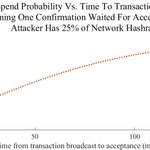


The standard acceptance policy of accepting after 5 confirmations "throws away" block timing.
"Accept after N-confirms" trades security for simplicity. As Bitcoin's security budget declines, acceptance policies that incorporate block timing information may be useful.
1
9
Bitcoin confirmations alone are not enough!
bitcoindoublespend.com/
Double-spend risk depends on the not just the number of confirmations, but the amount of time it takes for those confirmations to arrive.
Slowly arriving blocks give attacker lots of time to build

1
3
23
And 5% can effectively censor transactions in PoW mining via feather forking (which makes it a gamble for any miner to include txs that these 5% wish to censor).
5


Seb Neumayer retweeted

“There is no simple solution to the problem of privacy, because privacy itself is a solution to societal challenges that are in constant flux.” thereader.mitpress.mit.edu/t…
Seb Neumayer retweeted

Today the security halvening will take place over BTC
The amount of value protecting the network will be cut in half, drasticly reducing the security of the network
Another step down the path of a doomed security model
The halvening is a fundemental crisis, not a bullish event
Double spend probability is also function of the *time waited for those confirmations*
6 confirmations in 20 minutes is stronger than 6 confirmations in 4 hours
Accepting after a fixed number of confirmations discards timing info. There are other types of acceptance policies
1
Seb Neumayer retweeted

7. Satoshi did foresee, but was wrong on, what happens when transaction fees exceed block rewards. He indicated that the system would operate as normal. This is incorrect, as miners have an incentive to snipe each other's transactions instead of collaboratively building a chain.
There are policies for accepting transactions beyond "wait for N confirmations." Specifically, the transactions are accepted as a function of time since transaction broadcast as well as confirmations. First presented by @hashdag and further analyzed here:
eprint.iacr.org/2018/040
Double spend probability also depends on the timing of block arrivals. 6 confirmations in 3 hours is not as strong as 6 confirmations in 20 minutes.
eprint.iacr.org/2018/040
@PeterRizun I also Bitcoin-related double spending probability questions. I am specifically interested in how the timing of block arrival affects the probability of double spend. I would appreciate any feedback you have on this e-Print paper on the topic: eprint.iacr.org/2018/040
Always seemed strange to require a fixed number of confirmations to accept a transaction given the stochastic nature of block arrivals. Doesn't the probability of double spend at acceptance depend both on number of confirms as well as the amount of time since trans broadcast?
From Satoshi's paper: "assuming the honest blocks took the average expected time per block." Satoshi discarded the stochastic behavior of block arrivals, and so his equations are approximations. The answer to the quiz is 20.83%. Block timing information affects the 2x spend prob.
Unfortunately it is not that simple. Using n=2 implies accepting a transaction after exactly two confirmations, only after which may the attacker double spend. The attacker waiting for two confirmations instead of just one to release his chain affects the double spend calculation
1
That paper assumed that the attacker starts one block ahead in the double spend attempt. From Meni's paper: "(we assume one block was pre-mined by the attacker before commencing the attack)". Peter clarified that we assume no premine, so the chart does not apply.
1
2
Double spend probability depends on how long the one confirmation took to arrive. This timing information is public and available that the receiving party should not discard. Blocks can take a long time to arrive. blockchain.info/block-height… (90+ min --> 70%+ 2x spend probability)

Block timing information is required to answer this question. If the single confirmation took 90 minutes to arrive, the 2x spend probability is quite high. If the single confirmation arrived in only 2 minutes, probability is drastically lower. See: eprint.iacr.org/2018/040
1
These blocks can be made as big as you want, right? If so, I think you just solved the Bitcoin scaling issue!
Also, how much work/time goes into each block?