
Postdoc - designing proteins at Dana-Farber/Harvard Medical School | @EMBOFellows | formerly, evolutionary biochemistry at Max PIanck Marburg
Joined August 2021
- Tweets100
- Following231
- Followers511
- Likes526






Franziska Sendker retweeted

Ever wondered what a cell has experienced in the past? This is in general hard to measure. Here we introduce the recordanelle, to equip cells with a tool that lets them record their own history.
nature.com/articles/s41587-0…
@NatureBiotech @ETH @randall_platt @ETH_BSSE

Franziska Sendker retweeted

Excited to share a preprint of my main PhD work in @nickpolizzi_'s lab - introducing LUCI-tag, a new orthogonal self-labeling protein tag based on K-Ras(G12C) and its covalent inhibitors! biorxiv.org/content/10.64898… (1/16)

Franziska Sendker retweeted

We have a new paper out on bioRxiv describing how to turn "static" small-molecule binders into dynamic shape changers! Short 🧵
biorxiv.org/content/10.64898…

Franziska Sendker retweeted

De novo designed oligomers that respond to copper, small molecules, and phosphorylation...
Using a single design strategy? 🧬⚙️
🎉
Excited to share our new bioRxiv preprint—a collaboration between the Khmelinskaia, Correia, Schoeder and a Tinnefeld labs!
biorxiv.org/content/10.64898…


Franziska Sendker retweeted

Our latest work on the nitrogenase-like methylthio-alkane reductase is now out
@NatureCatalysis
doi.org/10.1038/s41929-025-0… We biochemically and structurally characterized the methylthio-alkane reductase, a metalloenzyme that can produce ethylene from organic sulfur compounds.


Franziska Sendker retweeted

New paper from the lab from @SriramGarg. We introduce a general substitution matrix for structural phylogenetics. I think this is a big deal, so read on below if you think deep history is important. academic.oup.com/mbe/advance…

Franziska Sendker retweeted

Zero-shot design of drug-binding proteins via neural selection-expansion
1. This study introduces a powerful method for the zero-shot design of small-molecule binding proteins using neural networks. The approach combines two reciprocal neural networks, LASErMPNN and RoseTTAFold-All Atom (RFAA), in an iterative design process called NISE, achieving high-affinity small-molecule binders from scratch.
2. The core of the method involves a self-consistency optimization algorithm that iterates between sequence design and co-structure prediction. LASErMPNN designs protein sequences based on protein-ligand co-structure, while RFAA predicts protein-ligand co-structures from the designed sequences, optimizing both protein and ligand coordinates.
3. The method was tested by designing a protein binder for the anticancer drug exatecan, a topoisomerase I inhibitor. The designs showed promising results, with the best-performing design binding exatecan with a dissociation constant (Kd) as low as 120 nM, surpassing state-of-the-art methods by up to 70-fold in terms of affinity.
4. A major innovation of this work is the introduction of "neural proofreading," where LASErMPNN suggests mutations to improve binding affinity. By adding just two predicted mutations, the affinity was improved by over 100-fold, achieving a Kd of 1.2 nM for the exatecan-binding protein.
5. The designed proteins were also tested for their ability to protect exatecan from hydrolysis, a common issue for the drug in the bloodstream. The best design, EPIC, protected exatecan from hydrolysis for days, a dramatic improvement compared to the drug’s typical half-life of a few hours.
6. This approach provides a general framework for designing small-molecule binding proteins, with potential applications in drug delivery, antidotes, and sensors. It demonstrates that deep learning models can be used to automate and accelerate the design of highly specific protein binders for a wide range of molecules.
7. The study also highlights the challenges in protein-ligand co-structure prediction, particularly in accurately modeling ligand functional groups, but the results suggest that future improvements in structure prediction will further enhance the method's performance.
@nickpolizzi_ @benf549 @PolizziLab
📜Paper: biorxiv.org/content/10.1101/…
#ProteinDesign #DeepLearning #DrugDiscovery #Bioinformatics #MachineLearning #ComputationalBiology #AIinBiology #NeuralNetworks #SmallMoleculeBinders


Franziska Sendker retweeted

Excited to share our latest work on the structure and mechanism of the ancient sodium-pumping Rnf complex, now out in @NatureComms nature.com/articles/s41467-0…
Franziska Sendker retweeted

Glad to see my main PhD project finally out @NatureMicrobiol nature.com/articles/s41564-0… We show for the first time that a synthetic and engineered pathway can indeed exceed nature at one-carbon fixation.

Happy to share our story on evolution of protein quaternary structure!
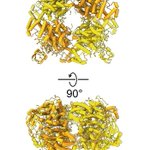
We discover an astounding variation in assembly across evolutionary timescales contrasted by strong functional conservation suggesting a significant role of non-adaptive processes nature.com/articles/s41467-0…
👇🧵

This observation agrees with theoretical predictions (Lynch, 2013) as well as other recent computational and experimental inferences and leads us to advocate for a non-adaptive null hypothesis when discovering a new type of quaternary assembly until it is proven otherwise.