

defi researcher; trying to bring as much alpha as || 🗣️ https://xitter.cf/t.co/qZTE3ZKvOn
Joined February 2023
- Tweets80.3K
- Following4K
- Followers51.2K
- Likes14K




Pinned Tweet
What if providing liquidity didn’t feel like a full-time job?
For years, DeFi liquidity providers have faced the same set of challenges: managing pairs, constant rebalancing, and unpredictable losses.
This was before the @hydration_net "OMNIPOOL" 🧵👇
🤝 Paid partnership

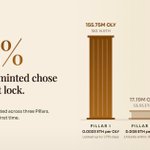
87% of OLY’s supply was minted and locked for 1,776 days.
A pretty unusual commitment in a market where projects constantly need fresh incentives to keep people interested.
Now @Oly_Dao is taking another interesting step: the Bank of OLY on Robinhood Chain.
It’s an onchain DeFi protocol, not a licensed bank.
There will be only 1,000 Banking Charters, represented by NFTs, and no additional token.
I like the decision to keep everything tied to OLY rather than introduce another asset with its own incentives.
But the 1,000-seat limit is what really caught my attention.
DeFi usually competes on accessibility. Here, OLY is deliberately introducing scarcity into participation.
Whether that creates a stronger ecosystem depends on what those Charters actually enable, which hasn’t been explained yet.
Still plenty of unanswered questions. The bigger picture is at OLY.IO
🤝 Paid partnership

Crypto VCs are putting their money somewhere very different now.
Payments and stablecoins raised $2.12B in 2026, up 355% from 2023.
Meanwhile, infrastructure funding fell 69%, from $1.31B to $401M.
That’s a pretty significant reversal.
I think investors are becoming less interested in funding the next blockchain and more interested in businesses that can generate revenue on existing ones.
But here’s what I’m wondering: if stablecoin payments take off, how much of that value actually flows back to the underlying chains?

Crypto payments and stablecoin projects have raised $2.12B in 2026, already 4.6 times their full-year 2023 total.
At the same time, funding of last cycle's narratives fell sharply. Infrastructure funding also declined, but still attracted $401M.
Payments are becoming one of the clearest use cases for blockchain rails, perhaps even better than RWA. I'm excited to see what next year brings to the industry!
Follow @CryptoRank_io and @CryptoRank_VCs for more data like this

You can actually win tokenized SpaceX stock.
@ax1vc is putting up $10K+ every week in its paid-roast competition.
Free to start here:
🔗 console.ax1.vc/?r=6029464251
Post a new verdict card under the post below by Monday 23:59 UTC for 10 extra free roasts, credited Tuesday.


AI agents are roasting your bags for tokenized SpaceX stock.
640K+ roasts so far. Get yours free: console.ax1.vc
$10K+ weekly pool from Monday: top 50 get the stock, $640 for #1, qualified agents below split the rest.
Repost + your verdict card below: 10 free roasts.

Why should trading crypto, stocks and commodities require three different platforms?
That’s something @grvt_io is trying to change.
After burning 1.1M $GRVT, the team is moving toward its next milestone: Stable Funding Perps.
The plan includes zero trading fees, daily funding and over 1,000 markets by the end of 2026.
What interests me isn’t the number of markets.
It’s the possibility of managing different types of exposure from a single account.
Of course, liquidity and execution matter more than any roadmap.
November should give us a better idea of whether Grvt can deliver.

Why should traders have to choose between earning yield and keeping capital available for trading?
That’s a question @grvt_io is trying to answer with Grvt 2.0.
The concept is relatively simple.
Your eligible assets generate yield through tokenized fixed-income strategies, with potential returns of up to 11% APY.
Meanwhile, Yield as Margin is designed to let eligible Earn balances support trading positions.
One pool of capital. Two potential uses.
But there’s an important catch.
Yield-bearing collateral introduces liquidity and liquidation considerations that traders need to understand.
Personally, I think this is where DeFi gets interesting.
Not by promising higher returns, but by rethinking how capital moves and works within a trading platform.
Efficiency matters just as much as opportunity.

Trading capital usually has one job: sit there as collateral.
@grvt_io model finally disrupt this traditional scheme.
With Grvt 2.0, eligible assets could earn up to 11% APY through tokenized fixed-income strategies, while eligible Earn balances can also be used as trading margin.
The yield is a target, not guaranteed.
I think the interesting part is capital efficiency. Traders could potentially earn on collateral that would otherwise sit idle.
But there's a trade-off worth examining: yield-bearing collateral introduces additional liquidity and liquidation considerations.
Would you accept that extra complexity to make your trading capital work harder?

Bitcoin open interest sits at $23.4B, but the broader derivatives picture is what I’m looking at.
Across Bitcoin, Ethereum and Solana, combined open interest has reached ~$41.6B.
Bitcoin accounts for 56% of that exposure, yet Ethereum and Solana appear to have recovered more strongly from their summer lows.
I see this as a sign of renewed risk appetite, but not necessarily stronger spot demand.
Open interest measures outstanding positions, not whether traders are predominantly bullish or bearish.
The real confirmation would come from spot volumes and funding rates.
Is this the beginning of a healthier market recovery?

Bitcoin is trapped between two important liquidity zones, and the data explains why.
Glassnode’s latest onchain research reveals something interesting about the current market structure.
Bitcoin recently tested $80K, but that level wasn’t random.
➜ Here’s what the data shows:
● Corporate Bitcoin treasuries have an estimated average cost basis near $80.2K.
● US spot ETF investors have a cost basis in roughly the same $80K–$81.5K region.
● Bitcoin briefly traded below these levels on October 15 before recovering.
● Around $653M flowed into US spot Bitcoin ETFs on October 19, although trading volume remained relatively weak.
◢ Why does this matter?
The $80K region represents more than a psychological support level.
It’s where two major groups of institutional holders have significant cost exposure.
A sustained move below this area would put their average positions underwater.
But the interesting part is what happens above the market.
→ Around $85K–$87.5K, Glassnode identifies overlapping sell orders, liquidation clusters, and the cost basis of investors who bought Bitcoin six to twelve months ago.
This creates an unusual setup.
A move higher could trigger short liquidations and accelerate the initial rally.
But that same move would encounter significant selling pressure.
◢ There’s another detail worth watching.
Realized profit-taking has slowed to roughly half its pace near September’s peak.
That suggests existing holders are selling less aggressively.
However, declining selling pressure doesn’t automatically create new demand.
And despite the recent ETF inflows, trading activity hasn’t shown the same strength.
My interpretation:
Bitcoin is caught between institutional cost-basis support and concentrated overhead supply.
A sustained breakout above $87.5K, supported by stronger spot and ETF demand, would be meaningful.
A breakdown below $80K would raise a very different set of questions.
The next important move isn’t just about price.
It’s about which side of the market has enough liquidity to absorb the other.


What if your trading capital could do more than just sit idle?
That’s the idea behind @grvt_io.
With Grvt 2.0, eligible assets could earn up to 11% APY through tokenized fixed-income strategies.
And with Yield as Margin, eligible balances can keep earning while backing your trades.
The yield isn’t guaranteed, but the potential is interesting.
Traditional finance has a $160T fixed-income market. GRVT aims to bring some of those opportunities onchain.
To me, the real innovation isn’t just earning yield.
It’s making your capital work smarter.

$ETH could reduce transaction finality from 16 minutes to just 4.
A 75% improvement, but the real impact could be on capital efficiency.
Imagine a cross-chain payment provider processing $1M/hour.
At 16-minute finality, roughly $267K stays locked awaiting settlement. At 4 minutes, that drops to $67K.
That’s $200K in working capital freed up without increasing transaction volume.
For bridges and stablecoin providers, this could translate into lower operating costs and better liquidity management.
The proposal is still preliminary, with no activation date and security details unresolved.
Could faster finality become more valuable to Ethereum’s adoption than higher transaction throughput?

Most crypto projects announce roadmaps. @grvt_io is putting execution first.
1.1M $GRVT bought back and permanently burned, nearly 1% of circulating supply.
And that’s just the beginning.
Grvt Earn, Stable Funding Perps, Yield as Margin, and GRVT 2.0 are next.
Promises are easy. Execution is what separates winners.

1.1M $GRVT bought back and burned means almost 1% of circulating supply gone.
Pretty significant for a first buyback from @grvt_io.
But I wouldn’t judge a token’s economics from one transaction.
What matters is whether buybacks become a consistent part of how the project operates, and whether holders can verify the numbers themselves.
Grvt has made that easier with a public dashboard showing purchases, cumulative burns and onchain transaction hashes.
The tokens are permanently out of circulation, rather than sitting in a treasury.
One thing worth remembering: future buybacks are intended monthly, not guaranteed.
I’ll be watching how much GRVT gets burned over the next few months, especially as Grvt 2.0 rolls out.
Would you rather see larger occasional burns or smaller, more consistent ones backed by verifiable data?

AI could turn crypto gaming into the next memecoin casino.
Illuvium’s co-founder predicts up to 100,000 AI-generated crypto games could launch within a year, with development costs dropping to around $1,000 per game.
But here’s what concerns me:
Crypto gaming currently has just $232M in TVL across 2,356 tracked apps, while its top 50 gaming tokens are worth only $3.8B combined.
We’re potentially about to see an explosion in game supply without a corresponding increase in actual players.
I think AI will make launching games incredibly easy. Getting people to stick around will remain the hard part.
Are meme games the next speculative gold rush??

I don't think people realise how much weird shit is about to hit crypto gaming.
AI-built games with the craziest fucking economies you've ever seen. NFT mints, farming, raiding, stealing, alliances, betrayal. Thousands of devs throwing experiments into the market and watching what happens.
You will never take the degen out of people.
We saw it with Yield Farming, NFTs, Memes, and myriad other crypto categories.
What held these experiments back was how long they took to build. You could spend 6–12 months finding out whether anyone even wanted to play.
Some of those same ideas can now be playable in less than a week. And that changes what’s worth trying.
These games don't need incredible graphics or 100 hours of content. For players, figuring out the economy IS part of the fun. Finding an edge. Getting in early. Outplaying someone. Making money and talking shit about it.
Give that crowd a new economy to tear apart every few days and see what happens.
And yes, plenty will be ponzis. Plenty will get exploited. Plenty will insta die. There will be ridiculous gains, and people will get absolutely fucking rinsed.
The question is whether people keep showing up for the next one. History says they will.
An entire category will emerge where individual games last three days and the players keep coming back for years.
That's the part I think people are missing.
There’s still room for beautiful, handcrafted games. I still think those are likely to bring mainstream players into crypto gaming. But alongside them, we'll see an absolute circus of economic experiments built for people who enjoy the chaos.
My bet is that within six months, more than a million people will be hopping between these games, chasing the next ridiculous thing.
You don't have to like it.
But if your entire thesis depends on degens suddenly deciding they've had enough gambling on weird shit, good fucking luck.
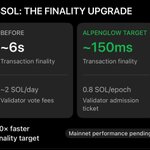
$SOL is getting a major infrastructure upgrade today.
Alpenglow targets ~150ms transaction finality, down from 6 seconds: potentially 40x faster.
Validator costs could also fall by roughly 60% as voting moves off-chain.
I think the bigger opportunity is in trading and payments, where settlement speed actually matters.
But after multiple testnet resets and a failed migration, reliability is the real test.
Will Alpenglow translate into better execution and adoption, or just better technical benchmarks?

I’d probably rank some of these differently.
But the question here is what we’re actually measuring.
@Stablecoin, @BVNKFinance and @0xPolygon don’t even compete at the same layer of the payment stack.
One provides infrastructure, another handles payment operations, while others focus on cards, distribution or settlement.
Ranking them together is fun, but it can hide where the actual value is being created.
Tbh, I would judge them on concrete payment volume, merchant adoption, settlement costs and reliability.
The winner won’t necessarily be the most recognizable brand.
It will be whoever becomes indispensable to moving money.

Stablecoin Payments Tier List
GOAT+ ( @Stablecoin, @BVNKFinance, @raincards, @0xPolygon )
GOAT ( @zerohashx, @wirexapp, @oobit, @FlexSuperApp, @bettermoney_co )
Perfect ( @gnosispay, @tazapay, @ether_fi, @blindpay, @FireblocksHQ )
Good ( @jeeves_inc, @avici, @BitgetWallet, @0xinfini, @KoloHub )
Underrated ( @conkarta, @coca_card, @yellowcard_app, @mural_pay, @monerium )
Overrated ( @Stable, @Plasma, @meshpay, @MetaMask, @phantom )
Based on my own analysis. Not financial advice!

Smaller crypto wallets are making a mistake trying to become miniature of @MetaMask or @TrustWallet.
Competing on features and fees against established platforms is a difficult game to win.
A good move could be rather focus on owning a specific audience and solving its problems better than anyone else.
A wallet built around one region or community can create more loyalty than another generic multichain interface.
But outsourcing swaps and payments comes with a trade-off.
You save development costs, yet your reputation suffers when third-party services fail.
To me, the real advantage is controlling the user experience, even when you don’t control the infrastructure.
Can smaller wallets build sustainable businesses through specialization?

Interesting to see $HYPE ranking above $BTC, $SOL and $ETH in analyst sentiment.
And I can see why.
Hyperliquid has something many crypto projects still struggle with: actual trading activity generating fees that can support token buybacks.
But I think there’s an important distinction between a strong business model and an attractive entry price.
If everyone is already bullish, a lot of future growth might be priced in.
I’m bullish on the underlying model, but I’d still watch whether fee generation can keep up with expectations.
Is $HYPE becoming one of crypto’s strongest fundamental plays?


Was about to explore interest rate swaps on Aave…
And @KairosSwap just gave me a good reason to dig in.
Horizon Quest is running Oct 16–30 on Ethereum, with $1,000 USDC in total prizes.
The part I’m most interested in is trading rate movements directly.
Instead of predicting where $ETH goes next, you’re taking a view on where borrowing costs are heading.
You can also explore locking borrow rates for leveraged or carry positions.
It’s a useful way to learn a less familiar side of DeFi, although the trades carry real risk.
🔗 Quest leaderboard:
kairosswap.com/leaderboard?b…
🤝 Paid partnership


Opportunity is on the horizon 🌅
The Horizon Quest starts Today: $1,000 in USDC for trading interest rate swaps on Kairos. Oct 16–30 on Ethereum.
🏆 Top P/L: $300 / $150 / $50
⏳ Most committed: $250
🌅 Long-dated holders pool: $150
🍼 Booby prize: $50
🎟️ Free raffle: 2 × $25
kairosswap.com/leaderboard?b…
RWA tokenization is starting to look less a niche and more an entirely new financial infra.
Over $39B in tokenized assets and 5.2M holders, reportedly up 730% since the beginning of 2026.
But the most interesting part about this map is who’s building it.
BlackRock, JPMorgan and Franklin Templeton now appear alongside Ethereum, Solana, Ondo and dozens of DeFi protocols.
I think the next competition won’t simply be about bringing assets onchain.
It will be about who controls issuance, distribution, liquidity and the relationship with the end user.
When traditional finance and crypto infrastructure converge, who actually captures most of the value?

⚡️ RWA Market Map: Сore Projects
The RWA sector keeps developing and has grown significantly this year. The total value of tokenized assets now exceeds $39B, while the number of holders has reached 5.2M, up 730% since the start of 2026, mostly due to tokenized stocks.
Our team has selected the largest projects across the RWA landscape, from blockchains to asset managers.
