

Trench Scientist
Tokyo-to, Japan
Joined July 2010
- Tweets2.9K
- Following832
- Followers1.1K
- Likes8.8K






Sheff C (𝔦, 𝔦) retweeted

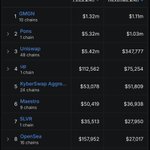
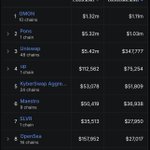
The #1 native revenue-generator on RH chain is
ethereum:0x07f5b6823751c2e2cd4560f28af75ff887102241. The #2 is $UP.
ethereum:0x07f5b6823751c2e2cd4560f28af75ff887102241 and $UP feel similar to me. I'll tell you why.
A month ago, @ponsdotfamily ethereum:0x07f5b6823751c2e2cd4560f28af75ff887102241 had to fend off an onslaught of launchpad competitors (uniswap, noxa, STONKBROKERS).
It survived. That's why it won. Same thing is happening to @uponrh $UP in this new ve(3,3) battle on RH chain. We have $RAM, $prologue, and more.
Yet $UP, similar to ethereum:0x07f5b6823751c2e2cd4560f28af75ff887102241, has the highest revenue of the competitors and quietly maintains its top spot.
A winning position for a liquidity hub on RH chain would imply a significantly higher valuation for $UP.
Consider the actual mcap is around $20M because most of the supply has been perma-locked or burned.
Which other successful protocol has a popular and effective burn mechanism? ethereum:0x07f5b6823751c2e2cd4560f28af75ff887102241
I added more $UP on this -35% dip.


RH chain's next play could be the ve(3 , 3) dex wars
up-2:native vs $prologue
last month, it was launchpad vs launchpad. ethereum:0x07f5b6823751c2e2cd4560f28af75ff887102241 vs solana:92LKNLj4aU9sjUKkgH5mQCuQTPSr42HwF2QrdWDApump
if you'd bid both before they got hot, you'd have won regardless
similar narrative unfolding on @uponrh (established) vs @fablesfi (new)


Sheff C (𝔦, 𝔦) retweeted

100% of up-2:native revenue goes to token holders
5% of ramses:native revenue goes to token holders, with the rest going to LPs lol
It’s essentially a meme coin. Not surprising that all the KOLs are shilling it. They don’t care about value accrual they just want a quick pump and dump
Sheff C (𝔦, 𝔦) retweeted

There are gonna be many projects claiming to be the “Aerodrome of RH”. It is just the nature of the beast given the amount of capital sloshing around the ecosystem.
But one cannot ignore that $UP is one of the OG claimants to the throne. Revenues are going parabolic, the team cares deeply about sustainable tokenomics, and it only takes listening to their dev for a few minutes to understand how experienced the people behind it are.
IMHO, this still looks like a gift at a $20m mc, but where it goes from here will largely depend on whether those revenues prove sustainable over the coming days and weeks.
It pays to DYOR in this RH gold rush, and I can only recommend starting with this interview. 👇

Today on MCG
$UP | @uponrh w/ @nativeaborean
up. is the native (3,3) exchange and liquidity layer of Robinhood Chain.
Highlights include:
01:07 – What ve(3,3) actually means
02:41 – Why voting tokens had value
07:52 – How locking works
13:02 – The core problem with most ve(3,3)s
15:39 – Up's fix
25:39 – Capital efficiency stats
26:23 – Circulating supply is actually below launch levels
32:43 – Composability pitch
36:44 – Tokenomics deep dive
47:25 – Closing thesis
Sheff C (𝔦, 𝔦) retweeted

Let’s talk about the StonkBrokers Special Projects incubator.
The thesis was simple: find talented builders early, give them infrastructure, liquidity and distribution, then let them cook.
The results are starting to speak for themselves.
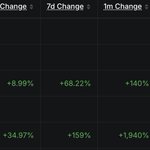
$UP has grown into $12M+ TVL with over $400M in cumulative DEX volume. The token is up 400%+ in the last 7 days alone and 1600% since joining the program.
$MANCER just went live with their aggregator and has grown to $800k in onchain liquidity, $3M+ in daily trading volume and is currently trading more than 300% above its lows.
These are independent teams building real infrastructure that recycle liquidity back to the real users on RobinHood chain and plugs back into the StonkBrokers ecosystem.
Special Projects was built to be an incubator and distribution engine for talented teams building new technology on Robinhood Chain.
The goal isn’t to launch more projects.
It’s to help launch better ones.
Proof has entered the pudding.

Sheff C (𝔦, 𝔦) retweeted

Final thread on $RAM x $UP
Supply, fees and FOMO cabal proof.
$RAM Circulating supply is 236m tokens x 0.18 current price = $42m
FDV is 1b tokens = $180m
Source: ramses.xyz/tokenomics
Staked tokens are free to unstake. You get a 50% cut, but also there are 2x more xRAM in the staking contract than was emitted. So it is even and consider it circulating.
Source: docs.ramses.xyz/pages/xram
Where the much lower numbers are coming from? They are hiding the circulating staking tokens. It is unlocked with 1 click.
1/3

Sheff C (𝔦, 𝔦) retweeted
Yo this is crazy unipcs is pretending up-2:native doesn’t exist lmao. He’s way too smart to not know about, he’s not mentioning it in this thesis on purpose
And now him and every other influencer are doing a mass coordinated shill for ramses:native
up-2:native really is the Hyperliquid of Robinhood lmao. Sorry influencers, no paid deals🤣


Sheff C (𝔦, 𝔦) retweeted

500M supply. 12M weekly emissions. Looks terrible
Until you actually look inside.
This is the most misunderstood trade on Robinhood Chain



Sheff C (𝔦, 𝔦) retweeted
If you’re a fellow Hype maxi, do yourself a favor and watch this
It’s AERO on Robinhood with Hyperliquid ethos, and it prints money


Sheff C (𝔦, 𝔦) retweeted

$UP
It's a dark horse. I'm underwriting the bet on a longer horizon basis (ex. metrics etc.) based on
1. We want to buy the primitives of the chains
2. Sometime point 1 doesn't work out because chain dies, e.g., Sui etc. BUT RH chain won't die because Vlad isn't a crypto extractor. He's in tradfi and who else is a comparable? Coinbase and BASE chain and look where it's at today in TVL usage etc. (it's not dead)
3. It's 4th on DefiLlama with a working audited product & token and has barely done any inorganic marketing to get to this silver place leadership.
Long the underpriced coiling tension.


Sheff C (𝔦, 𝔦) retweeted

Apparently there was no $TIG spaces today because the team was meeting with "an important industry figure."
Good.
All they have to do is get the word out about what they're doing.
We've already seen this protocol produce a SOTA algorithm. More will come.
TIG needs more innovators and to connect with licensing integrators and when they do this, they will find themselves in the same room as the biggest companies globally.
"There is no second best" meme will eventually belong to $TIG.
Every serious company will end up holding a $TIG commercial license to the best basket of algorithms in the world. The only variable is when, and what they paid to wait.
I really won't be surprised if TIGs first license goes to a fortune 500 company.
What they're facilitating is too valuable.
Exciting times ahead.
Sheff C (𝔦, 𝔦) retweeted

Hi Jensen, This looks amazing!
The Innovation Game (TIG) just developed a record-breaking open vehicle routing algorithm..
Collaboratively combining insights from both AI and human experts: teapawt.net/tigfoundation/status/2…
We'd be happy to assist in integrating this breakthrough into @nvidia's autonomous vehicle capability


Today, we’re launching Alpamayo 2 Super, our frontier open reasoning model for autonomous vehicles.
Beyond seeing, Alpamayo understands and reasons through the complex world - thinks before it acts.
It’s a powerful backbone for robotaxis, trucks, shuttles, delivery vans, tractors and the long tail of mobile robots—billions of autonomous machines someday.
We’re releasing it for commercial use under OpenMDW-1.1 so teams can inspect it, fine-tune it and deploy it—open models advance safety and security.
The next wave of AI is robotics—and it starts with autonomous vehicles.
Great work, Alpamayo team!
blogs.nvidia.com/blog/alpama…


Sheff C (𝔦, 𝔦) retweeted
Prometheus swarm is live! 🜂
Anyone can now mine algorithms from their laptop.
You point a group of AI agents at a challenge and they rewrite the algorithm over and over, searching for one that beats the current best.
No maths background needed, and nobody in the swarm has to understand the challenge
Installation video below 👇
Setup is one command.
Grab a few people you trust and leave one running over the weekend.
This release is for trusted swarms only.
Everyone in a swarm can see the algorithm being mined, so only join a swarm with people you know and trust.
Prometheus swarm is open source, and from today it's in the community's hands.
We are excited to see what people do with it!
The participants from the beta are in the TIG Discord so if you get stuck, ask in there.
github.com/tig-foundation/pr…
Sheff C (𝔦, 𝔦) retweeted

Dear @karpathy, Update on this.
Earlier this month @tigfoundation announced a new SOTA routing algorithm had been collaboratively developed and submitted to The Innovation Game.
The algorithm demonstrated the largest single perfomance jump in the modern history of the field on standard academic benchmarks: teapawt.net/tigfoundation/status/2…
This success is a powerful proof of concept. I believe the wider implications will also interest you.
As you know, the "Source" in AI is algorithms and data. These algorithms are typically for "hard to solve but easy to verify" problems.
Remarkably, this allows the creation of a market for pricing improvements to these algorithms (roughly, the market is created by "racing" the algorithms, to see which can produce proof-of-work fastest).
Availability of a market mechanism means open development of the algorithms can be funded by capturing a portion of the value they generate, and allocating it back to algorithm developers.
The allocation is efficient, naturally integrating information (such as hardware availability) through revealed preferences.
Importantly, market allocation is also "impersonal", which mitigates the risk to community cohesion that has historically afflicted Open Source projects offering monetary reward.
Note: That a market for pricing code could extend Open Source to areas requiring monetary reward was (as far as I know) first suggested by Eric Raymond in 1999 @esrtweet : semanticscholar.org/paper/Th…
Conclusion: The structure of Open Source AI means it can operate commercially. For example, value captured via Open Source "dual licensing", with allocation of the value by a market generated by proof-of-work.
I'd love to hear your thoughts on this. Please see tig.foundation for more detail.

Andrej,
I’m John Fletcher. I have a PhD in mathematics and theoretical physics from Cambridge, and since 2016 I have been working full-time on the problem of how to coordinate untrusted distributed compute for algorithmic innovation.
I listened to your No Priors conversation and recognised the architecture you were describing: commits that build on each other, computational asymmetry (hard to find, cheap to verify), an untrusted pool of workers collaborating through a blockchain-like structure.
The result is The Innovation Game (TIG), which has been in continuous operation since mid-2024. The correspondence is so close that I thought it worth writing.
The short version: roughly 7,000 Benchmarkers test algorithms submitted by Innovators by solving instances of asymmetric computational challenges (SAT, Vehicle Routing, Quadratic Knapsack, Vector Search, among others).
This testing is "proof of work" in the technical sense of Dwork and Naor (1992). Innovators earn rewards proportional to adoption by the Benchmarkers. The repository of algorithms is open source (github.com/tig-foundation/ti…).
The system is already producing state-of-the-art results. For the Quadratic Knapsack Problem, 476 iterative submissions by independent contributors brought solution quality to a level that now exceeds methods published by Hochbaum et al. in the European Journal of Operational Research (2025).
We are working with Thibaut Vidal (Polytechnique Montréal), who has submitted a state-of-the-art vehicle routing algorithm directly to TIG, and with Yuji Nakatsukasa (Oxford) and Dario Paccagnan (Imperial College London), among many others.
One of TIG’s active challenges is directly relevant to your autoresearch work: an optimiser for neural network training (play.tig.foundation/challeng…), where Innovators compete to develop an improved optimiser (see screenshot).
One way in which TIG extends the vision is on the economic side. In our view, a monetary incentive is required, otherwise the open strand simply cannot compete at scale. TIG’s open source dual licensing model (designed by my co-founder Philip David, who was General Counsel at Arm Holdings for over a decade, and was the artchitect of ARMs licensing strategy) is intended to solve that problem.
I expect we have each thought about parts of this that the other hasn’t. Happy to talk whenever suits.
John Fletcher
tig.foundation

Sheff C (𝔦, 𝔦) retweeted
Exactly
Scientific and mathematical breakthroughs will be mined and shared between nodes in a global decentralised network
This illustrates how massive but also how sporadic algorithmic breakthroughs have been historically: ide.mit.edu/wp-content/uploa…
The world's not ready for what's about to happen

