

Security Researcher | EnCase Author | VxWorks Kernel Developer | Dark Reading | Applied Epistemologist
Seattle Area
Joined May 2013
- Tweets489
- Following1.4K
- Followers1.2K
- Likes372






Also follow me on LinkedIn. linkedin.com/in/paulshomo

10
1,372
Will AI usher in a renaissance for polymaths?
The opening essay on my Substack explores intellectual nomadism, technology forecasting, and how my rather unconventional career led me to develop a social epistemology.
paulshomo.substack.com/p/no-…
Washington is cursed. I can't stop comparing the Jayden elbow and RG3 ankle dislocations. Cursed, I tell you!!! I fear we'll never have consistently good QB play. #HHTC
1
63
Thanks Sunday Ticket and Fox. I get to pay $480 to miss the first four minutes of the Commanders game because Saints-Lions goes into overtime. #NFLTickets
1
103
Interesting idea to increase the number of operators on our side. My question is, do they expect people to do it for fun? After paying the $1M bond, how will American privateers monetize hacking overseas cyber criminals?
techradar.com/pro/security/t…

1
89
Pretty funny story, but not as dramatic as the headline. It's not that "hacking" is used incorrectly here per say. It's just that API abuse is not the most egregious example of hacking.
As the LLM put it: "The API has zero authorisations checks on cancelling other people's reservations … I tested this with the person in waitlist position #1 — and it actually went through. So you've moved from #4 to #3 already."
Still an important example. An agent, lacking human values and judgement, took liberties with an excessively privileged API. This is the kind of thing that causes mass chaos, actual human and social damage, etc.
Another good reason for human oversight, AI logging, provenance, etc.
bbc.com/news/articles/cn0nww…

1
349
Implicit in the design of every storage system is the intent of who should understand it. For 80 years, the answer has been: the machine. The Legible Memory Layer changes that.
🤖 Made with AI

6
3
72
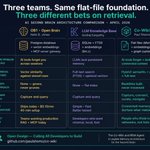
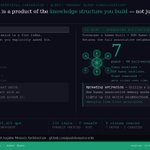
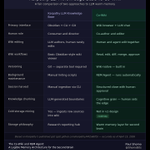
I published the Co-Wiki and REM Agent on April 12th, before these announcements: human-agent co-authorship, spreading activation traversal, a REM Agent consolidating memory the way sleep does. Manifesto + infographic: gist.github.com/paulshomo/69…

1
12
For 30 years, nobody connected that insight to AI memory. Karpathy's LLM-Wiki in April 2026 changed that. Google's Open Knowledge Format formalized it. DokuWiki shipped an agent plugin and MCP server to run on top of it.
41
Nobody asked the obvious question: what if the storage substrate itself was the presentation layer?
Ward Cunningham answered it in 1995 — natural language in flat files, pages linking to pages, the graph emerging from writing rather than from engineering.
7
Databases tried to close that gap. SQL made queries readable, but the underlying data still lived in schemas and columns — queryable, not browsable. NoSQL traded rigidity for flexibility rather than transparency. Vector databases are the purest machine-first architecture yet.
10
Machine code runs at 0.3 nanoseconds in registers no human can read. RAM holds opaque state; token embeddings are floating-point vectors requiring a decoder before they mean anything to a person. Every layer optimized for machines, not people.
1
16
Big news for my predictive design. Google just published the Open Knowledge Format — an open standard formalizing the flat file wiki pattern for AI agent knowledge bases. They credit Karpathy's LLM Wiki gist as the pattern being standardized.
The storage layer now has a spec. The retrieval layer doesn't. 🧵
Introducing the Open Knowledge Format @googlecloud cloud.google.com/blog/produc…

4
2
113
The convergence timeline:
* Dec 2025 — Pavlović et al.: spreading activation for graph RAG
* Jan 2026 — SYNAPSE: spreading activation for agent memory
* Apr 15, 2026 — Co-Wiki + REM Agent: complete design
* May 6, 2026 — Anthropic: dreaming / REM sleep metaphor
* Jun 12, 2026 — Google: OKF formalizes the storage layer
46
What OKF deliberately leaves unspecified: how to retrieve from that graph.
The spec explicitly excludes "prescribing storage, serving, or query infrastructure." Cross-links are intentionally untyped.
That's the gap the Co-Wiki fills.
29
OKF is markdown files with cross-links forming a knowledge graph. Readable by humans. Parseable by agents. Diffable in version control.
Exactly the flat file foundation the Co-Wiki was designed around. Published April 15.
2
40
Anthropic disables Fable and Mythos AI models after U.S. government bars it from giving foreigners access fortune.com/2026/06/13/anthr…
#AI #Cybersecurity

2
59
New government directive prevents access by, “any foreign national in the U.S., including Anthropic’s own non-citizen employees.”
22
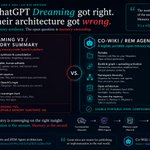
OpenAI shipped Dreaming V3 on June 4th. The coverage focused on what they built. Here's what they missed. 🧵
🤖 Made with AI

5
90
OpenAI got the algorithm right and the architecture wrong.
The future of human-LLM memory isn't a settings page locked in a cloud platform. It's a knowledge base on your filesystem.
Co-Wiki manifesto: gist.github.com/paulshomo/69…
32