

Reinforcement Learning and Fundation Model focused PhD student at UT-Austin. Eager to learn about the world 💔.
Austin, TX
Joined April 2022
- Tweets125
- Following557
- Followers173
- Likes371








Shuozhe Li retweeted

Thrilled to see our work on AI price reversal featured in The Wall Street Journal today! 📰
I enjoyed discussing the practical takeaway with WSJ: price alone should not be used to infer which model is actually cheaper. 💡
wsj.com/tech/personal-tech/a…

If you decided to be inactive during rebuttal period, please DON'T sign up for Reviewer or AC. This is insulting the academia and review system. @COLM_conf #COLM2026
None of the 4 reviewers responsed to my rebuttal! This is so disrespectful and insulting!

I spent a whole week staying up late and making my rebuttal but don't why but all of the reviewers and AC don't reply to even one of my responses 🤡😫😭 @COLM_conf #COLM2026
Shuozhe Li retweeted

Our paper “Post-Training Neural Network Pruning using Graph Curvature” has been accepted by TMLR!
Paper: openreview.net/pdf?id=kwACVY…
Code: github.com/SH-Tan/Post-Train…
Do we need full global attention everywhere?? If attention is often local + sparse + a few global sink.

Attention pattern analysis: sparsity, locality, and attention sink 🧵
1/3
Inspecting softmax(QKᵀ) under causal masking, I found many near-zero weights outside the masked region. These are not evenly distributed across heads;
256


Shuozhe Li retweeted

cant agree more

NEW test environment for offline RL. It will be great if prof.@nanjiang_cs can provide the data he collected over the break.

I complained for yrs being abandoned by mainstream gaming as learning curves in most action-heavy AAAs don't work for old man like me, until I discover... why service games deserve the money they make.
just a little embrrsing when students asked me what I did over the break 😅

2
245
Seriously? One day before ICML deadline? #ICML2026

Introducing Prism, a free workspace for scientists to write and collaborate on research, powered by GPT-5.2.
Available today to anyone with a ChatGPT personal account: prism.openai.com/
2
386
Although this paper is a year old, I still prefer this type of work which is not advertising but verifying.

Dr Fei-Fei Li says language models are extremely limited.
this @GoogleDeepMind paper makes almost the same point, but for video models.
The models are just very advanced pattern matchers.
They can recreate what looks like reality because they’ve seen so much data, but they don’t know why the world works the way it does.
The models can generate clips that look stunningly real, but when you test whether they actually follow basic physics, they fall apart.
The Physics-IQ benchmark shows that visual polish and true understanding are two completely different things.
Here, the authors build Physics-IQ, a real-video benchmark spanning solid mechanics, fluids, optics, thermodynamics, and magnetism
Each test shows the start of an event, then asks a model to continue the next seconds.
They compare the prediction to the real future using motion checks for where, when, and how much things move.
Scores then roll into a single Physics-IQ number that caps at what 2 real takes agree on.
Across popular models, even the strongest sits far below that cap, while multiframe versions usually beat image-to-video versions.
Sora is hardest to tell apart from real videos, yet its physics score stays low, showing realism and physics are uncorrelated.
Some cases work, like paint smearing or pouring liquid, but contact and cutting often fail.
----
arxiv. org/abs/2501.09038

1
163
Lovely example! Let's take it further, so the two kids will inherit some of the mom's preference but still having contradicting preference with her and each other🤔, how does our method handle that?

I wrote a short story to explain to my students the evolution of PPO, DPO, GRPO, to GDPO (NVIDIA's new paper). 👇
This story is based on my own personal RL journey to become the family chef. 🍳
(when my wife was my girlfriend)
𝗣𝗣𝗢 I wanted to cook a new dish for our next date. I hired an expert (my buddy) to try it and tell me whether it might be good. If not, I tweaked my cooking method and tried again. This loop repeated. My girlfriend (user) was not involved during the training time, until the date (aka, the inference time).
𝗗𝗣𝗢 I stopped cooking new dishes for a moment. Instead, I went back through all my past meals — successes and disasters. I replayed those scenarios in my head and asked: “What would I have done differently?” I updated my 𝘥𝘦𝘤𝘪𝘴𝘪𝘰𝘯-𝘮𝘢𝘬𝘪𝘯𝘨, not by trying new dishes, but by learning from comparisons.
(we got married)
𝗚𝗥𝗣𝗢 I’m out of past examples. And I didn't want to hire an expert anymore (I no longer lived with my buddies). So I cooked a bunch of dishes at once and simply watched: Which one did my wife eat more than the others? No expert judgment — just relative preference from outcomes.
(now we have 2 kids)
𝗚𝗗𝗣𝗢 Then life gets more interesting. Now we have two kids. That’s two additional reward functions.
Do I combine all their preferences into a single objective? Do I keep them separate? How do I optimize without one child dominating the signal?
This is where multi-reward alignment starts to matter.
#ppo #dpo #grpo #gdpo #aibyhand
3
144
Shuozhe Li retweeted

I really liked this new paper which finds that dense MLPs from transformers can be distilled well into much sparser MoEs. This makes it a bit less surprising that gradient-based attribution on dense MLPs shows only a few neurons are responsible for the bulk of behaviour. arxiv.org/abs/2512.18452

Quality > Quantity?
Can't wait LLM doing stream RL 💪🏻
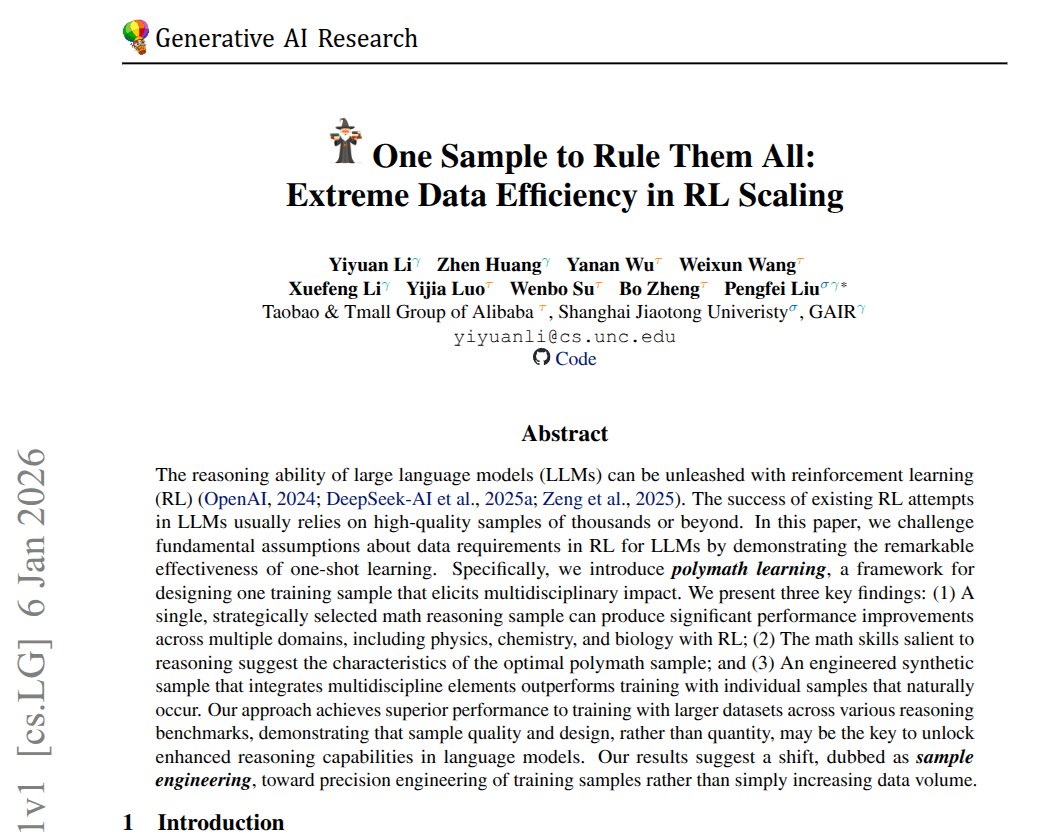
This paper tests if training on 1 question can boost LLM reasoning, and finds that it can.
Instead of more than 1,000 problems, the authors use 1 smart problem to improve reasoning across domains.
Most reinforcement learning for LLM reasoning assumes more than 1,000 checked questions are needed, which makes training slow and costly.
They call this polymath learning, where 1 carefully picked math problem teaches general reasoning habits, and they find algebra and precalculus, the math before calculus, matter most.
The authors train a base model with reinforcement learning, meaning it gets a score for the final answer, then measure changes on math, science, and general knowledge tests.
A well chosen algebra style sample can rival training on an 8,000 problem math set, and a made up problem that mixes physics, chemistry, and biology gives the strongest overall gains.
The paper's takeaway is sample engineering, designing 1 high quality training example on purpose, which the authors argue can beat piling up data and avoid overfitting, meaning gains that do not carry to new tasks.
----
Paper Link – arxiv. org/abs/2601.03111
Paper Title: "One Sample to Rule Them All: Extreme Data Efficiency in RL Scaling"
2
163
I believe it's the time going back to pretraining to look for the reasons!!

1/ New paper! "Wait, Wait, Wait… Why Do Reasoning Models Loop?"
Under greedy/low-temp decoding, reasoning LLMs get stuck in loops repeating themselves, wasting test-time compute and sometimes never terminating!
We study why this🔁 happens and why increasing temp is a band-aid

1
119

Only 26k math and 17k coding problems during RL training!?
Really!? That surprises me!!
DeepSeek-R1’s famous paper was updated 2 days ago, expanding from 22 pages to 86 pages and adding a substantial amount of detail.
mainly on the following areas.
- adds much clearer training story with 3 checkpoints, Dev1, Dev2, Dev3. You see what each stage teaches, from basic instruction following, to reasoning gains from RL, to final polish.
- explains the RL setup in more detail. they spell out reward rules for correctness, safety, and tidy language.
- Benchmarks are much broader. Beyond math and coding, it now covers general knowledge sets like MMLU and GPQA, plus human baselines, so results feel less cherry picked.
- There is analysis of how the model “self evolves” as it trains, for example more reflective steps and better error checks over time, plus many visuals and long appendices with data and infra details.

1
84