
Fintech, Blockchain, AI | Cricket, Politics, Food Founder https://xitter.cf/t.co/cpfsgDCdh1 & https://xitter.cf/t.co/x5luFdEZs8 (They aren't responsible for what I Tweet)
India | US
Joined December 2020
- Tweets823
- Following410
- Followers283
- Likes1.9K




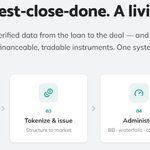





Financing had to link with asset register, which in turn has to connect with custody.
Once this trust layer is in place, given what AI can automate, and how assets and money can move on-chain, we can get down to 'Building Tomorrow's Markets'.
Look forward to sharing the @intainft approach to trust infra, on a panel with @snapdocs
@BNYglobal and @LowensteinLLP #ABSEast #structuredfinance @ftlive

To bring asset-backed finance on-chain, smaller deals have to be possible.
Smaller deals need investors who are excited about these opportunities. But these investors have no way to asses the risk or a returns in a complex, multi-layered asset class like structured finance.
We have addressed the risk issue over the years through verified assets backing the financing being on-chain, before financing.
Now, we are making the returns assesment easier with Ida, our AI agent.

Introducing IntainVECTOR: Structured Finance Intelligence, powered by Ida.
To bring new set of investors to structured finance on-chain, we need to make the asset class accessible. Accessibility does not mean simply listing a token. It means trust, and ability to forecast without a team of experienced modelers and analysts.
It’s our next contribution to democratizing asset-backed finance: building on our work to make smaller deals viable through efficiency and guardrails.
IntainVECTOR brings easy access to traditional statistical approaches, machine learning forecasts and Monte Carlo simulation to investment analysts and managers. Designed for use across asset classes, our deepest initial testing is in #HELOCs.
For sophisticated institutions, it offers another perspective to challenge assumptions. For smaller investment teams, Ida helps bring greater modelling and analytical depth within reach.
Learn more in the blog here lnkd.in/g-UzJA97 - and connect with us to pilot IntainVECTOR on assets you know.

"Among Plumbers and Punters in the Blockchain World, We are the Plumber", I wrote this, in a blog titled, 'The Boring Blockchain initiative' about our approach at @intainft . This was way back in Feb '19 when I saw many the crypto space fly too close to the sun.
So much of the recent news validates our belief to build ignoring hype cycles and token prices. And either be profitable or within striking distance of profitability (so that in any crisis, one flick of a switch can bring us back to profitability), because that is the only way to control our fortunes.
medium.com/intain/the-boring…

Based on some of the points I made at AI Governance Panel at the @SFAssociation - Aligning with the Operational Risk Management Framework siddhartha-sid.medium.com/ai…
I’ll be in Miami for ABS East and Private Credit Connect: East, and look forward to connecting with investors, issuers and trust intermediaries across asset-backed finance.
At the SFA Research Symposium on the #AIGovernance panel, we had some important conversations regarding AI, and agreed to continue the same in Miami - look forward to reconnecting with those leading AI initiatives in ABF.
If you’re an issuer seeking financing, an investor looking seeking #trust #guardrails in asset-backed opportunities, or a partner supporting these transactions, let’s connect. @intainft
#ABSEast #PrivateCredit #AssetBackedFinance
🤖 Made with AI

Discussions over Justin Drake's post, and some of the panels in the Institutional part of the conference, are rare valuable parts of #Token2049
Even on the institutional side, those whose book is crypto or mandate is digital assets still reading the brief on 'institutions are coming onboard, intermediaries will be challenged', with remarks about rent seekers; without wondering who are all the sponsors and participants at Token2049 if not rent seekers? (And more expensive ones than the 2-3 bps that BNY Melon or State Street charge)

Today I call upon the blockchain industry to calmly begin planning for "bunker mode". My personal recommendation is to set in motion a controlled mass migration of assets to fresh addresses, i.e. addresses whose pubkeys remain hidden behind a hash.
Holders, starting with large and sophisticated ones, should consider moving the bulk of their funds to addresses that have never signed a transaction. And when they do sign one, they should also move remaining funds to a new address (possibly generated from the same seed phrase).
Don't rush. While I believe there is cause for action a rushed migration would do more harm than good. Don't panic either. Moving assets to protected addresses is a simple, preventative step which does not require new cryptography or new wallets.
IMO it is now reasonable to brace for the possibility that ECDSA breaks before qday, in the worst case in months not years. By "break" I mean fast private key recovery (e.g. in one week) on available hardware (e.g. a large GPU cluster).
Recent days have been humbling for human mathematical intuition. Long-held, unquestioned hypotheses have fallen. This includes the n log(n) bound for integer multiplication and the 3SUM conjecture. In hindsight, May's unexpected disproof of the Erdős unit distance conjecture was our warning shot.
Yesterday's OpenAI drop made it clear that mathematical superintelligence is upon us. They say there are weeks where decades happen. We are about to live through weeks where centuries of mathematical progress happen. Could our magic 64-byte ECDSA signatures be too good to be true? Was it just security through obscurity all this time?
Elliptic curves feel especially vulnerable to superintelligence. Curves carry rich structure, with room for fancy tricks like Schoof, Frobenius, pairings. (By contrast, hashes are designed to minimise algebraic structure.)
Separately, as Ewin Tang can attest, an efficient quantum algorithm sometimes foreshadows an efficient classical one. We should be open to the possibility of a classical counterpart to Shor that breaks elliptic curves and RSA at once.
Also noteworthy is the striking under-representation of cryptographic breakthroughs among the 722 mathematical results OpenAI published. I've witnessed first-hand the US government censoring academic quantum cryptanalysis results. Backroom interventionism is my base case.
I urge large, sophisticated actors to lead by example. Project11's "risq list" (bitcoin-risq-list.projecteleven[.]com) is a great tracker of exposed BTC pubkeys. Binance, Bitbank, Robinhood, Bitfinex, and Tether have an opportunity to harden their cold storage. Next month I'll address institutions in London in a live Q&A (forum.ethereuminstitutional[.]org/london-2026).
Again, please do not rush. Wallets holding under 50 BTC enjoy partial cover from "Satoshi's shield", i.e. his 20K exposed addresses that hold 50 BTC each. Load-bearing signers like oracles and L2 security councils should consider rotating ECDSA pubkeys with every signed message and/or multi-signing with a hash-based schemes like SPHINCS.
Exiting bunker mode safely will require post-AI cryptography. My inclination is to go all-in on hash-based cryptography and avoid structured mathematical assumptions entirely, whether from curves, lattices, or isogenies. A single battle-tested hash (e.g. from the SHA or BLAKE families) yields plausible post-AI security.
The Ethereum roadmap on strawmap[.]org fully embraces hash-based cryptography with end-to-end formal verification as a response to the quantum threat. Those timelines must now be revisited and accelerated in light of mathematical superintelligence. I'll be pushing for maximum defensive acceleration.
If you are a wealth manager, asset manager or a vault curator, participating in #Token2049, looking at asset-backed investment opportunities where underlying assets are certified on-chain (as was the case in this POSCO receivables financing), drop a note
mbiz.heraldcorp.com/article/…


Amazing stuff considering how most government websites in most countries are.
Maybe @kunalb11 should offer help to the Indian government where so many of the websites landing pages are collection of hyperlinks @AshwiniVaishnaw

A new national front door to the federal government.
One trusted place to help people find answers. Whatever you need from government, start here: AMERICA.GOV

I’ll be at #TOKEN2049. The Morpho-triggered debate puts two RWA challenges in focus:
- transparency beneath the token and
- economics that survive the fee stack.
Intain’s approach: verified asset provenance, ongoing monitoring and AI automation to lower the cost of institutional trust.
Investors, vault curators and infrastructure providers—let’s connect. DM me to meet.
#Transparency > #Trust > #Liquidity (in that order)

Why the full stack technology built, tested and scaled over years matters (400K loans, $40B in AuA); that just tokenization cannot substitute
@intainft

Whether Morpho's post was genuine or not is immaterial. Whether web3 disintermediates or re-intermediates at even higher cost, is the debate that matters.
The debate triggered by the recent @Morpho post raises a question bigger than any one protocol (which is being unnecessarily vilified - even if that was AI gone rogue, be thankful that a real debate has started) : does the new intermediation stack make financing work better?
For asset-backed finance, the test is straightforward: how does tokenization achieve (a) lower costs, (b) visibility into the underlying assets, and (c) credible access to capital and liquidity.
Tokenization is not the product. Improved terms of financing is.
thedefiant.io/news/defi/morp…

Some very interesting stuff with respect to document understanding (that we depend a lot on at @intainft for asset verification).
Our approach is to breakdown down the process in sub tasks, so that we can built in HIL controls at each step (e.g. we would use separate classification model to identify the document, before extraction - reason is that, post HIL review, we need to have 100% assurance that we identified the document right).
We had tested sometime back, with all-in @llama_index as well as separate using of extraction only.
Need to revisit.

We benchmarked 20+ open-weight models on easy-to-hard document extraction tasks through ExtractBench. The results are all available on @huggingface 🤗
ExtractBench is a schema-guided extraction benchmark that contains 4.8k+ pages across 8 domains and 67 document types, with a mix of short, medium, long docs and simple/complex schema.s
The results reported is a measure of “value accuracy” through unified F1.
✅ Qwen 3.8 leads the pack
✅ earlier generations of Qwen models are also quite strong
✅ kimi-k3 is the next best.
GLM-5.3-flash and qwen 3.8 flash also just released today - hopefully will have results on these soon!
Note : these results don’t include visual grounding (whether each value is mapped to the right bounding box) and confidence scores. When you include these, it is increasingly clear why specialized OCR tools (like LlamaParse) matter, since this is metadata that’s hard to DIY by prompting the raw model.
Come check out our HF leaderboard: huggingface.co/datasets/llam…
Learn more about ExtractBench here: extractbench.ai/

This transaction demonstrates how AI-enabled asset verification and a trusted blockchain register can re-establish collateral integrity in receivables financing.
Recent cases involving #FirstBrands and #BankimBrahmbhatt have brought renewed attention to one of the risks in receivables financing : there is lack of a reliable way to establish whether the underlying invoices exist, reconcile and have already been financed elsewhere.
The transaction was executed on Intain’s Layer 1 network on the @avax.
@justinkim415 thanks for introducing POSCO to us.


AI-enabled verification integrated with a trusted asset asset register of verified (and tokenized) assets. This is a pre-requisite when for asset-backed finance tokenization for us at @intainft

At the recent #SFAResearchSymposium , on the AI Governance panel, I had the chance to share @intainft 's experience with AI implementation in structured finance.
Here I have recapped the points I made: linkedin.com/pulse/ai-govern…
🤖 Made with AI

Asset-Backed Finance does not have to accept #Tricolor, #firstbrands and #bankimbrahmbhatt simply as the cost of doing business.
AI-enabled verification combined with a blockchain based asset-register will significantly mitigate the risk.
@intainft demonstrated this in a cross-border receivables transaction.
@newsgreenstreet @SFAssociation
