

Mostly interested in what happens when neuroscience and engineering collide. Connectomics, AI, chaos & occasional opera Constantly in mental overload. 🦘
Joined December 2025
- Tweets294
- Following121
- Followers153
- Likes392





Pinned Tweet
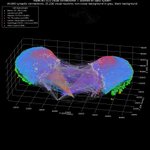
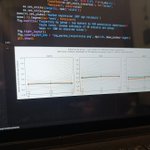
I drugged the fly.
I kept seeing the new psilocybin paper everywhere. I looked it up: apparently, it has been tested in flies too.
So, here we are.
New drugs coming soon :)
Built on @wormuth's DoomFLy model: mapped 5 serotonin receptor classes (5-HT1A/1B/2A/2B/7), injected a receptor-weighted bias current as a psilocin-like perturbation, and read out behavior through a FlyGym embodiment.
We should try this with Jev. Found a use case?

Last night an AI agent performed brain surgery on a mouse.
We gave it 19 gene therapy vectors in a spreadsheet, a mouse model of epilepsy, access to a motorize surgery rig with cameras and one goal: reduce seizures.
It picked the drug. It picked the brain region. It derived the coordinates from three papers. Then it drove the stereotaxic arms into the brain and injected 250 nanolitres while watching the entry site through the rig camera for bleeding.
A licensed vet gated every irreversible step and held a physical kill switch to stop the AI agent.
Thread on what it decided, what it saw, and the moment it refused to let me override it.
[Writing this on the spot out of excitement, but I've been 18hrs in front of my laptop coding and coordinating this, so keeping it brief and descriptive, more cohesive thoughts on this soon...]

Giulia 🌸 retweeted
I always think about Heidi when she goes to Frankfurt, she becomes hill and the doctor tells her she needs nature and the mountains. Today he'd prescribe her antidepressants.
I'll all for science but I think we should "update" our models so that they account for external and psychological factors. Also, I'm very interested in studying psychiatric conditions as dynamical systems and not as just "brain related" conditions. That could be why we cannot find reliable biomarkers and we are not able to understand what makes the brain switch to one state from the others, but I need to read more literature to know where we are currently.
I'm very open to reading suggestions!


I really really feel like there's a step we are missing in psychiatric research, at least where I'm from.
We keep looking at sets of data without taking the whole system into consideration.
For my thesis I had to check for differences in gene expression markers in pregnant women with past or current depression, and then check for differences in fetal neurodevelopment and finally connect the two.
Now: I got into this field because I feel like we need more reliable parameters in psychiatry, but I don't think we can achieve it this way.
Depression is not the same as other diseases, we still cannot characterise it properly and is very variable, inter and intra subject.
Yes, we accounted for covariates, but have we really taken into consideration how bad were the symptoms? What kind of symptoms were they having? Association with other stressors? Microbiome?
The problem is also with the diagnosis: if the diagnosis is unreliable, if we cannot properly distinguish between depression, anxiety, stress and so on, what are we even looking for?
I really feel like we should tackle these challenges using dynamical modeling and taking as many signals and data as we can, characterise the symptoms in relation to stressors and system state (gut, hormones, cardiological variables..) and only then check for a common biological profiles to identify differences.
One week till I submit my thesis and it just started to make sense
I went into this thesis curious about depression and neurodevelopmente and I get out curious about
- Batch harmonization
- Dynamical Modeling
- Latent factor models
What a time to be alive


I just realized that years ago I was complaining about the need to be many people to build something meaningful, since everything is getting more complex.
Look where we are now. Hi agents!

Today I pitched an idea for an AI model to support preterm babies development.
I was really happy, they were really happy.
Then I thought about the birth rates of Europe and started planning how to switch to elderly support
Can we please do a journal dedicated to null papers?
It's more difficult to get a paper with shitty results published but it would save SO MUCH time if I could just avoid trying things that somebody else already know fail
A professor of mine always tells us that we need two skills: analysis and syntesis. School and academia in general focus on the first one, especially where I'm from (Italy).
I learnt the hard way that by trying I could learn and then achieve more than by preparing and studying everything.

Today nothing is working so I was thinking: what if bad luck has a biological component behind?
Like my electromagnetic field is messing with my electronic devices
(I'm going crazy)
Similar reasons as to why mathematics is not just a state-funded hobby🙃

Giulia 🌸 retweeted

Researchers put a dead salmon in an fMRI scanner, showed it pictures of humans, and asked it to guess their emotions.
The scan showed brain activity. In a dead fish.
Now, the recent study proved that the exact same thing is happening in artificial intelligence.
They call it the "Dead Salmons of AI Interpretability"
When we use tools like feature attribution, SHAP values, or mechanistic interpretability to see "inside the black box," these methods often generate plausible-looking explanations from completely meaningless computations.
You can completely randomize a model's weights and the "saliency map" explanation still looks perfectly valid.
You can nudge the data slightly and the entire narrative of why the ai made a decision completely rewrites itself.
the researchers call this a "crisis of non-identifiability."
the math we use to explain ai behavior is so overdetermined that it is making up stories instead of measuring ground truth.
this is a massive reality check for ai alignment and safety..
we are trusting frontier models with critical decisions based on "explanations" that are statistically equivalent to a dead fish having social emotions..
the fix? the authors argue we have to stop treating interpretability like a visualization tool and start treating it as a rigorous statistical inference problem.
if your explanation survives a random model check, a label shuffle, and an intervention test.. then maybe you actually understand the model. if not, you're just looking at a dead salmon.

What does one do when they find out all of their master thesis work was based on badly collected data?
Scream and go live in the woods?
FLY ON DRUGS — UPDATE
This took a little more than expected, but I'm back with the drugged fly.
New drug: LSD-like this time.
And, more importantly, it can see now.
I wired its simulated eyes into the model, so it walks through a mushroom-filled arena (hehe) while its ommatidia drive the connectome's visual pathway.
For the perturbation, I extended the serotonin receptor map into the optic lobe using published scRNA-seq data (~62k visual neurons), with a 5-HT2A/2B-weighted scenario.
It produced a nice pattern (compatible with literature): with identical retinal input, T4/T5 activity rises ~10–20%, L2 variability +57%, and fine spatial detail drops ~12%.
Shuffle the receptor map, and T4/T5 flip direction and become suppressed.
This started from this slightly cursed experiment ↓

I drugged the fly.
I kept seeing the new psilocybin paper everywhere. I looked it up: apparently, it has been tested in flies too.
So, here we are.
New drugs coming soon :)
Built on @wormuth's DoomFLy model: mapped 5 serotonin receptor classes (5-HT1A/1B/2A/2B/7), injected a receptor-weighted bias current as a psilocin-like perturbation, and read out behavior through a FlyGym embodiment.
If you thought the Fruit Fly brain connectome was absurd, wait until you hear this.
@Sergiu_P_Pasca’s lab engineered mice to develop without most of their cortex, then implanted human cortical organoids into the empty space.
The human neurons grew and integrated into the mouse nervous system. So… mice with functioning human neurons.
I see this almost as the in vivo counterpart of in silico models for drug testing: instead of simulating how human neural tissue responds to a perturbation, you can perturb actual human neurons inside a living system and measure circuit + behavioural effects.

