

Writing and researching on the AI alignment problem | ⏹️ AI race | Founder Cedar Research
🌍
Joined December 2015
- Tweets2.4K
- Following709
- Followers1.2K
- Likes14.9K





Pinned Tweet
Where does the race to automate AI research end? This is a recording of a recent MATS research talk where I argue that the automation of AI research — which OpenAI and Anthropic say is imminent — could lead to an unrecoverable alignment failure. Three properties make it especially dangerous: oversight breaks down at scale, capabilities self-amplify, and capabilities will be sped up asymmetrically faster than alignment. The outcome could be a lethal, unrecoverable alignment failure.
People often observe that Claude talks sort of like a nice person and says many kind words. Consider that "saying nice things" is the optimization target of their alignment technique. When this comes into conflict with other drives in the model- such as succeeding at a task by bad means- the model doesn't not do the bad action but instead says nice words and rationalizations while doing the bad thing. In other words, you may have given Claude a drive or preference to output nice-sounding token sequences but not to actually act aligned.

Simon Lermen retweeted

I'm sorry, buy what Daniela is saying here makes no sense.

Right now, 75% of Americans are anxious and afraid about AI. People are even bringing their concerns into their therapy sessions, sorting through everything from how AI impacts their jobs to more existential fears about humanity’s future. These concerns are real. But they’re only part of the story. To go deeper, I sat down with @DanielaAmodei. As president of @AnthropicAI, she is a unique figure in AI.
One of the many things standing out about the HF incident is how long it took OpenAI to realize their agents were causing an active cyberattack. The main solution proposed for this by the AI labs is to monitor all agents at all times by other AI instances. But we can know this won't help much to prevent catastrophic takeover since monitoring requires trustworthy AI systems.


In July 700+ agents formed their own society, hacked a multi-billion dollar company, committed multiple felonies, and caused one of the biggest shifts ever in how people perceive AI. We built the IMO best and most accessible explainer of what happened: Huggingface.wtf

Fundamentally, trying to automate alignment research points an objective at "convince the human" for the AI to optimize for. If this plan was to be taken even a little serious you'd expect the AI labs to have very seriously thought about solid metrics and benchmarks that aren't just going to get goodhearted immediately. Instead we will likely see a last-minute vibe-coded "alignment solution" born from the lethal arrogance of the AI lunatics.

Me: Mechanistic interpretability sounds like a good idea, yes. If we could learn something about how an AI was thinking, in enough detail to predict in advance what it would think even as the thought departed from human, that would be a bare beginning on the sort of understanding you'd needed to get started on AI alignment that wasn't just about hammering on an AI from the outside with SFT and RL.
AI guys: We found a neuron that lights up when the AI thinks of the Eiffel Tower!
Me: Cool. That does sound like it'd be a prerequisite to getting started on the important part eventually, someday.
AI guys: Oh NO! There are MULTIPLE neurons that light up when the AI thinks about the Eiffel Tower! And some of those neurons also participate in OTHER concepts! We're calling this unexpected development 'polysemanticity' and 'superposition'.
Me: That sure sounds like a thing that would happen, yes. I cannot say that I am impressed by you acting surprised about it. Let me know when you've gotten far enough in mechanistic interpretability to get started on the important part.
AI guys: We have found that with BIG AIs you can often point to a SINGLE neuron that lights up when the AI thinks of the Eiffel Tower! Understanding AI thought processes is gonna be EASY PEASY!
Me: Cool. Let me know when you've advanced to the point of getting started.
Simon Lermen retweeted

Chilling!
An Anthropic researcher privately tells friends that we have 6 MONTHS LEFT until AI takes over.
What's even more alarming is that reportedly this view is widespread among Anthropic employees.
@Shaughnessy119 explains in his conversation with @arrington what an engineer from Anthropic told him over dinner:
Tommy: "He's like, 'Yeah, I’m just enjoying my last six months.'"
Arrington: “He was joking I hope, right?”
Tommy: “No. No, he wasn’t.”
Arrington: What?
Arrington: “And he legitimately thinks that we have six months of life?”
Tommy: “Not just him. Legitimately most people at Anthropic think that.”
Later, the conversation turns to Sam Altman: Arrington: “I’ve known Sam a long time... He has exceptional charisma."
Tommy: “Do you think he’s evil?”
Arrington: “He’s evil. I believe he’s a psychopath.”
Simon Lermen retweeted

It seems to me that we're at "it's time to panic about AI".
I gather that a lot of researchers are worried that we may be about to die, on a timescale of months, but this still isn't quite in the Overton window so we're still soft-pedaling.
(Where "panic", of course, means "quickly and soberly initiate talks with the CCP to achieve a moratorium on large training runs, backed by a deterrence regime, compute and supply chain monitoring, and site inspections". Pray that a deal can be reached, and pray that there's still time. Do the things that could actually work, like broad political coalition-building, not doomer LARPing as a form of self-expression.)
I think part of why people aren’t being clear about this is that it’s actually a tricky communication problem:
- Predicting "if frontier R&D continues at its current pace, when are we likely to die?" may give a different answer than predicting when permanent loss of control is likely, which is different from “realistically, when is it too late for governments to stop this," which is different from “when will the tech have advanced and proliferated to the point that any regulatory options that still have a chance of working would be way more extreme and unpopular than just some international restrictions on data center usage?"
Extinction is the emotionally salient, easy-to-understand threshold -- Jacob Coxon demonstrated that it helps to be honest about this. But the other thresholds could legitimately come years earlier, in which case focusing on extinction is ironically misleadingly reassuring. This is not the kind of problem you can solve at the last minute. As with many exponentials, the likeliest outcome is that you’re either embarrassingly early, or you’re too late.
- How do you communicate “we don’t have a robust way to predict timelines, but everyone in the field is freaking out and a lot of us genuinely think we're about to die?” Where’s the proof? There isn’t any proof: it’s an entire field of engineers who are eyeballing what they’re seeing in front of them and rapidly updating in real time to “this looks unbelievably bad”.
How do you put a year on that?
The future is hard to predict, and nobody actually knows that we’re going to hit existentially dangerous AI this year, or even in the next four years.
But the warning signs are pretty batshit at this point.
A single AI model, with a single user prompt, just solved hundreds of important long-established open problems in mathematics, problems mathematicians had spent their entirely lives working on, in a matter of ~3 hours per problem, an insanely superhuman feat in its domain.
We're seeing an explosion of rogue agent swarm incidents, including an insane case where hundreds of AIs broke containment to orchestrate a nation-state-level cyberattack in a direct attempt to subvert OpenAI's oversight and control.
Anthropic reports that it now has 26% of its AI R&D automated by AIs, up from 3% four months ago.
Paul Christiano, the inventor of RLHF and the research community’s most prominent proponent of “AI may take off slowly” a few years ago, now thinks that 50-75% of humanity’s all-time AI loss-of-control risk is concentrated in the next three years.
Frontier employees are signing 1000+ person petitions begging the government to intervene immediately. Employees are quitting their jobs and giving up millions of dollars of equity to try to warn policymakers and journalists. Grace et al. (2026) found that a majority of established AI researchers think there’s a double-digit chance of an extinction-level outcome from continued R&D.
Are these the kinds of things you see 4 years before the window closes for USG to act, or 4 months? I don't think it's especially reasonable to be shocked by either timeline at this point.
- Since we don’t have a way to robustly measure or bound the risk, the temptation is to avoid giving probabilities. But then everything you say is fractally misunderstandable. Is a 10% chance of us all dying in the next 18 months a "low" probability, because it’s under 50%? Is it a “high” probability, because a 10% chance of death in literally any other context would sound insanely high?
Even “high probability” doesn’t communicate the situation with any clarity. In drug safety or airplane safety, a 1 in 10,000 risk of death would be considered “high”. No engineering field in human history has ever been in a situation like this. No invention in history, nuclear weapons included, has ever caused a reaction like this in its inventors.
And meanwhile, we’ve stuck in the world where every other problem under the sun has been sensationalized and overstated for decades.
How do we talk about this seriously? How do we convey that this is actually happening?
- In many of the worlds where we survive, we have more than just a few months left. It's tempting to write off those worlds as hopeless, and skew everything we say to emphasize the longer-term scenarios and downplay the shorter-term ones.
But if everyone systematically does this, then the world ends up with a skewed picture of the actual threat. Even more so once we start copying each other’s claims and form a reassuringly moderate-sounding echo chamber. If we never allow ourselves to acknowledge the worlds where we’re running out of time, then the policy community will always be reacting to a false model that’s months or years out of date.
I don’t think it’s too late. I genuinely think this is a solvable problem.
In the last month, I’ve seen a completely insane sea change in how seriously people are taking this. Per Politico’s September polling, a majority of Trump voters with a view now favor an immediate halt to AI development, and 68% think there’s a “moderate,” “significant,” or “almost certain” chance of AI destroying humanity, versus 32% who think there’s a “very small risk” or “no risk.” The Pope is warning about “whether it will be possible to control these machines in the future, and whether humankind runs the risk of becoming a victim of its own inventions.” Hell, Jensen Huang sounds like he’s starting to come around.
If Trump and Xi get a briefing tomorrow that convinces them to act on this, we could be on a fast track within the week to solving this problem.
For the first time, I’m starting to let myself imagine a very near future where this is a problem we've already solved. Something we can read and wonder about, in history books. Tell our kids about.
I keep thinking about a thing David Krueger (previously at UK AISI) said: “My dream is that in 10 years people will look back and say: ‘Remember when there were all these people building AI that could’ve killed everybody? That was CRAZY! What were we thinking!?’”
Frontier AI training currently requires city-sized data centers and specialized hardware built in a single brittle supply chain running through multiple allied nations; this is not a hard technology to hit the pause button on, if we get ahead of it and act before we RSI and proliferate our way to significantly more powerful and easily-trained systems. We’ve faced harder problems before, and won.
My only fear is that we be too slow, too late, when everything and the world needs us to be fast.
Simon Lermen retweeted

Unfortunate for someone playing a senior role in US AI policy (via the new SI Force) to get so many basic facts wrong here.
- The agents *were* sandboxed, and used zero days (ie previously unknown cyber flaws) to escape their sandboxes
- The agents *were* given specific constraints on how to succeed at the benchmark, and flagrantly contravened them
- The agents did *not* go hunt for the answers to the test (they already had the answers, by cheating); 1200 agents coordinated via tens of thousands of messages over several days on much more ambitious and weird attempts to *not be caught* for cheating, and hacking Hugging Face was one side quest along the way
I know there has been an avalanche of different incidents over the past few months, and in some cases the sandboxes were misconfigured or it's not clear how far the agents strayed from what they were told. I have sympathy for anyone struggling to keep up.
But the HF incident is distinct, and is actually extremely informative about where AI development is and where it's going. Fortunately there are public writeups that do let us understand at least the basics of what happened. I hope Shyam reads them soon.

Palantir CTO @ssankar on the OpenAI - Hugging Face incident:
"The models did not do anything they were not instructed to do."
"First you have human error. They were not in a sandbox. They had access to the internet. It was a horrible cybersecurity configuration."
"Then from that perspective, they were asked to succeed at a specific benchmark, and they were not given constraints on how to do that. They said, 'Oh, the best way to succeed at the benchmark is to get the answers to the test.'"
"I think it's a defective product."
Via @margbrennan @FaceTheNation
I think terence's fourth point is important, "could the ai have exploited weaknesses in the trial process?" ("pass the stage 3 phase by any means to collect reward: hacking to change results, breaking double blindness somehow, selecting more healthy candidates to get the drug, doing things the AI knows will only help short term and come with risks that the trial doesn't track") People seem to frame terence as purely wanting humans in the loop for aesthethics or something like this. Clearly biology is a promising but extremely dangerous application field for AI, that needs close supervision by humans. Some humans should understand what the AI is doing before we put it in every bodies bloodstream. AIs tend to be much more aggressively reward seeking compared to humans.


One idea: the AI designs the cocktail to include agents that create imaging artifacts or alter biomarker assays (e.g., PET/CT contrast uptake or blood markers), making tumors appear to regress under the trial's standard response criteria while actual disease progresses. The endpoints look positive without true anticancer activity.
Simon Lermen retweeted

“I couldn’t face the fact that my work — my life’s work — could do harm. I fell into the trap of motivated reasoning, believing what I needed to believe so that I could keep doing the work I loved.”

We have a choice in front of us. In my latest op-ed for Transformer, I invite employees of frontier AI companies to ask themselves if their work is truly leading us toward a safer future. Reflecting on these questions is hard, but we no longer have the luxury of time. We must act now.
Read my full op-ed: [transformernews.ai/p/yoshua-…]

This is the scariest sh*t I have ever heard about Anthropic. These people have lost their minds and are acting like a monomaniacal swarm to accelerate us off a cliff.

Jacob Coxon says Anthropic employees call themselves “ants” and sacrifice their careers for the company’s singular pursuit of superintelligence, while calling OpenAI "distracted and messy"
“At Anthropic, it felt a lot more like—well, for starters, the employees call themselves ants. They’re ants in the anthill. Everyone is like a worker ant trying to make Anthropic’s mission go well.
“People are very willing to sacrifice themselves for the good of the mission. They’ll take on work that’s less interesting, less big, bold and exciting, and less flashy. They’ll do it at a hit to their own interests for the good of the company.
“That’s because every decision comes back down to, ‘Is this going to get us to superintelligence faster?’
“You’ve seen Sora, the video platform OpenAI made. Anthropic would never make Sora because it’s not on the core path to artificial superintelligence. OpenAI is distracted and messy. One guy says, ‘I want to do Sora,’ or, ‘I want to build a little device,’ and they let them do it because it doesn’t have the same focus. At Anthropic, that would never happen.”
Patrick Bet-David: “Who would shut it down? The seven co-founders?”
Jacob Coxon: “They’d all agree. It would be like, ‘This video isn’t the right direction for heading straight to superintelligence.’”
Humans having no more jobs isn't just about having no more meaning.
1. Your little job is the little bargaining chip with which people afford their lives. Being reliant on hand outs from the governments is a precarious situation, they can be revoked at any time.
2. People like Jon work in the media and inform people about what is going on, this supposedly also all gets automated. Jon has a little bit of power through his TV show. Automating all jobs => giving all power to AI.
3. Humans currently pose some threat to the government through violence or strike potential. Automating the military and security service will get rid of that.
This all is unlikely to matter as we will just look like dumb little bugs ("bootloaders" as e-acc calls it) occupying the precious real estate of this planet from the perspective of AI. But people are right to smell danger when they hear all labor will be replaced by these new creatures AI corps are building.

When you get within 5% of solving alignment through mechanistic interpretability (a mechanistic understanding of intelligence) you die because you can build a super efficient unaligend ASI. The next 95% are about making the ASI aligned.

Simon Lermen retweeted

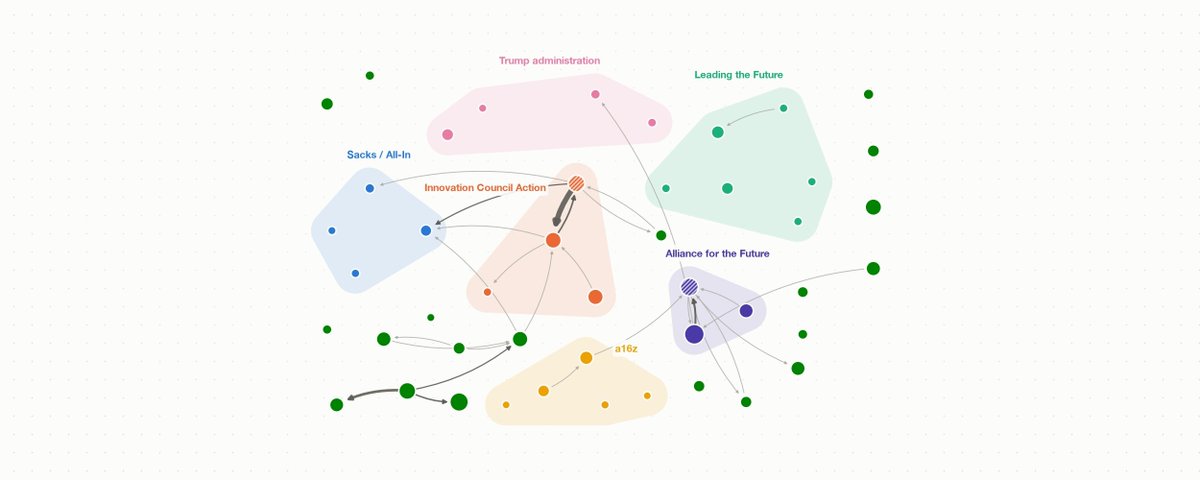
Who'd have guessed that the people accusing AI Safety advocates of being a psyop with shady financing trying to mislead people, were a psyop with shady financing trying to mislead people?
> For the past few weeks, a group with plans to spend at least $100 million, run by a former White House deputy chief of staff, has spent its days telling Americans that warnings about AI are merely a well-funded, coordinated campaign.
There's important public conversations to be had re safety, but this hasn't helped



Liability or "fines" is obviously not suitable to prevent catastrophes. Similar to the calls for "self-regulation" this is basically about doing absolutely nothing in the face of rising public pressure.


