

Welcome to Slow Reads by The Daily Star. Your go-to section for long-form storytelling that goes beyond the headlines.
Joined September 2025
- Tweets976
- Following11
- Followers82
- Likes6





After decades as a major manufacturing nation, Bangladesh still relies heavily on foreign professionals to manage production, sourcing and logistics. As the country moves into more complex industries, this dependence exposes a critical gap in its domestic workforce.
Read the full article: thedailystar.net/slow-reads/…
.
.
.
.
.
#TheDailyStar #SlowReads #Manufacturing #BangladeshEconomy #SkilledWorkforce

4
Often referred to as the ‘Jim Corbett of Bengal’ by the popular press and educated folk, Pachapdi Gazi killed 53 tigers in the Sundarbans—20 of which were ‘man-eaters’—before he officially retired as a hunter after the independence of Bangladesh. Gazi killed most of his tigers in the Sundarbans during the East Pakistani era (1947–71), when tigers were not considered iconic conservation species.
Read the full article: thedailystar.net/slow-reads/…
.
.
.
.
.
#TheDailyStar #SlowReads #Sundarbans #WildlifeConservation #BengalHistory

10
Kagmari was a rebuke to those in the power, who thought politics could only happen in modern spaces. Bhashani, through Kagmari, had shown that peasants, and other marginalised constituencies, were as modern, progressive and capable of political thought as their urban and elite counterparts. The Sammelon was a manifestation of Jacques Ranciere's "principle of axiomatic equality—the equality of anyone with anyone", a space of radical equality.
Read the full article: thedailystar.net/slow-reads/…
.
.
.
.
.
#TheDailyStar #SlowReads #MaulanaBhashani #KagmariFestival #BangladeshHistory

9
Bangladesh fronts the Bay of Bengal and sits at the crossroads of South Asia and Southeast Asia. As economic power shifts towards the Indo-Pacific, this location gives Bangladesh a unique opportunity to play the role of a regional and inter-regional node and hub, serving as a meeting point for trade.
Read the full article here: thedailystar.net/slow-reads/…
#SlowReads #Bangladesh #SoutheastAsia #BIGB #RegionalTrade

6
For many Bangladeshi students, the dream of studying abroad begins with a cinematic vision of new cities and freedom. But reality often hits hard and fast. It can come as an academic shock when you realise everyone in your classroom is already ahead of you because of a different curriculum, or as the quieter strain of financial anxiety and a bare-minimum work-life balance. Behind the curated Instagram photos of cafe visits and graduations lies a different story: sleep deprivation, money worries, and loneliness. International students become remarkably adaptable, but in the process, a part of them quietly fades.
Read the full article: thedailystar.net/slow-reads/…
.
.
.
.
#TheDailyStar #SlowReads #InternationalStudents #StudyAbroad #StudentLife #MentalHealth #Australia #Bangladesh

8
Many scientific men thought that science could supplant the messiness of politics in settling questions of group identity and political belonging. The polymath Sir Brojendra Nath Seal had long advocated a scientific approach to settling issues of national composition and future development based on concrete, measurable numbers. But he had never gotten further than the idea. The challenge of how to turn something as complex as human political identities into simple numbers was left to his juniors to work out.
Read the full article: thedailystar.net/opinion/foc…
.
.
.
.
.
#TheDailyStar #SlowReads #RaceScience #Anthropology #ColonialHistory

14
How should we understand the political history of Bengali Muslims beyond the familiar narratives of religious nationalism and secularism? In this Slow Reads interview, philosopher Akeel Bilgrami revisits the Khilafat movement, the politics leading to Partition, the emergence of Bengali nationalism, and the changing place of religion in Bangladesh’s politics.
Read the full article: thedailystar.net/slow-reads/…
.
.
.
.
.
#TheDailyStar #SlowReads #BangladeshHistory #BengaliNationalism #MuslimPolitics

It is encouraging that labour migration from Bangladesh to Malaysia is likely to resume at the end of this month. However, given the history of repeated suspensions, a more important question is whether this renewed initiative will address the structural problems that have long plagued the recruitment process.
The recurring allegations behind these suspensions include corruption in recruitment, exorbitant migration costs, indebtedness, unemployment and severe exploitation of migrant workers.
Read the full article here: thedailystar.net/slow-reads/…
#TheDailyStar #SlowReads #BangladeshMalaysia #LabourMigration #MigrantWorkers

With about 37 million inhabitants, Greater Dhaka is now the world’s second-largest metropolitan region. Yet as development pushes eastward, a critical question remains: is this expansion guided by a coherent vision, or is urban planning simply serving as cover for real estate accumulation?
In this Slow Reads piece, Mushahid Hussain traces the competing interests, geopolitical shifts, and local realities that are reshaping Dhaka's urban fringes, from land brokers to displaced farmers.
Read the full article: thedailystar.net/slow-reads/…
.
.
.
.
.
#TheDailyStar #SlowReads #GreaterDhaka #UrbanDevelopment #Bangladesh

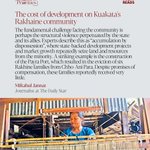
For over 250 years, the Rakhine community cleared the forests and shaped the land that is now Kuakata. Today, they are disappearing. A population that once numbered over 50,000 has dwindled to barely 2,200, driven by land grabbing, forged documents, and state-backed development projects that displace them without fair compensation. They have lost their farms, their temples, and even their cremation grounds to encroachment. Without legal protection, political representation, or social safety nets, this indigenous community is being pushed into silence. Displacement is rarely a single event; it is a slow process that makes people strangers in their own land. Without urgent intervention, the Rakhines of Kuakata will continue to vanish.
Read the full article: thedailystar.net/slow-reads/…
.
.
.
.
.
#TheDailyStar #SlowReads #Rakhine #IndigenousRights #LandRights #Kuakata #Bangladesh

Almost all of Syed Waliullah’s fiction has a sad ending. Perhaps losing his mother when he was very young left a void in his life, which is reflected in much of his fiction. The tone of nostalgia and gloom, perhaps what may be called an existential despair, is present in many of his stories, whether written in Bangla or English. Through his three Bangla novels, Lal Salu, Chander Amabasya and Kando Nadi Kando, Waliullah explores loneliness, moral responsibility and the struggles of human existence. His fiction also reflects his life away from his homeland and his enduring connection to Bengal.
Read the full article: thedailystar.net/slow-reads/…
.
.
.
#SlowReads #SyedWaliullah #BanglaLiterature

South Asia is now confronting a new generation of risks, vulnerabilities and security threats that are largely non-traditional and transboundary in nature, requiring coordinated action by both state and non-state actors. The evolving security landscape demands a fundamental rethink of how regional cooperation is understood and practised.
Read the full article here: thedailystar.net/slow-reads/…
#SlowReads #SouthAsia #RegionalCooperation #ClimateSecurity

Khulna requires a shift from conventional land-use planning towards an integrated, strategic and people-centred approach that simultaneously addresses economic restructuring, climate resilience and social inclusion.
As traditional industries faded and climate-induced migration grew, Khulna's economy shifted heavily toward informal livelihoods. This Slow Reads piece traces how rethinking urban development can turn the southwestern hub back into a thriving city of opportunity.
Read the full article: thedailystar.net/slow-reads/…
.
.
.
.
.
#TheDailyStar #SlowReads #Khulna #UrbanPlanning #BangladeshEconomy

11
In the chars of Chilmari, when the river swallows a family's home, they survive by making a "char contract" with a landowner. They build a house in exchange for an advance, but the right is never permanent. If the char disappears, the contract disappears. Even if the land re-emerges years later, the original owner can reclaim it, while the displaced family is left with nothing. The law offers no protection. For generations, char dwellers have borne the full cost of river erosion alone. The question is simple: why must they carry this burden by themselves? As climate change intensifies, the state must step in with compensation and legal recognition, giving these communities the freedom to rebuild their own futures.
Read the full article: thedailystar.net/slow-reads/…
.
.
.
.
.
#TheDailyStar #SlowReads #RiverErosion #ClimateChange #CharDwellers #Bangladesh #ClimateJustice

20
Raja Pratapaditya's legacy is one of admiration, controversy and competing interpretations. Remembered through numerous biographies and works of fiction, he became a prominent figure in nineteenth-century Bengal as the nationalist movement gained momentum. Historian Clinton B. Seely describes him as a “problematic hero”. His story also offers a glimpse into the beginnings of Bengali history writing through Ramram Basu's Raja Pratapaditya Charitra (1801), a pioneering work that brought together historical accounts, oral traditions and literary narrative. The book marked an important moment in the development of Bengali prose and historical literature.
Read the full article here: thedailystar.net/slow-reads/…
.
.
.
#SlowReads #BengalHistory #HistoryWriting #TheDailyStar

There is an assumption that women's jobs are safe from AI because they dominate care work. The data proves otherwise. In Australia, clerical and administrative roles are highly exposed to automation, and these jobs are overwhelmingly held by women. The fallout is already happening, with job vacancies for these roles shrinking faster than the wider workforce. If AI policies ignore gender, many women will be left behind. We need proactive policies that help these workers transition into new roles before the damage is done.
Read the full article: Read the full article: thedailystar.net/slow-reads/…
.
.
.
.
.
#TheDailyStar #SlowReads #AI #WomensRights #FutureOfWork #GenderEquality

"Very few people know that Bengal was once ruled by Habshi African sultans. Four rulers from an African background occupied the Sultanate of Bengal during 1487-94. How was it possible when there was no African invasion in Bengal or the size of the African community was not sufficiently large in our country, at any time, to enable this to happen?"
Find out the largely untold history of how Ethiopian slave soldiers rose through the ranks to rule the medieval Bengal Sultanate.
Read the full article: thedailystar.net/views/in-fo…
.
.
.
.
.
#TheDailyStar #SlowReads #BengalHistory #HabshiRule #MedievalHistory

Thirty years of Ganges Treaty records reveal what worked at Farakka, why downstream guarantees failed and what India and Bangladesh should negotiate next.
Read the full article here: thedailystar.net/slow-reads/…
#TheDailyStar #SlowReads #GangesWaterTreaty #IndiaBangladeshRelations #WaterDiplomacy

When losing access to a single application can disrupt an entire working day, it raises a bigger question: how dependent have we become on a handful of technology companies? Beyond subscription fees and convenience, our digital dependence carries hidden financial and environmental costs, from energy-hungry data centres to electronic waste and the difficulty of switching providers. As our digital economy expands, can it truly become sustainable without giving users and organisations the freedom to choose?
Read the full article here: thedailystar.net/slow-reads/…
.
.
#SlowReads #DigitalSustainability #Microsoft #Technology

Cybersecurity law should protect people and systems from harm, not regulate the wider information ecosystem or unnecessarily block access to lawful information. As Bangladesh debates the proposed Cyber Protection Act, striking the right balance is vital to ensure public safety without compromising free expression.
Read the full article: thedailystar.net/slow-reads/…
.
.
.
.
.
#TheDailyStar #SlowReads #CyberProtectionAct #FreeSpeech #Bangladesh
