

Ex Hedge Fund analyst Building AI agents for Equity Research @primerapp_
Joined August 2020
- Tweets44.1K
- Following247
- Followers14.1K
- Likes57.4K







Pinned Tweet
People are missing the point here
Calling this quant, systematic, quantamental or whatever else doesn’t explain what’s happening.
The frontier has moved from helping analysts do their existing process faster to the most ambitious firms pushing towards autonomous, end-to-end fundamental research
These are systems that decide what to investigate, gather evidence, test competing explanations, build forecasts and challenge their own conclusions. Then work out what to investigate next.
to give context, we've shown LLMs can successfully identify genuine regime shifts before shares react
they can also find and map alternative data to company KPIs at scale
they can investigate test and demonstrate genuinely additive mosaic theory across thousands of businesses at once.
we’ve seen AI earnings forecasts significantly beating consensus across 2 earnings seasons and even base models call earnings-day share-price reactions
the market thought all these tasks were 'too human' and required too much judgement to do well but they've all been bitter lessoned
now that key facets of the 'existing investment process' can largely be managed by agents, the frontier is thinking deeply about how to use compute discover total novel methods to extract signal from huge swathes of structured and unstructured data
Fundamental equity teams need to think seriously about how they’re set up to compete there
I’ll give you a clue: it’s not signing up for another app with some “agentic features”.
Best-in-class research infrastructure is the first step, build it or buy it, but assess whether you can afford to wait for your dev team to take 12mo to build it
Without that foundation, you can’t reliably automate research end to end, let alone start exploring novel methods...

THIS IS NOT A DRILL
I don't think you could see a better signal for direction of travel
Do not kid yourselves that this technology is just 'help me do my job faster so I can think more' type of change
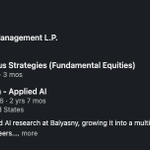
Balyasny's head of research and the guy that set up applied AI research has recently moved to being head of autonomous strategies
Clearly they've seen enough from their work that risk could be taken without human involvement with fundamental research foundations
This is who you're going to have to compete with, not larry the long only with his new chatgpt subscription
great flag @HochstatMichael

Markets re-rate stocks on evidence that’s already public. We built agents that find it first.
The system names every regime shift that could re-rate a stock.
Agents gather evidence for each one from alternative data and from peers, customers and suppliers.
Every week a model weighs it all into one view of the skew.
On Yubico, it turned bullish well before the shares doubled.
An analyst can do this for a handful of names.
Our system can do it for all of them, as often as you want.
This is a big step closer to autonomous equity research.
This is a demonstration of how we pulled together 3 separate systems we'd written about:
1. Identifying regime shifts - primerapp.com/blog/identifyi…
2. Mosaid theory at scale - primerapp.com/blog/mosaic-th…
3. Systematic alternative data at scale - primerapp.com/blog/systemati…

2
70

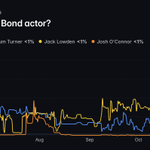
Robert Pattinson barely existed in James Bond prediction markets 8 days ago, and now he's 007.
Classic stock market lesson here: you can only trade the eventualities you've identified...
Could we classify Robert Pattinson as a fat tail..?!

1
205
Adding some more detail here...you're absolutely right that procedural knowledge is vitally important to AI systems 'replicating' human investors
Nobody has ever written it down because it's all learned by experience and codifying unconscious process is HARD to do manually
But there's a real meta point here I'd like to make about 'decision ledgers'
I'm not talking about your trade logbook or anything like that, I'm taking about every single micro decision you make on a daily basis as an investor
'I saw this on the cf statement, so I went and check this for this reason, and it was high/low so I checked this'
No firm in the world has a record of that journey, probably not even a single firm in the world that has one of those full journeys recorded.
I've spoken to so many firms that go 'we have 20 years of investment notes and mgmt meeting notes, what an amazing dataset'...
Those notes are final form, or near final form. They don't capture thousands of smaller decisions you made along the way.
'This product is good for X reason'
'Don't think this competitor matters'
'This competing technology is probably 10 years away'
All of which is super important to understanding how you reached the investment decision.
I think encoding human knowledge and know-how is only the first step in building Ai systems for fundamental investing (but a story for another post...)
Decision records/journals are quite exciting for fundamental investors for 3 reasons:
1. They build themselves - as people use agents as copilots, much more of the investigation can be recorded as it happens; the questions, avenues explored or dismissed and reasons why etc. Computer use/session recording could cover anything not done with a coding agent too.
2. You can actually review how you think - over time, you have something to postmortem (albeit careful of sample size). Which assumptions do you repeatedly get wrong? Which risks do you overestimate? Why?
3. You can assess the ideas you never invested in - traditional portfolio analytics and attribution focused on the invested companies. What happens when you can also assess the ideas you turned away, why you rejected them and how they subsequently did. What can you learn from that?
This gets you much closer to assessing the whole process...
MUCH more useful than another review of the portfolio which inevitably ends with 'you don't hold your winners long enough or cut your losers early enough'

Very cool insights: Agree 100%. One thing I would add is this: many/most investment professionals (perhaps as a result of learning efficient market theory or some such) may think that there is too much information - but I think this is false in a crucial sense...yes, we have never had more information available to us - and yes, the market is extremely good at processing that information...but in another sense it is false: there is one kind of information that we have very little of in the market (or very little available to most people)...and that is procedural knowledge...knowledge of 'how-to', rather than propositional or representational knowledge (graphs, pictures, data, theory etc.)...So what is procedural knowledge and why could it be a crucial missing ingredient? Procedural is the difference between knowing how to hit a forehand and being able to describe it or draw a picture of it...it is the difference between running a company and learning the theory of how to run a company...it is tacit...
A picture may be worth a thousand words - and there is a good reason why there is this saying (related to information theory for those who are interested) and its implication - that a thousand and one words many be worth more than a picture....the challenge and opportunity of tacit/how-to/procedural knowledge is that it is difficult to - or seems incredibly hard to - turn into a recipe or a picture...not impossible (as humans do it, and we are "computers"), but it seems that whereas a picture may require a 1000 words, know-HOW - would require a thousand pictures or a million words....
In short (lol, I see the reply turned out much longer than I initially planned!): (So, in long): I think we have way too little of this procedural knowledge available to AI's at the moment (they are trained on propositional and representational knowledge - and tangentially by procedural knowledge as fragments of our know-how seep through into our language and representations)...To gain more procedural knowledge, and hence the possibility to map human nature and behaviour much better - would require AI's to gain access to procedural knowledge in a far more effective way (how? AI's need more - and different kinds of sensors: just like a blind person won't know what red is because they sadly lack the right sensors for that kind of knowledge, AI's largely lack the kind of sensors that can "see" procedures to the extent required for their analytical and synthetic powers to create mastery...somehow, they need to see/feel/experience us acting, this final step would be a fantastic learning experience for them...one that they currently only "see" through the metaphorical and pictorial traces we make available to them through the Internet/etc.
Being trained on existing knowledge doesn't mean you can only reproduce consensus...almost as if humans don't learn from existing knowledge too
AlphaEvolve used LLMs to propose and test solutions to improve on best known results in math...and did a pretty good job
LLMs have solved generation math problems? Were they consensus too?
LLMs have made phenomenal findings in drug discovery...
The list goes on!

Former Citadel head of equity quant research Dan Morillo on why AI can't generate alpha yet:
"It is trained on millions of documents, thousands of millions of documents."
"In finance, you would think of this as, it gives you the consensus."
"If you put a prompt in ChatGPT, what you get back is essentially some average of what a typical person might say."
"When you think about alpha generation, you don't make money off of the consensus. You make money off of differences."
"We just don't think it's at that stage at this point."
Sympathetic to this having seen tens of our users go through this same eureka moment.
The only gripe I have here is on 'survive', because it assume people and roles stay still while the technology evolves.
I think the jobs themselves change much, much more than we're currently imagining.
For fundamental investors, this goes well beyond getting AI to read filings or build our existing models faster. Existing research processes were designed around what a small team of humans could realistically do to a good standard.
if you remove some of those restraints, a whole new world opens up.
Rich Sutton's bitter lesson draws on 70 years of AI research and argues that methods which scale through computation, like search & learn ultimately outperform any attempts to encode our existing expertise.
Investors frankly are not taking that seriously enough.
Imagine a system which could systematically discover relationships across thousands of businesses, it could experience every event you have and learn what you've learned from them in minutes not decades...
The role of the PM and analyst (if they're even called that going forward) will become more of an engineering based role than investing
Quant and fundamental will merge in the sense that both types of investors will spend most of their time optimising their system, discovering new methods and signals and putting capital to work behind them accordingly.
As we all know, edge & outperformance is a moving feast, so it's not build once and reap rewards...

I've always just used to regular Chat mode in ChatGPT.
Today is the first time I used work mode.
How can anyone think white collar / computer work is going to survive in a few years?
1
5
568
Well said @SinanXin, I think those outside the industry define edge as a single thing repeated to generate better risk adjusted returns consistently for years
in reality, edge is an ever evolving thing and AI adds to the facets of your edge that needs to continue to evolve
staying 'ahead' will increasingly become an engineering problem, just just an investing problem
I'm very sceptical that the human remains in the loop in the way most of the market expects
the human will move out of the fundamental research loop (i.e. not directing the agent on individual parts of doing work on a company/sector/theme) and move into the engineering loop where we are building systems to do all of this autonomously.

Emerging markets tech hedge fund manager Sinan Xin (@SinanXin) on why AI won't be the durable edge:
"AI, like alternative data, is just another tool for the fundamental investor."
"If you're first to that kind of tool, it is helpful and you do become differentiated."
"But if it's something that you've built that's obviously based on public information, it will diminish over time."
"If you were reading, you're going to the library and you were borrowing the 10-K, reading it, you had an edge."
"The tools will always evolve."
"What is actually harder to build but is more durable is behavior."
if you can get the topline right, you're 90% of the way there.

"only podbrained idiots focus on revenue"
no
its because 1. its the most important 2. there's like 10 different sources of edge or possible theses I could build around it 3. pricing power is always mismodeled by street
good luck with your "long AMZN based on quality, I believe that their competitive advantages are underestimated by the street, and so my 2040-2045 ROIC is above consensus"
imagination-land ass thesis
teapawt.net/gregoryblotnick/status…
1
12
1,381
“AI won't replace human judgement in investing”
I think a lot of investors are betting their careers on that holding up.
Here’s why I think it breaks down, and where investment edge moves as a result.

Think you've nailed the distinction in skillsets, but is there a hidden massive market structure impact as a result?
The more I work on AI for equity research, the more I think the abilities you describe become central to where 'fundamental edge' goes.
As monitoring and near term modelling excellency becomes standard, I expect longer duration investing to rise back to the top.
Understanding how a business evolves, forming a differentiated view a few years ahead and and crucially, being in a fund structure that allows you to wear the vol while it plays out.
A really core part of this is quarterly junkies have generally done well. Deep sector specialisms and a refined skillset of understanding positioning, bogey numbers, getting in front of sell side upgrades/downgrades and the behavioural aspects of quarterly number trading has been a happy hunting ground for many.
The traditional MM risk limit/vol structure has somewhat pigeonholed investors into this type of process. And the massive growth in number of pods has created a huge talent set which has only known one way of investing (particularly at the analyst level).
What I wonder is to what extent that skillset is at all transferrable to the next leg of fundamental investing process. i.e. it probably doesn't hold in a longer-duration and more directional style of investing.
There could be quite profound market structure implications from this. If general investment horizons shift outwards, then the risk/vol limits needs to evolve with those.
With higher risk & vol, leverage at the top co level for the MMs won't be able to stay where it is.
If leverage comes down even 1 turn, then annualised returns come down quite materially.
Whether these returns still justify the level of passthrough costs (which are going up, see DE Shaw's tech levy for example) is still a question mark.
My view is that attracting additional capital, where the allocator isn't sitting on a healthy profit might be quite difficult (and that's before you try to quantify the number of newly underperforming pods as the regime shifts).
Does this mean we see material capital formation back to single manager structures with track records in directional an/or longer duration strategies?

Genuine question: there’s a (big) group of Gen X PMs who got very rich operating this model. They live in the spreadsheet, keep pressing the same checks for trend lines, talk to management twice a quarter to detect some slight change in tone or explanation of a driver, then run back to the model and tweak incremental margins or customer adds or whatever for the next two quarters.
I feel like this form of investing is both ascendant and dying at the same time.
I get that “it comes down to the numbers,” but increasingly I think getting the big annual P&L wins requires being “qualitatively precise”. By that I mean understanding the rate of change within an industry, anticipating inflections based on first principles (not today’s credit card data), and having a deeply informed view of how a business evolves through technological shifts, competitive shocks, and cycles.
These approaches obviously aren’t mutually exclusive. But I rarely find the Gen X model-obsessed set equally obsessed with understanding how the product actually works, which architecture survives change, where value accrues, how a market absorbs incremental competition, etc. Maybe this matters disproportionately in TMT.
But the guy who runs back to his model to update next quarter’s GM% based on an offhand management comment at a conference rarely seems to be the same guy who can tell you, with any real precision, what the business is going to look like in three years. And I wonder whether the second skill is actually the better way to get the next two quarters right too (or at least treat them as vol or margins of errors as noise toward a more inevitable outcome). Checks still matter. Listening for change matters. But knowing what the heck you own really matters and the credit card data or next quarters RPO within 100bps doesn’t tell you that.
2
6
1,292
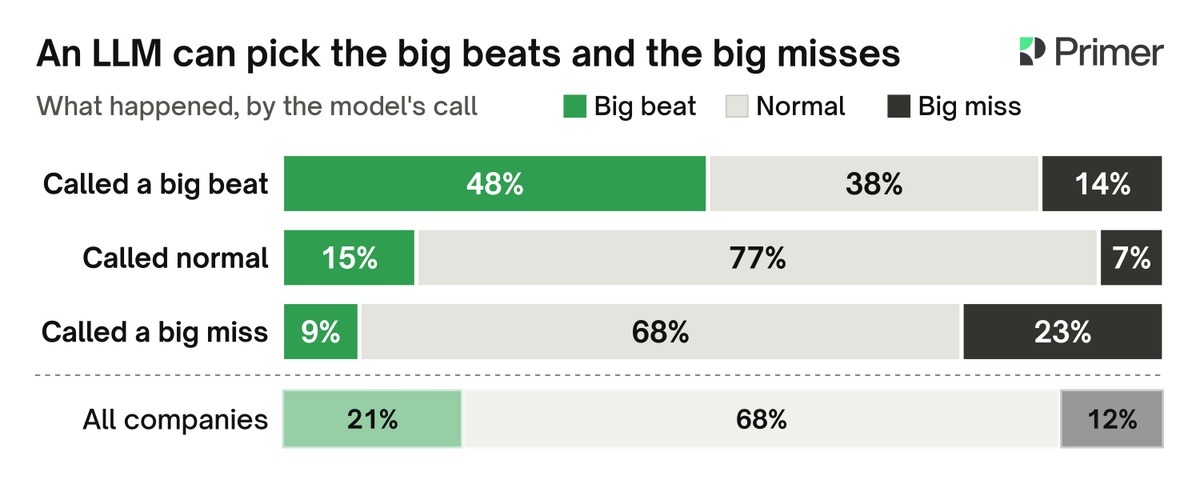
Spent weeks trying to get LLMs to forecast earnings better than we already do.
Tried 17 fixes but none of them worked meaningfully.
However, LLMs ARE good at picking who beats vs who doesn't.
Walkthrough of full methods and failure modes.
1
13
1,235
95% of tasks in knowledge work will start from your coding agent
and more specifically for the investment industry, it's already moving this way
it's clear that the labs are trying to capture as much as they can both vertically and laterally
context density is so important in investment research. you want the agent to have access to absolutely everything (all internal data, external data, your process)
coding agents are the obvious medium to do this
the foundational labs will be the first to have connectors to your data inputs and if they don't your coding agent can build you one
computer use is the fallback for anything you can build for
this is where I think all workflow apps get bitter lessoned. why work around a vendor's fixed process when the agent can build around yours?
gone are the days of traditional SaaS where your workflow has to mould to the one they built for, AI and coding agents have changed the economics of customisation
I want it all connected in one place and attached to tools that are the most capable of doing whatever you want with that data.

Introducing Claude Meetings: add Claude to your team’s video call and it builds docs, whiteboards, and other artifacts with you while you’re still talking.
Starting to roll out in beta on Team and Enterprise plans.
1
314

Al Smallwood retweeted

My advice for someone just getting involved in golf is the following:
Don't listen to a word I say because I don't know the first F'ing thing about golf. Worse than that I'm left handed (which my golfer brother tells me is a handicap) and have absolutely no real interest in it.
Also, it's a shame that all the people giving out free 'trading' advice can't have the same realistic self assessment with trading as I do with golf.
Are junior analysts dead?
And if they do die, where does the next generation of PMs/MDs come from?
This is what I'm calling "The Apprenticeship Paradox"...I think the junior role will change enormously and we'll need to think how that work develops 'judgement'
In fact, not even judgement, just a very deep and clear understanding on the fundamentals
The previous way of 'being trained' as a junior was a very simple case of reps x failures
And as a function of these reps and failures, you built your understanding of what mattered (some better than others).
We still need experienced investors, but we're about to live in a world where we will have automated most of the work through which an inexperienced junior would have learned.
My proposal is for firms to build AI sandboxes for juniors to learn in...
🧵 1/3
A junior equity analyst covering 10 companies might experience 50 scheduled events a year: four quarters and perhaps one more event, like an investor day.
These are opportunities to hone your craft, essentially forced learning events.
But there's the limitation, your education depends heavily on what happens during your ~3 years of training.
Yes, you'll have 150 events to have sharpened your nose, but you might only know one economic regime and have no experience of systemic shocks.
For example, I didn't have a clue about how inflation really affected companies apart from the economics 101 and common sense. It wasn't until I'd experienced it in 2022 that I really understood the nuance.
An AI sandbox would be a much broader training ground.
A junior could rigorously follow 40 companies instead of 10, which could give them so many more reps to form expectations and compare it vs what actually happens.
I actually think the most interesting thing here is about economic regimes
As somebody who wasn't in the market in 2008, I would have benefitted enormously from working through it day by day seeing how companies and market participants reacted.
This learning would have been invaluable during crisis times like covid, the Ukraine/Russia war and the Iran war.
If you learned in a sandbox, your employer could also track your progress, learnings and skills live.
Not only would this de-risk promotion from junior analyst, but the 'time to maturity' as an analyst could theoretically be so much faster.
But importantly, what does a junior analyst need to look like (skills wise) in this evolving world?
🧵2/3
I'm not going to list skills or qualifications you'd see on a CV/resume, this is more about characteristics...
1. Deeply AI curious - easily measured by how much they are using it in their personal life. If they say they've used @bot to book flights - HIRE THEM.
2. Experimental - always coming up with ideas on how businesses, data and prices might connect and willingness and evolving capability to test those.
3. Wants to make money, not just be right - happy to disagree with the market but doesn't confuse being contrarian with edge. Can change their mind and walk away while admitting being wrong.
4. Worldly & savvy - is aware of the world and makes connections between economics, politics and behavioural aspects well.
🧵3/3
1
7
404
Al Smallwood retweeted

Great points, but I'd go a step further.
If I had the choice, the entirety of my modelling and forecasting would live in Python. Agents are native in code, git gives you full version history for free, and every driver can be a distribution rather than a point estimate.
I'd also question how long humans keep the edge on spotting patterns in the history. Agents can iterate through filings far faster than we can, and I suspect they'll get better than us at catching margin inflections or shifts in seasonality. The learning moves from keying in numbers to interrogating the agent's reasoning.
Which is where the front end matters. I don't think the answer is Excel with extra UI bolted on. It's a clean HTML output sitting on a Python back end, where you can click into any driver, forecast or assumption.
Click on FY27 revenue growth and out pops a driver card:
1. The forecast as a distribution, not a single number
2. The path: how the range has moved over time and what moved it
3. The evidence: management guidance, industry data, alt data, all cited
4. What agrees and what disagrees
5. A probability grounded in history, e.g. how often this company has actually delivered on guidance like this
Compare that to an Excel cell that says 8% with no reference to why it was modelled that way.
Excel probably survives as the export for colleagues who want a spreadsheet. It just stops being the engine and the interface.

imo it DOESN'T die, but bear with me on this
whether excel dies or doesn't die has been topic du jour in investing for at least the last 2 years and I wanted to weigh in
for me there are 2 sides to this:
1. Excel isn't the most natural tool for agents to model in. Making them operate cell by cell feels like square peg round hole (and we've tested this too). It can add errors, there's no version history, latency and cost are also an issue. This is SO important when you're doing it across hundreds of companies.
2. Excel is still the most natural way for humans to inspect this type of work. It's familiar, you can trace assumptions and you can send it to a collague who will very quickly understand it.
it might help to start with why we model companies, in my view it's for 2 reasons:
1. Understanding the history - building the model is part of learning the business. As you key in the numbers, you spot patterns, understand seasonality, notice margins falling or cash conversion improving. Every time you spot one of these patterns you go back to primary filings or other sources to understand why which drives the learning process.
2. Marking all of you implicit thoughts explicit - once you've learned about the business through historics, you set out on a question to learn everything you can about the company and take a view. All of these implicit thoughts need to be translated into explicit forecasts so 1) you can quantify your thoughts and 2) so it can be easily communicated to colleagues or clients.
I expect both of of these jobs to survive somewhat, but how they get done likely changes:
1. Agents do the construction and maintenance - modelling absolutely still exists, but I expect us to move from point in time updates to continuous updating done by agents when relevant information arrives which changes surfaced to the human where needed.
2. More of our thinking gets represented in the model and they become far richer - that 8% revenue growth forecast is an unnecessarily precise forecast for something we know in our head is a probability weighted range of outcomes. We already use scenarios and sensitivities, but maintaining that a written down version of your expected range of outcomes for every driver is impossible/exhausting and would look very messy. If this could be maintained by agents, I'd expect forecast quality to improve significantly.
FLY IN THE OINTMENT
In this new paradigm of modelling I'm going to want to:
1. Easily see the range of outcomes for each driver
2. See the full history of how that range has changed, when it change and what changed it
3. Do all of that without having to prompt my coding agent to tell me
So there really is a UI challenge here, excel is without doubt going to be the familiar form factor but I think the best in class tools for this will add additional UI to a UI which looks like excel at it's core but it's purpose built for agents and probabilistic, constantly updating models
(yes, I realised this is a meme account)