

Humans suck at many fields of science (cough cough nutrition....) - building a Personalized Health AI - powered by a scientific reasoning engine.
Vancouver Island
Joined October 2013
- Tweets11.3K
- Following973
- Followers1.7K
- Likes15.8K






Pinned Tweet
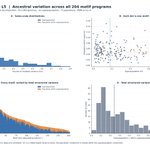
FOXO is a core metabolic resilience program, part of the insulin signaling pathway that governs carbohydrate metabolism.
The number of FOXO binding sites across the whole genome differs by sex and ancestry — and so does their association with obesity.
There is no single answer to what FOXO does to metabolism.
Context sets meaning.
FOXO counts are split by median (high/low).

80
Sean Mark, PhD retweeted

Big day here at @AsteraInstitute! We're opening applications (due Jan 7) for the next call of residents. This is across all our focus areas including life sciences, deep tech, neuroscience, AI research, and open science. See below to learn about the fully funded 12-18 month opportunity.
Alongside specific navigation for projects with commercial avenues for impact, our general expectation is to work in the open. To learn about why we work this way and our open science policy see here: astera.org/open-science/
We're also looking for three new full time hires within the open science team including:
An Open Science Operations Lead to work with me on all things including our internal open science efforts and external facing opportunities jobs.ashbyhq.com/astera/08fb…
A Program Manager for our Federal Science Partnerships located in Washington, DC to work with our policy lead on our growing federal partnership work jobs.ashbyhq.com/astera/e1de…
A Member of Technical Staff for Open Science who can serve as a data steward to help our hires and awardees generate first class data products for reusable science jobs.ashbyhq.com/astera/e26a…
Apply or share - look forward to hearing from you!

Applications are open for Astera Residencies, now through January 7, 2027! Up to $2M in funding, based out of our Emeryville hub. This round, we’re sharing a few specific project requests. Read more and apply here: astera.org/residency/
Reshare with folks who should see this!

Sean Mark, PhD retweeted

Relatedly, I’m amazed at what’s possible with AI now.
Example:

New episode of HARD DRUGS!
Will AI progress be crushed by Eroom’s law?
Even as technology has advanced, drug development has gotten more and more expensive over time.
In the 1950s, one billion dollars of R&D spending got us roughly fifty new drugs. Today, it gets us about one.
This trend is called Eroom’s law, or Moore’s law spelled backwards. It seems pretty bleak: the R&D cost per new drug has roughly doubled every nine years, in inflation-adjusted dollars, meaning drug development has become exponentially more expensive.
What could explain this? Here are some possibilities:
• Our standards of evidence and requirements for safety testing have risen, through regulation, public expectations, and risk aversion.
• We’ve picked the low-hanging fruit already. Perhaps we’ve already made the easiest discoveries, and diseases that are harder to understand or treat are left.
• Or perhaps it’s the ‘better than the Beatles’ problem: New drugs not only have to be effective, but have to compete with existing treatments, which are already effective. Plus, some of them have gone off-patent and become cheap generics, making the price contrast starker.
Relatedly, as diseases become rarer or milder, it takes more effort to demonstrate that new drugs are effective, with larger or longer clinical trials.
But there are also reasons to question these explanations. We still lack effective treatments for many diseases. And our tools for studying biology have improved enormously. Why hasn’t that been enough?
Will our best efforts be crushed by Eroom’s law, too? Or can AI reverse the trend?
In our latest episode of HARD DRUGS, @JacobTref and I chat about all this and more. Listen wherever you get your podcasts!
Chapters:
00:00 Introduction
02:53 Eroom’s law trivia
12:33 How much does it really cost to develop a drug?
22:35 The better than the Beatles problem
33:06 Clinical trials are larger and more rigorous today
42:01 Have we picked the low-hanging fruit?
01:01:22 Is Eroom’s law slowing down because of rare disease drugs?
01:06:18 Can AI reverse Eroom’s law?
01:15:09 Conclusion
Sean Mark, PhD retweeted

A full generation of young scientists have grown up thinking the p-value is the way to measure scientific rigor. That is a collective failure of our scientific training mission. It's much easier to teach, but it has had a very negative effect on how young scientists think.
Sean Mark, PhD retweeted

A pack of wolves walking through a forest in British Columbia, captured by a trail camera
I know a lot of people are the singing the praises of Opus 5.5 -> but I find it terrible to use for stats and biology. TERRIBLE. Fable 5.2 -> I've had limited use -> but doesn't seem much better.
Open AI's models do a better job for my stats and bio uses. And Anthropic's bio filter is super annoying.
1
1
82


Sean Mark, PhD retweeted

Going back to Canada is depressing. All anyone talks about is the trade war with the US (which, incidentally, is crashing the economy), a topic I literally haven’t heard a single American bring up in over a year. Canada is seething, and Americans aren’t even aware.
It’s like if a guy and a girl hooked up several months ago and he never called her back, and she’s been furiously seething and obsessed and fruitlessly planning revenge, and he hasn’t thought of her in months.
Sean Mark, PhD retweeted

Female octopuses sometimes hurl shells, silt, and rock debris at overly persistent male octopuses.
📹made with AI
Sean Mark, PhD retweeted

He's wildly inaccurate. Decades of research on sex and relationships show a pretty consistent rate of lifetime cheating that's about 20-25% of married men and 10-15% of married women.
He says 'over 90%'? Based on what? Vibes?
Sean Mark, PhD retweeted
Apologies in advance. I know this is absoluely wrong, stupid, crazy and insane.
But what if...and I am spitballing here...what if we just assumed that all male Billionaires, World Leaders and other Superperformers were expected to be driven PRIMARILY by access to...oh nevermind.
Sean Mark, PhD retweeted
A consistent aerobic exercise routine reduced brain aging in a new clinical trial. In fact, participants’ brains tested younger than at the start of the trial – and all it took was 150 minutes a week. menshealth.com/health/a71537…

Sean Mark, PhD retweeted

Generating molecules was never the bottleneck. AI is nowhere near close to replacing clinical trials which have always been the right limiting step and drug development.

AI now generates molecules far faster than the wet lab can test them.
The bottleneck in #AIxBio has shifted. That’s why we've built one of the world’s largest self-driving lab fleets: 300+ workstations running 24/7, generating data 40x more efficiently.
Sean Mark, PhD retweeted

Brute force computation is not enough for intelligence. Clever new methods are needed. The science of AI is far from finished. IMHO
Sean Mark, PhD retweeted

After Seeing Election Results, Trump Announces Retaliatory Tariffs On America buff.ly/4wppxgt


Sean Mark, PhD retweeted

It’s interesting that important parts of the financial world like @SwissRe are taking a serious interest in metabolic health, insulin resistance and diet It’s not looking good for carbs, particularly SUGAR!!

Endurance matters...the overall time you can spend on hard problem matters - measured in years.
The problem with much academic science, from what i've seen, is that funding priorities change before legit progress on harder problems, with high uncertainty, is made. Hard problems take endurance.

Andrew Huberman on the best advice he ever got: figure out the most real work you can do every day, consistently, and find a way to reset every week.
"The best advice I ever got: there was a neurologist out at UC Berkeley and UCSF, Bob Knight, some years ago, very talented. I asked him for advice starting graduate school."
"He said, 'Figure out the maximum amount of real work that you can do every day consistently, and then figure out some non-destructive way to reset yourself every single week.'"
"I said, 'How do you reset?' He said he likes fishing. I like to hike. I like to get into nature and spend time with people while I do it. I figured out I could work X number of hours per day, 5 days a week, and I just stuck to it for 25 years."
"People who take a ton of stimulants and just blitz, blitz, blitz, blitz, blitz. These are the same people that crash and disappear. You have to figure out and build your capacity."
"Yes, you have to work extremely hard. You have to be extremely focused. But you also have to figure out how long you can keep this up."
@hubermanlab
48