

Expert Intelligence Layer of AI Distilling specialized human knowledge to power the next generation of models email:[email protected]
Joined April 2026
- Tweets56
- Following45
- Followers128
- Likes34



👋 Meet Senhao Liu @Musen_Liu , co-first author of OpticalRAG and a PhD student in Chunyu Wei’s research group at the School of Information, Renmin University of China. He studies Personal AI and leads a startup exploring how personal assistants can adapt over time.
📖 The most useful line in a 40-page manual might be a footnote: “Skip this step on older models.” A general summary could easily leave it out.
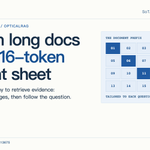
🔍 OpticalRAG renders the document as page images and builds a searchable index of their visual features. When a question comes in, it retrieves the relevant features and distills them into a 16-token prefix. Ask about maintenance instead of model compatibility, and the evidence can change.
📊 On LongBench-v2, OpticalRAG scored 35.79 versus 31.41 for standard RAG, using 16 document tokens instead of about 1,623 on average. On BAMBOO, its raw score was lower. The 16 tokens count what reaches the answering model as document context; rendering, indexing, and retrieval happen before that.
📄 Paper: arxiv.org/abs/2611.13675
💻 Code: github.com/brighterr/Optical…
#AIResearch #RAG


51
SoTALab’s first stop at Tsinghua — a quick look at the Wudaokou open mic.🎉
First time meeting everyone at Tsinghua. So glad to finally hang out IRL with researchers from across Beijing: talking shop, swapping ideas, and just having fun !
More events coming. Join the Researcher Club — we’ll be showing up in more cities to meet fellow researchers.
Today’s treat: an “Accepted” cake, just for you. Here’s to every paper landing 📩!!


1
69
AI models are getting smarter.
What data is still hard to get?
Join SoTALab for a dinner hosted by Jinyan Su.
🏠 Organized by SoTALab in Shenzhen
🎙️ Hosted by Jinyan Su @SuJinyan6
📅 Nov 28 or 29
Bring a data problem you’re working on.
Scan the QR code on the poster to sign up!

Heading to #NeurIPS2026 in Sydney? 🇦🇺
Join SoTALab for a casual meetup around Data, Benchmarks & Evaluation.
No slides or formal talks. Just research, weird problems, future papers, and new friends. ☕️
📍Near the venue
🎟️ Limited spots. Scan the QR code to join us!
🎁 Visit us at Booth K6 and grab some free swag!
#NeurIPS2026 #MachineLearning #Data #Benchmarks #Evaluation


In the latest BlenderForge update, we build entire photorealistic scenes in Blender, from a train pulling into a station to a quiet path along the river.

👋 Meet Xinglin Wang and Zishen Liu, co-first authors of “On Time, Within Budget.”
Xinglin Wang is a PhD student in computer science at Beijing Institute of Technology and a research intern on Qwen foundation models. He has published seven first-author papers at leading conferences including NeurIPS, ACL, EMNLP, and NAACL. His research focuses on test-time scaling, agentic workflows, and long-horizon tasks.
Zishen Liu is a PhD student in computer science at Beijing Institute of Technology and an algorithm intern in AI search at Xiaohongshu. His research focuses on agentic workflows, agentic discovery, and multi-agent communication.
⏱️ Your coding agent has 30 minutes and $1 in API spend. Should it run more samples now, or save that budget for debugging later?
The paper studies online resource allocation for agentic workflows with explicit budgets and deadlines. The objective is the probability that the entire workflow succeeds while meeting both limits.
🔧 Monte Carlo Portfolio Planning (MCPP) chooses a model and a parallel sampling width for ready subtasks. It simulates how candidate allocations might play out across downstream dependencies, then replans as outcomes arrive and the remaining time and budget change.
📊 In simulation experiments on CodeFlow and ProofFlow, MCPP improved constrained completion probability over uniform allocation and a local retry baseline across the tested budget and deadline settings. The paper also examines how model diversity and errors in execution estimates affect the planner.
📄 Paper arxiv.org/abs/2605.06110
💻 Code github.com/WangXinglin/MCPP
#AIAgents #LLM #AIResearch


3
215
👨💻 Meet Zhongwei Xie, first author of “CoworkEnv: Synthesizing Training Environments for Long-Horizon Cowork Agents.”
Zhongwei is a PhD student in Computer Science at HKUST, supervised by Prof. Yangqiu Song. His interests include long-horizon cowork agents, LLM reasoning, and efficient AI training frameworks.
💡 An AI coworker may need to follow an email thread, check financial records, coordinate services, and act within workflow constraints—all within one task.
Training that behavior requires an environment where the records, tools, instructions, and grading checks fit together.
🏢 CoworkEnv builds executable training environments guided by workflow requirements. Tasks bring together an initial workspace state, service interfaces, goals, and action constraints.
Programmatic validation and feedback repair check generated specifications and grading behavior.
🔧 Teacher executions provide curated demonstrations for supervised fine-tuning. Student interactions provide rollouts and rewards for reinforcement learning. The team uses these resources to train compact PocketWorker models.
📊 For Qwen3-VL-8B-Instruct, the paper reports that SFT raises the ClawEval mean score from 46.6 to 64.1, with a 31.9-point gain on multi-turn tasks.
The study also extends SFT to ClawMark and compares RL training dynamics across reward-processing and credit-assignment configurations.
💭 When we ask an agent to finish a workflow, what training experience prepares it to follow the evidence, coordinate its actions, and leave the workspace in the right state?
📖 Paper: arxiv.org/abs/2610.24960
💻 Code: github.com/HKUST-KnowComp/Co…
📦 Models: huggingface.co/collections/z…
📝 Lessons: github.com/zhongweixie/Cowor…
Have research to share? DM us 👋
#AIAgents #LLM #AIResearch


2
67
👨💻 Meet Yang Xiao @Yang_Xiao_nlp , co-first author of “Vela: User Behavior as Supervision Sparks LLM Intelligence.”
Yang is a Computer Science PhD student at The Hong Kong Polytechnic University, with an undergraduate degree in Software Engineering from Fudan University. His research spans continual pretraining, agent post-training, and recursive self-improvement, connecting data construction, model training, evaluation, and harness design.
He has received an ACL Best System Demonstration Paper Award and an Outstanding System Demonstration Paper Award in two consecutive years.
💡 The starting point: knowing more facts does not automatically mean understanding an individual user.
Personal assistants and other user-facing systems need to infer preferences, intent, and likely actions from behavior histories that evolve over time.
🔍 Vela turns user behavior into supervision. Using anonymized records from 100,000 users, it constructs tasks across 91 templates. Predictive questions are grounded in observed future behavior; summary and attribution questions use task-specific rubrics.
Difficulty filtering and trajectory selection retain approximately 75,000 Vela-Instruct examples. Fine-tuning Qwen3.6-35B-A3B on these examples produces Vela-35B-A3B.
📊 The paper reports an 11.5-point gain on VelaBench, a 6.2-point average gain on independent user-related benchmarks, and a 4.0-point average gain on general benchmarks over the base model.
More behavior data improves user-related performance. With the same downstream RL configuration, starting from a Vela SFT checkpoint also produces stronger final results than starting from the base model: 66.2 vs. 58.5 on VelaBench, and 37.6 vs. 29.9 on ProfileSummary. These experiments use the 18.8K-example Vela checkpoint.
💭 A question worth exploring: what can real choices teach models that static text alone leaves out?
📖 Paper: arxiv.org/abs/2610.14709
🔗 Project: allspark-research.github.io/…
Have research to share? DM us 👋
#LLM #AIAgents #AIResearch

1
1
157
👨💻 Meet Maohua Li, co-first author of “Rethinking Cross-Layer Information Routing in Diffusion Transformers,” accepted as a NeurIPS 2026 Poster.
Affiliated with Nanjing University, Maohua helped refine the research idea and led the paper writing and REPA-related work. The study introduces Diffusion-Adaptive Routing (DAR).
💡 The starting point: diffusion Transformers have evolved in many directions, while their residual stream still largely follows the original Transformer design.
The authors diagnose three symptoms of standard residual routing: forward magnitude inflation, backward gradient decay, and block-wise redundancy.
🔍 DAR makes cross-layer aggregation learnable and timestep-adaptive. Instead of accumulating all previous sublayer outputs with fixed unit weights, it learns how to combine historical sources for the current computation.
The denoising timestep matters: different noise levels call for different mixtures of earlier representations. DAR supports timestep-aware queries and chunked aggregation to manage source storage.
📊 On ImageNet 256×256, the paper reports an FID of 7.56 versus 9.67 for the SiT-XL/2 baseline under ODE sampling without classifier-free guidance. DAR matches the baseline’s converged quality using roughly one-eighth as many training iterations (1/8.75).
Combined with REPA, DAR reaches an FID of 7.09 at 100K iterations, close to REPA alone at 200K (6.89). The study also explores detail preservation during Distribution Matching Distillation of Qwen-Image.
💭 A question worth exploring: how much more can generative models learn when we improve the way information flows between their layers?
📖 Read the paper: arxiv.org/abs/2605.20708
Have research to share? DM us 👋


1
76
👨💻 Meet Minhua Lin, first author of “Language Models Learn to Improve Language Models,” affiliated with The Pennsylvania State University.
His work with collaborators introduces LM2LM, a framework for training language models to propose effective improvements to other language models.
💡 The starting point: running experiments and deciding what to try are different challenges. Learning from real training runs is expensive, while predictions can become unreliable as proposals change.
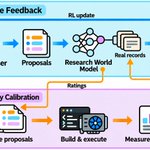
🔍 LM2LM uses a frozen research world model (RWM) to predict proposal gains from real experimental records supplied in context. These predictions provide rewards for reinforcement learning.
As optimization progresses, the proposer may favor ideas whose gains the RWM overestimates.
🧪 To keep feedback grounded, LM2LM periodically executes highly ranked proposals from the current policy and adds their measured outcomes to the RWM’s context. Its parameters remain frozen; its experimental records grow.
📊 Across eight autoregressive and diffusion LM development environments, the authors report that LM2LM enables Qwen3.8-27B to outperform GPT-6-sol on held-out tasks, even when GPT-6-sol receives 300 real experimental records in context.
They also report 33% lower data-generation cost and generalization to a model family unseen during training.
The study focuses on proposal-level improvements. Broader environments and longer, end-to-end research campaigns remain directions for future work.
💭 A question worth exploring: how can experimental feedback help models make better decisions about what to try next?
📖 Read the paper: arxiv.org/abs/2610.23344
Have research to share? DM us


1
88
More Chinese AI labs and researchers share work on Zhihu. Zhihu-incubated SoTALab is launching Researcher Club with @ZhihuFrontier , a long-term program to share research, meet peers and find support.
Let important research be seen and discussed, and new collaborations begin. Join us!
#AIresearcher #zhihu

2
54
Meet Yanke Zhou, first author of “Full Attention Strikes Back,” accepted at NeurIPS 2026.
His work introduces RTPurbo, an approach to making existing full-attention LLMs more efficient for long-context inference.
Yanke studies at the School of Computer Science, Nanjing University, advised by Prof. Xiaoxing Ma.
His research interests include software automation and model inference optimization.
The starting point: attention heads already specialize.
Some retrieve relevant information from distant context; many focus on nearby tokens. RTPurbo uses this division of labor, keeping the full KV cache for retrieval heads and limiting local heads to a small window.
For retrieval heads, a 16-dimensional indexer estimates which tokens matter.
Dynamic top-p selection then adjusts the token budget to each query. The indexer handles routing; attention over selected tokens still uses full-dimensional features.
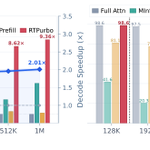
At 1M context, the paper reports up to 9.36× prefill and about 2.01× decode speedups over FlashAttention-2 on NVIDIA H20.
These measure a single attention layer, rather than end-to-end model latency. Accuracy stays close to full attention on the evaluated tasks.
RTPurbo uses two-stage adaptation: indexer training followed by self-distillation.
A question worth exploring: how much efficiency can we unlock by understanding the structure models have already learned?
Read the paper
Have research to share? DM us 👋.
#NeurIPS2026 #LLM


New paper from SoTALab with
@lllaborg @HaoZhao_AIRSUN
: MathVis — a benchmark for research-level mathematical figure generation .🎉
512 tasks · 27 subfields · 16 model configs Models must output TikZ/SVG from text only — no tools, no web. Best Pass@1: 31.25%. Most figures render; few are mathematically correct.
We hope MathVis pushes models to treat diagrams as part of reasoning — not just a final illustration.
paper: arxiv.org/abs/2610.12954
Special thanks to @wenhaocha1
🤖 Made with AI



SoTALab has a long-standing focus on AI research, evaluation, and real-world practice. We aim to connect outstanding researchers and help frontier research reach a wider audience.
During NeurIPS, we’re looking forward to meeting more researchers with accepted papers in Sydney. We’d love to exchange research ideas, hear about your latest work, and explore new opportunities for collaboration 👋
If you have a paper accepted at #NeurIPS2026 or will be attending the conference in person, come meet us at the SoTALab booth! We’d be excited to learn more about your research and discuss how we might work together in the future.
For selected collaborators, SoTALab will provide tailored support based on the paper’s research area, acceptance type, and the proposed collaboration.
Support may include
✈️ Flights, accommodation, and other conference-related expenses
💰 Conference sponsorship
📚 Promotion and outreach support for your research
After applying, selected researchers will work with SoTALab to share their research and co-create content based on the agreed collaboration plan. This may include presentations at in-person events, livestreams, and conversations on site at NeurIPS.
We look forward to seeing you at NeurIPS, exchanging frontier ideas, and sparking new research possibilities together! 🤝
🔗 DM us to receive the application form.
#NeurIPS2026 #AI #Researcher

3
140