
Postdoctoral Researcher in Milan Italy at @humantechnopole
Milan, Italy
Joined June 2009
- Tweets657
- Following417
- Followers245
- Likes514






7/8
Everything is open. Code, trained model weights, summary statistics and polygenic scores:
🔗 glastonburygroup.github.io/C…
📄 Paper: nature.com/articles/s41467-0…
#MachineLearning #GWAS #PRS #CardiacMRI #UKBiobank #DiffusionModels #ML #AI #ComputerVision

8/8
I had the privilege of co-leading this with @OmettoSara, as joint first authors.
Conceived and led in @C_Glastonbury's lab at @humantechnopole. Thanks to every co-author @sodbosha @EmanuelSoda1 @francescocist9 @FraIev84 @Di_Angelantonio @NPirastu and others
4/8
Do these learnt traits mean anything biologically? They do.
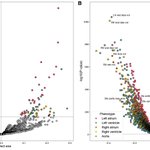
Across 71,017 UK Biobank participants, they proved reproducible across repeat scans, heritable (SNP-based h² of 4 to 18%), and significantly associated with cardiometabolic health.

2/8
The model is a 3D diffusion autoencoder.
An encoder compresses each temporally resolved (moving) scan into a compact, low-dimensional latent vector. A diffusion decoder then learns to reconstruct the heart from it by reversing a Gaussian noising process.
🚀 Honoured to mentor at the 7th @HarvardHSI Hackathon! Organised by the @HarvardChanSPH, this global event comes to #MIND, #Milan on 10 & 11 April, thanks to @LaStatale, @polimi, @humantechnopole & SIIAM. Let us rethink health systems together to create a lasting impact!

[3/4]
📊 Validated on two datasets, the models handled severe class imbalance robustly:
🏆 Peak F1-score (classification): 0.93
✅ Tumour-only accuracy (classification): 98.74% (outperforming state-of-the-art glioma grading classifiers!)
🎯 Median Dice (segmentation): 0.728
[4/4]
Massive thanks to my fantastic co-authors , Hadya, Andreas and Oliver for the collaboration. 🤝
🔓 Read for free until 17 May 2026: authors.elsevier.com/a/1mrGU…
💻 Open-source code: github.com/soumickmj/GPModel…
#ExplainableAI #MedicalImaging #BrainTumour #Neurocomputing
Soumick retweeted

🎉 Congratulations to our @C_Glastonbury Group on receiving a grant from FRRB to study the immune landscape of pancreatic #cancer.
🧬 The project will use AI & single-cell tech to improve immunotherapy in #PDAC
humantechnopole.it/en/news/f…

[1/3] LUMEN, a #DL pipeline for the 3D morphological analysis of lenticulostriate arteries from 7T MRI, published today by @ElsevierConnect, reseach lead by @li_rl574, an amazing collaboration with @CamStroke and @c_t_rodgers from @Cambridge_Uni
➡️ Paper: lnkd.in/et58aRt5
[3/3] LUMEN pipeline offers a more accurate and detailed characterisation of vessel morphology than traditional 2D MIP analysis, providing a powerful open-source tool to advance research into the pathophysiology of CSVD
Open-source pipeline: lnkd.in/eiPvhgb4
#ai #vessel

