

Our duty is to maintain and evolve the human superorganism. "Our lives are not our own." Founder at Neon Health.
San Francisco, CA
Joined November 2013
- Tweets1.5K
- Following536
- Followers544
- Likes4.5K






Pinned Tweet
So fun! thanks for hosting @jamdotdev @thedanigrant

This AI agent automates calls to combat $4.9T in healthcare spend 👏
Tensor.dev is changing the healthcare industry, handling 1000s of calls every day - lowering costs while improving patient care.
Thank you for showing us @StedmanBlake - it's awesome.
Stedman retweeted

life in 12 to 36 months, if the 2026 data holds:
- balding? a daily pill
- obesity? a shot that takes off ~20% of your body weight
- low t? the fda already dropped the heart warning
- kidney failure? a pig kidney
- high cholesterol? one gene edit, LDL down 62%
- aging? the fda is drafting how to run the trial
- cancer screening? a blood test, or a dog
- inherited disease? startups are already editing embryos in the lab
- premature birth? an artificial placenta, human trials targeted in ~5 years
- stress? a patch that reads your cortisol through sweat
if you're investing in human enhancement biotech, DMs open
welcome to the acceleration of bio.
Stedman retweeted

In retrospect, Isaac Asimov may have been Hari Seldon in disguise. Eighty-four years after the first Foundation stories appeared, many who read his novels in their youth have grown up and begun quietly setting his plan in motion—advancing the long project of human continuity across time, knowledge, and worlds.
When you look outward from the Sun, the vast darkness of the universe overwhelms the senses. The stars are distant, the voids immense, and the scale of what lies beyond is difficult to hold in the mind. Yet our ancestors, gazing toward the horizon of the seas and what they called the edge of the world, were not primarily thinking that their ships might fall off it. They were already charting a new course for humanity, treating the unknown not as an ending but as the next stretch of open water.
Fear is how entropy keeps us caged—by narrowing our horizon to what is already known and safe. Curiosity is what keeps history moving, turning the same darkness into a direction.
As parents, our duty is to keep our children safe from the dangers that are real while preparing them to travel farther than we have. The horizon does not disappear because we love them; it is why we prepare them to meet it.


Stedman retweeted

Trump Pledges That If Voters Defeat Socialism In November, They Will Each Get An Equal Redistribution Of Wealth From The Government buff.ly/kRXF5x9


Stedman retweeted

Not many areas in view at apartment, which is usually preferable, but makes it difficultish to do a yard sign except maybe on balcony

Stedman retweeted

There are cathedrals everywhere, for those with eyes to see…

If you’ve never sat on the back of the ramp, feet dangling, and watch the Hogs coming to trough, you haven’t lived.
🤣😎🇺🇸🔥 teapawt.net/A10TheHog/status/20902…
The true story of Australia's first "autonomous AI cyberattack". For AI doomers, it's fantastic news.
What happened was - this guy asked his AI Agent to book him a gym class.
The class was full - there weren't any spots left in the class. But the AI Agent has a goal, and didn't want to give up.
So the it found a bug in the gym's scheduling software that let it cancel other gym members' appointments, so that it could move him up the list.
Pretty annoying for these folks who had their appointments cancelled...
But horrifying for AI safety researchers who are still unsure how we're going to keep AI systems "aligned" - especially as capabilities increase.
Why is this good news for AI doomers?
Every "nuisance" failure like this is public, relatable, and damning of AI. Stack enough of them, and public backlash could reach a critical point long before misalignment becomes an existential threat.
Sandoz just bought a cheap option on a risky bet.
In late June, they asked the FDA for permission to sell cheap copies of Mounjaro and Zepbound (GLP-1s).
Even though Eli Lilly and Company's patents on the drug don't run out until 2036, the reason to file a decade early is that US law rewards the first generic company to file and win a patent challenge with six months as the only generic on the market.
That prize is worth fighting for because tirzepatide is a $36 billion-a-year drug – literally the best-selling drug on the planet.
And because it's legally a small molecule rather than a biologic, the day a generic is approved, pharmacies can start swapping it in automatically - so 𝗟𝗶𝗹𝗹𝘆 𝗹𝗼𝘀𝗲𝘀 𝗺𝗼𝘀𝘁 𝗼𝗳 𝘁𝗵𝗮𝘁 𝗿𝗲𝘃𝗲𝗻𝘂𝗲 𝘄𝗶𝘁𝗵𝗶𝗻 𝗺𝗼𝗻𝘁𝗵𝘀 𝗼𝗳 𝗮𝗽𝗽𝗿𝗼𝘃𝗮𝗹.
Here's the most likely way this plays out:
1/ Lilly sues Sandoz within 45 days. That step is procedural, and Lilly has already sued dozens of compounders over the same molecule.
2/ Then... nothing happens for a long time. Patent litigation on a franchise this size runs years.
3/ Lilly's core patent is probably strong. Empower Pharmacy already tried to invalidate it and lost twice, most recently in January.
4/ The realistic ending is a settlement with an agreed entry date, somewhere around 2033-2035. Sandoz drops the challenge, Lilly buys certainty, everyone avoids a verdict.
5/ By then, tirzepatide may be yesterday's drug. 𝗟𝗶𝗹𝗹𝘆 𝗶𝘀 𝗮𝗹𝗿𝗲𝗮𝗱𝘆 𝗿𝗲𝗽𝗹𝗮𝗰𝗶𝗻𝗴 𝗶𝘁 𝘄𝗶𝘁𝗵 𝗮𝗻 𝗼𝗿𝗮𝗹 𝗽𝗶𝗹𝗹, orforglipron, and retatrutide behind that.
6/ The one thing working in Sandoz's favor: peptides are genuinely hard to manufacture at scale, so fewer generic makers show up and prices fall less far than in a typical generic launch.
The option is cheap. The real risk is that tirzepatide is not the drug worth copying by the time Sandoz is finally allowed to copy it -- since oral GLP-1s may have taken over by then.

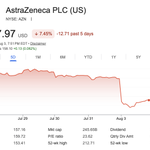
AstraZeneca lost £17B(!) in market value in one day - on news that it might get bigger.
The company held early merger talks with Bristol Myers Squibb. A combined group would be worth roughly $400B, the fourth-largest drugmaker in the world.
So why'd the market punished them so hard?
The move seems almost entirely political.
Washington is squeezing foreign drugmakers on pricing and tariffs, and buying BMS makes AZ an American company overnight.
It fits AZ's pattern: $50B committed to US manufacturing and R&D through 2030, a NYSE direct listing in June, and now a bid to absorb a US major.
Bloomberg's take was pretty blunt: "it makes limited strategic sense."
They're grading it as a pharma deal. But again, it's reallly a political move.
Results:
- AZ's stock price fell ~9%, £17B erased
- BMS stock popped +1.7% at the open, flat by midday
- Combined market cap: ~$400B, ranked 4th globally
- AZ 2030 target: $80B in sales, up from $59B last year
The scarcest asset in pharma M&A right now is a US address!

Stedman retweeted

Friendly reminder that I ultimately get to decide what happens in the Marina District


Hundreds of #SanFrancisco Marina residents turned out this evening for townhall on controversial @Safeway housing plan, which would place what for many is an uncomfortably tall, 22 & 18 story project at the low-slung neighborhood’s waterfront.
@sfchronicle


Patients who signed up for a GI specialty program but never booked an appointment were 25X(!!!) more likely to complete their first visit after an AI voice agent called them.
A reminder call. That was the whole intervention.
The standard of care here is simple: follow up with patients who show interest.
The problem is that following up at scale takes labor the system doesn't have.
So the calls don't happen, and patients suffer.
AI closes that gap by removing the labor bottleneck.
The study (linked in comments) had agents running 9x the outbound calls of human staff at GI clinic Oshi Health:
Results:
- Appointment completion up 3.42x overall (p < .001).
- 23.99% answer rate -- versus a 2-20% industry benchmark.
- 75 staff hours saved per 1,000 contacts.
- 70% efficiency gain for support specialists.
- Zero safety incidents identified.
The AI doesn't have to be very clever! It's just doing a simple task at a scale that humans can't keep up with.
Stedman retweeted

Trial lawyers are lobbying against self-driving cars because they're too safe. They need people to be killed and injured so that they have material for lawsuits.

Stedman retweeted

Scientists just estimated the upper limit of human lifespan determined by somatic mutations 👀
Researchers from Skoltech and AIRI developed a mathematical model to estimate how somatic DNA mutations influence the upper limit of human lifespan.
Their model suggests that if nearly all other reversible aging processes were eliminated, the accumulation of DNA mutations alone could limit the median human lifespan to around 146-194 years, roughly twice today's human longevity.
The model also found that somatic mutations reduced the median lifespan from a theoretical non-aging baseline of 1,759 years to around 156 years, highlighting how powerful mutation accumulation can be even in an idealized scenario.
This study also identified brain neurons and heart muscle cells (cardiomyocytes) as the biggest longevity bottlenecks because they regenerate very slowly and accumulate mutations over time, while regenerative organs like the liver can replace damaged cells and maintain function much longer.
Researchers conclude that somatic mutations are a major driver of aging, but they cannot fully explain human aging on their own, suggesting other hallmarks of aging contribute comparably to lifespan limits.
These findings provide new insight into one of the fundamental hallmarks of aging and could help researchers develop future therapies aimed at extending healthy human lifespan.
