

EIC @GamingLawRev | Gambling industry analyst-consultant | Nominated for an award once... didn't win
Earth
Joined May 2009
- Tweets32.2K
- Following980
- Followers7.1K
- Likes15.1K




Pinned Tweet
The Straight to the Point substack newsletter will be 1.5 years old next week, and the support I've received has been overwhelming.
18 months later, the newsletter is closing in on 1,000,000 total views and broke 5k views per day twice this week.
I took a big risk traveling down this path, leaving a really good, full-time job with benefits to start the newsletter from square 1.
The early sponsorship support from companies like @UnderdogFantasy and @GeoComply, people like @OPReport, who supported the project in a number of ways from Day 1, and the 150+ of you who have upgraded to a paid subscription provided me with some hope.
The subscriber list (now over 3,500 and growing by about 200 per month) allowed me to secure more sponsors, including @sporttrade_app, who signed up for a year-long commitment and allowed me to start a podcast, grow my consulting business, and add premium products.
What I've learned over the last year and a half is this: Aim big and work hard.
If anyone wants to further support Straight to the Point, you can like, subscribe, and comment on my posts, as well as upgrade to a paid subscription. I still have some sponsorship slots available, too.

The biggest difference between then and now is the special insert cards. You used to be as likely to receive a Don Mattingly RC as a Cecil Cooper. Trading cards were like video poker in that respect. Insert cards turned them into a progressive slot machine or Lottery drawing, and allowed the price per pack to explode.

Apologies for the ‘it was better in the past’ story but..
From the 1880s through the 1910s, some packs of cigarettes included a baseball card as an add-on. In 1933, Goudey recognized the appeal of baseball cards to kids and began selling packs containing one piece of gum and one card. Gradually, cards became the focus and the gum became secondary. Given the appeal to kids and that it did have a stick of gum, general retailers sold baseball cards in the candy aisle.
By the late 1940s, manufacturers were selling packs containing multiple cards but still just one piece of gum. Topps eventually established a virtual monopoly on baseball cards sold alone or with gum, which lasted until 1981. After a long antitrust battle, two competitors found a way around Topps' exclusive contracts by including a sticker or puzzle piece rather than gum.
By 1992, MLB decided that no insert was necessary. The stickers and puzzles were superfluous, while the gum could actually damage the cards. Manufacturers abandoned these extras. Still, sports cards continued to be sold in candy aisles until roughly the turn of the century when stores increasingly gave them their own section.
The first box of baseball cards I bought, at age 13, was 1987 Topps for $12. Last week, for old times sake, I bought a vintage box of the same on eBay for $70.
The box was delivered while I was out of town but I couldn’t find it when I got home. Last night, when I went to get a piece of chocolate, I discovered the box in the candy drawer. I was confused. Turns out my housekeeper had unpacked it but didn't know what the box was, at least until she noticed the words “bubble gum cards” prominently displayed on the box. Without realizing it, she'd put the box exactly where it would have belonged a generation ago: with the candy.
It reminded me of a simpler time when kids opened packs to complete a set rather than chase autographs and pieces of game-worn jerseys. When $12 bought 36 packs instead of one. When the thrill was finding your favorite player or the star rookie, not calculating what a card might be worth. When there weren’t professional grading services. And when a stick of gum was still part of the experience.

Someone has to be #3


DraftKings CEO: We’re Already ‘Clear No. 3’ in Prediction Markets
covers.com/industry/draftkin…
@Covers
Don't disagree that DK was singled out, but the lawsuit also includes its Pick6 DFS product, which isn't offered on other PMs.

Robins on Florida & @HardRockBet Lawsuit
Why $DKNG the target?
"For whatever reason they decided to make us the target. It is very interesting that there's a number of prediction operators in the state we're the ones we got singularly got sued."
Apparently, accurately describing prediction markets in the polling question is the reason most people think it's gambling.

I’m all for polls and statistics, but this one is super misleading.
IMO this is a poorly designed poll that mostly captures framing effects and ignorance.
The question explicitly frames prediction markets as “wager[ing] money” and asks if that is “a form of gambling.” That wording almost guarantees a high “yes” number. Meanwhile, ~90% of respondents have never used one, so most answers reflect media coverage rather than informed judgment.
this seems important, and it's something I often discuss in the newsletter, including recently:
"The problem, as I stated in the past, is advertising. Someone who isn’t thinking about gambling is suddenly face-to-face with an ad. Which is a big problem if the person is in recovery. It’s like a drink magically appearing in front of a recovering alcoholic. The seed gets planted.
"Someone in recovery doesn’t need to stumble across random ads, and call me a puritan if you want, but you should be able to watch a sporting event on TV without being bombarded with deposit bonuses for sportsbooks or prediction markets.
“Get the ads off my TV and out of sports. The world was fine before gambling ads were everywhere, and it will go on just fine without them. It shouldn’t be hard to find gambling advertisements, but it also shouldn’t be impossible to avoid them.”

Breaking news from @jstein_sun at the Washington Sun this morning: the FTC is starting to look into the online sports betting industry.
washingtonsun.com/administra…


So today is going to be a massive news day I see. Sun is barely up and we have NFL amicus brief, news that the CFTC is under a federal probe about staffing and enforcement, and a widening prediction market legal front ⬇️

DraftKings and its CEO Jason Robins have been sued by the Seminole Tribe of Florida, which holds exclusive rights to operate online and mobile sports betting in the state.
The idea is that $DKNG is illegally offering sports betting in Florida via its prediction-market product.

1) They are available in states - including Texas and California - with no legal sports betting options.
2) Kalshi and Poly are new to sports bettors, DK and FD have been available for at least a few years in states with legal betting.

This is remarkable.
Kalshi & Polymarket have 52% of the downloads of the Top 10.
I think what a lot of people are missing is that these apps are less intimidating to general bettor and the overall interface is more graphically entertaining.
(Data per @sam_mcquill)

I've been watching this closely for months, and while it's a shock, it shouldn't be shocking. Lula has long signaled he'll pull the plug, and there is recent precedent in India. So when people say, toothpaste doesn't go back in the tube, just point to India and Brazil.
This quoted post is unavailable.
Steve Ruddock retweeted

SCOOP: NCPG Looks To Replace Executive Director Amid Kalshi Controversy
gamblingharm.org/ncpg-looks-…

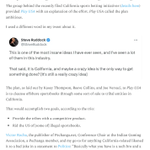
The use of monopoly to describe competitors like MGM, Caesars, Penn, Boyd, Wynn, Churchill Downs, Cordish, and a hundred other commercial operators (plus 250ish tribal operators) is something. Not to mention the states like Utah that aren't protecting any gambling "monopolies."

I find it baffling that it is considered backroom and shady to pay taxes to a state. Isn’t it the opposite? Was it also backroom and shady when Illinois jammed prediction market tax language into their budget with less than 30 minutes to review? Where is the commentary on that.
Legislators are the ones who decide where tax revenue is allocated, not companies! Perhaps next time a story like this is written, they learn the legislative process instead of creating false narratives about how it works.
If state legislators want to dedicate PM tax revenue to specific services, go for it!
And why is the casino industry opposed to prediction markets paying taxes and states collecting revenue? Let’s be honest about what’s really at stake - this isn’t about protecting consumers. It’s about protecting their monopolies.
MGM just played an Uno reverse card

Exclusive: MGM Resorts is discussing making a bid to purchase Barry Diller’s People Incorporated, which owns a roughly 27% stake in MGM. on.wsj.com/4jnmZ7q

As a martial arts school owner (Karate and BJJ), and parent of two kids who started very young, were good (one world class in karate competitions) I have two explanations for wunderkinds burning out.
1) They are used to winning, and when you're young, a little bit of talent plus experience and work ethic has always been enough. But, post-puberty, physical attributes start to close that gap. When winning gets hard, and the newbies they were dominating a few months before start beating them, they become disillusioned.
2) I can teach the same thing to a 12 year old in 1 Week that it takes a 7 year-old a month or more to learn (and often with bad habits due to a lack of coordination, proprioception, etc.).

Starting Jiu-Jitsu young has a huge advantage… but I believe there can also be a downside.
I started Jiu-Jitsu when I was 14 years old. When I was 15, I was a yellow belt competing against kids who had been training since they were 4 years old.
Some of these kids were already multiple-time Brazilian National Champions. Some became Juvenile World Champions at blue belt at 15, 16, or 17 years old.
But here’s the interesting part…
Many of those kids eventually quit Jiu-Jitsu.
I can think of so many incredibly talented young athletes who were way ahead of me when we were teenagers, but eventually stopped training.
That’s why I believe there is no “perfect age” to start Jiu-Jitsu.
If you were lucky enough to basically be born on the mats because your parents put you in Jiu-Jitsu very young, take advantage of that head start.
But if you started later, I believe there can be advantages to that too.
You may have less mileage on your body, and your motivation might be much higher.
Someone who starts at 40 or 50 might have a fresh body and the excitement of a beginner. Meanwhile, someone who started at 15 may reach 45 with 30 years of mileage on their body and possibly less motivation.
Every age has advantages and disadvantages.
Our job is to focus on the advantages we have and manage the disadvantages as well as we can.
So if you think you started Jiu-Jitsu “too late,” don’t worry about it.
There is no perfect age to start.
What matters is that you started.
Let me know your thoughts in the comments.
This is the game the industry has been playing for years, and prediction markets have perfected: words and numbers have different meanings and are important or useless depending on the context.

I used to consider Chris a serious person before this thread, but apparently I can't now:
1. It literally says $20,125,904 VOL
2. Kalshi/the industry has jammed down our throats that every person on the exchange is equal/a peer. Is taker volume less? Sure. But trying to semantics me to death is obnoxious as shit.

Steve Ruddock retweeted

NEW: Utah Senator John Curtis breaks ranks with Republicans to demand that Senate Judiciary Committee subpoena Donald Trump Jr. over his business dealings, including advisory ties to prediction market platforms reliant on favorable federal regulatory decisions by CFTC.


These headlines just get more and more bizarre. It's like a game of mad libs on acid.
It's a bit further down in the story, but Kasey Thompson, who tried to talk tribes into partnering with offshore operators in California a couple of years ago is involved in this.


Full story on Kevin Costner's upcoming Dunbar Ranch gaming industry retreat, by Jill R. Dorson: ingame.com/costner-predictio…

This is true to a certain extent. Whether you play poker, bet sports, or trade professionally, the gambling component is whether or not you actually have an edge.
In my experience, for every person who legit has an edge, there are five others who are just as certain they have an edge that don't.

Sports betting gets plenty of criticism. I’m not here to argue against it. However, there is another side to it.
I never imagined I’d be trading options on my own. Yet after years of poker and betting, I learned it's the same language. You’re either backing a favorite at a good number or betting an underdog the market has mispriced. I’ve spent the last year applying those same principles with confidence.
Used recklessly, betting can be destructive. Used responsibly, it can teach probability, price, risk management and how to make decisions under uncertainty.
All of those lessons travel.


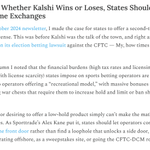
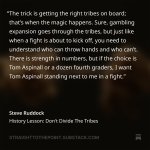
Not trying to downplay this news, but there are ~250 tribes In the US, operating 500+ casinos. Paragon is a solid regional casino (revenue is likely hundreds of million). That said, in FY2025 tribal casinos generated $46.2 Billion in revenue. As I said in the newsletter:


They could just read my newsletter to find out why this is a terrible strategy: straighttothepoint.substack.…
