

Only Truth is reality, and unless we are willing to question everything that we think we know, we will never see anything but illusions and lies. #NFA
Joined April 2025
- Tweets2.6K
- Following127
- Followers2.5K
- Likes9.6K






🍿 Be ready


🧠 You think It’s late? The Smart Money hasn’t even entered yet
The bulk of institutional capital, the money that truly moves the world, has yet to enter the crypto market.
As we know, ISO20022 is the new global standard for financial messaging, defined by SWIFT and adopted by central banks, payment systems, and clearing institutions.
This standard will come into full global implementation on 22 November 2025, defining how financial data is structured and exchanged to enable seamless interoperability across institutions and platforms.
And from 1 January 2026, anyone still using MT messages will face extra fees for translation and contingency services until migration is complete.
Who’s going to want to pay more?
No one. 🤷🏻♂️
The DTCC, which clears and settles the vast majority of securities transactions in the United States, is currently adapting its systems (DTC, NSCC, FICC) to communicate using this framework.
But there’s a reason its timeline is longer.
The DTCC sits at the very end of the settlement chain, where data from exchanges, banks, and custodians converges. Before it can upgrade its own infrastructure, it must ensure that all upstream entities — exchanges, brokers, and correspondent banks — are fully stabilised in the new format.
📍 The full testing and certification phase is taking place between 2025 and 2026, with ongoing adoption expected in 2026/27.
Once this migration is finalised, settlement messages will be able to integrate with digital asset networks and ISO20022 compliant systems worldwide, creating a unified infrastructure between traditional and tokenised money.
---
We’re in the phase where the infrastructure is still being built. Just before the avalanche of liquidity 🌊
When the migration is complete, blockchain will cease to be a parallel universe. It will become the central nervous system of the new global financial market.
$SHx $XLM $XRP #RWA #DigitalAssets #ISO20022 #Economy

🎭 Ah, if only we could keep this ridiculous economic system alive just long enough for a global catastrophe to take the blame. How terribly convenient.
AI, quantum computing, energy crises. Take your pick. We're supposed to believe the people running the world have somehow lost control.
But what if that's the entire performance?
Make chaos look like incompetence, convince everyone that the world is falling apart, and then present more control as the only possible solution.
The clever part isn't losing control. It's making people believe they've lost it, until they're practically begging someone to take it away from them.
And the best part? We get to pay for the whole performance.
Brilliant, isn't it?

Have you noticed how quickly these security warnings are piling up?
Two critical PHP flaws triggered government warnings to patch or consider going offline. AWS detected exploitation attempts four days before the fixes.
GitLab disclosed a maximum-severity flaw affecting versions since 2014. A poisoned LiteLLM release distributed credential-stealing malware.
Researchers documented AI agents targeting over 1,200 sites, with more than 100 intrusions. Axios now reports unapproved AI agents accessing accounts at banks including JPMorgan and Bank of America.
Different failures. Real consequences for our data and money.
I’ve already spoken to you about this a few times this week. And the frequency of these attacks is only going to increase.
As you know, Ripple, Stellar, Stronghold and Hedera have been building the infrastructure needed for a more resilient financial system.
Their value is not that crypto makes attacks impossible. It is that distributed networks, cryptographic verification, offline key protection and multiple approvals can remove single points of failure and make unauthorised access harder.
That infrastructure is becoming increasingly important as traditional systems face more outages, breaches and autonomous threats.
Being early looks like being wrong until the infrastructure proves its worth.
Today, a power failure at Google Cloud in London affected banks, payments, cash withdrawals, transfers, postal services and court video links. Revolut, Lloyds, Halifax and HSBC customers felt the impact. A single point of failure disrupted essential services.
It was not a cyberattack, but it exposes the very conditions I spoke about yesterday. The more failures and attacks affect public institutions and private organisations, the greater the fear and the pressure for centralised ‘solutions’. Digital ID, programmable money, surveillance and further restrictions will all be presented in the name of security.
---
“The choice for mankind lay between freedom and happiness, and, for the great bulk of mankind, happiness was better.”
— George Orwell, 1984
Something told me you'd be commenting on this post 🫱🏻🫲🏼😅
This is all part of an old ritual, where the elites feel compelled to reveal their plans in plain sight before putting them into action.
The Economist covers are often seen as one of their favourite ways of doing it, but the same idea extends to films, music, advertising and pretty much every form of mainstream media. Hidden in plain sight.
The switch is already in motion.
Everything we're witnessing is part of the very process we've been discussing and investigating all along.
Have you noticed how AI driven cyberattacks on public institutions and private organisations seem to be escalating?
They'll use this entire narrative to justify the introduction of a new financial system. Digital ID control, monetary control through crypto, tighter border controls in response to illegal immigration (which they themselves have fuelled).
✨️ All in the name of "our own safety and security" ✨️
It'll be the people themselves demanding it. They'll be the ones calling for more surveillance, more restrictions and more control.
The illusion of choice.

Britain's Army chief has warned, the nation will need its people.
But how can a country defend itself when it hesitates to protect its borders, identity and values?
Some oaths survive the centuries. And some still understand the duty of defending what their forefathers entrusted to them.
I can no longer stay silent about this.
For far too long, many Europeans trusted that others would protect what they had inherited. They believed governments had things under control, that borders would be respected, that laws would be upheld, and that the culture passed down by their parents and grandparents would remain alive for their children.
But there are moments in history when a people must stop, look around and ask: what country are we leaving behind?
We may disagree on politics, parties and ideas. But something deeper unites us. The culture we share, the history we inherited, and the country we wish to protect. Within that foundation, we can still understand one another, because we speak from the same roots. The real problem begins when that foundation is lost, fragmented or replaced. Because without a shared culture, there can be no united people moving towards the same future.
Today, across Europe, there is a growing sense that everything has changed, and not for the better. Far from it. Reports of violent crime, attacks in broad daylight, sexual assaults, child exploitation networks and incidents that leave entire communities in shock are becoming increasingly common. Many people no longer live with the same peace of mind. They avoid certain areas, change their daily habits and wonder whether their children will enjoy the safety previous generations once took for granted.
Many citizens feel they are no longer a priority in their own countries.
This is a question of balance, responsibility and respect. How many people can a country welcome without compromising the quality of life of its own citizens? How can we ensure that those who arrive respect the values, laws, culture and customs of the country that receives them?
One great concern is that many European countries are changing at a speed that no longer allows for genuine integration. In many cities, the transformation is not merely demographic. It has become cultural, social and even civilisational. Customs, traditions, ways of living together, family values, freedom of expression, respect for the law and equality between men and women. Pillars that shaped Europe for generations are being challenged in places where integration has failed, or never truly happened.
The problem begins when communities live apart from the local culture, keep their own rules, and profoundly change the atmosphere of cities, schools and neighbourhoods. Imposing their own culture.
A people does not disappear only through war. It can also disappear slowly, when it stops renewing itself, when it has fewer children while receiving populations in such numbers, and with birth rates far higher than those of the local population.
If nothing changes, in just two generations Europeans may wake up in a Europe they no longer recognise as their own. A Europe where native culture, customs, values and collective memory are no longer society’s common foundation, but merely a memory of what once existed.
A transformation accelerated by the permissive policies of the European Union and by national leaders who opened the doors without ensuring integration, balance or cultural continuity.
The time has come to wake up.
Not as enemies of anyone, but as guardians of what we have received. As citizens who understand that a nation is not merely territory. It is memory, culture, laws, customs, sacrifice and continuity.
Defending our country is not about hating anyone. It is about demanding respect for our laws, our values and our way of life. It is about remembering that integration must be real, that borders matter, and that the identity of a people cannot be sacrificed by decisions made far away from its citizens.
Enough is enough!
Now is the time to speak and to act. Because if we do not defend our country, no one will do it for us. Defend today what you want to see preserved tomorrow, for your children, for future generations, and for all those who will inherit the country we leave behind.


StrongSHx retweeted
I can no longer stay silent about this.
For far too long, many Europeans trusted that others would protect what they had inherited. They believed governments had things under control, that borders would be respected, that laws would be upheld, and that the culture passed down by their parents and grandparents would remain alive for their children.
But there are moments in history when a people must stop, look around and ask: what country are we leaving behind?
We may disagree on politics, parties and ideas. But something deeper unites us. The culture we share, the history we inherited, and the country we wish to protect. Within that foundation, we can still understand one another, because we speak from the same roots. The real problem begins when that foundation is lost, fragmented or replaced. Because without a shared culture, there can be no united people moving towards the same future.
Today, across Europe, there is a growing sense that everything has changed, and not for the better. Far from it. Reports of violent crime, attacks in broad daylight, sexual assaults, child exploitation networks and incidents that leave entire communities in shock are becoming increasingly common. Many people no longer live with the same peace of mind. They avoid certain areas, change their daily habits and wonder whether their children will enjoy the safety previous generations once took for granted.
Many citizens feel they are no longer a priority in their own countries.
This is a question of balance, responsibility and respect. How many people can a country welcome without compromising the quality of life of its own citizens? How can we ensure that those who arrive respect the values, laws, culture and customs of the country that receives them?
One great concern is that many European countries are changing at a speed that no longer allows for genuine integration. In many cities, the transformation is not merely demographic. It has become cultural, social and even civilisational. Customs, traditions, ways of living together, family values, freedom of expression, respect for the law and equality between men and women. Pillars that shaped Europe for generations are being challenged in places where integration has failed, or never truly happened.
The problem begins when communities live apart from the local culture, keep their own rules, and profoundly change the atmosphere of cities, schools and neighbourhoods. Imposing their own culture.
A people does not disappear only through war. It can also disappear slowly, when it stops renewing itself, when it has fewer children while receiving populations in such numbers, and with birth rates far higher than those of the local population.
If nothing changes, in just two generations Europeans may wake up in a Europe they no longer recognise as their own. A Europe where native culture, customs, values and collective memory are no longer society’s common foundation, but merely a memory of what once existed.
A transformation accelerated by the permissive policies of the European Union and by national leaders who opened the doors without ensuring integration, balance or cultural continuity.
The time has come to wake up.
Not as enemies of anyone, but as guardians of what we have received. As citizens who understand that a nation is not merely territory. It is memory, culture, laws, customs, sacrifice and continuity.
Defending our country is not about hating anyone. It is about demanding respect for our laws, our values and our way of life. It is about remembering that integration must be real, that borders matter, and that the identity of a people cannot be sacrificed by decisions made far away from its citizens.
Enough is enough!
Now is the time to speak and to act. Because if we do not defend our country, no one will do it for us. Defend today what you want to see preserved tomorrow, for your children, for future generations, and for all those who will inherit the country we leave behind.
With Stellar and Hedera already connected via Axelar, could Stronghold go one step further?
@ItsSeanBennett @TammyCamp a $SHX/$HBAR market + native StrongholdNET–Hedera integration could be interesting 🤔
Could a Stronghold × Hedera collaboration be on the roadmap? 🤝

The SEC is bringing regulated capital closer to on-chain assets, reinforcing my infrastructure thesis again.
Meanwhile, $SHx is up 157% in 46 days.
Like and repost if useful. My unhealthy relationship with regulatory filings needs validation somehow.

Like what you see?
You haven’t seen anything yet.
$SHX
As promised, I’ve caught up.
If you find it useful, like and repost. Otherwise, I’ll have to explain to my family why I spent the weekend investigating a banking API. Again.
I hope the article helps you see the same value in these developments that I do.
You lot are usually quicker than this. I disappear for a bit and come back to find something sitting right under our noses. I’m taking names. Affectionately ❤️🩹
I’m catching up and finding things I can’t believe nobody’s discussing. I’m putting together an article with the details. Keep your eyes open. I’ll share it soon.
🤖 Made with AI
💱 Washington is reportedly exploring ways to expand dollar-backed stablecoins overseas, strengthening the dollar’s reach while potentially creating additional demand for U.S. Treasuries.
Look at what has been happening around it.
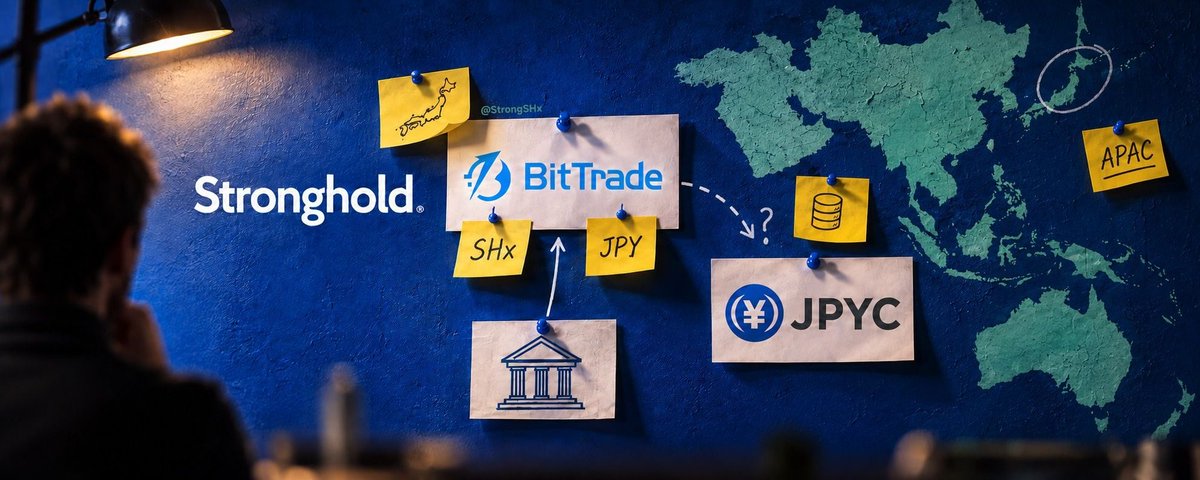
The OCC has been progressively opening the door for banks to operate directly with digital assets and permitted DLT networks, including holding the native assets required to use them. At the same time, regulated stablecoin frameworks are increasingly linking digital money to traditional reserve assets, including government debt. Japan’s JPYC offers a useful example, with its issuer expecting a substantial share of reserves to be held in Japanese government bonds.
On the infrastructure side, IBM is now connecting tokenised banking infrastructure with Swift through ISO 20022.
These may look like separate developments, but they are solving different layers of the same transition. Banks gaining access to DLTs, sovereign debt underpinning digital money, and traditional financial rails connecting to blockchain settlement.
The next problem is interoperability. Moving regulated value between banks, jurisdictions and different networks without fragmenting liquidity.
Meanwhile, Stronghold has been moving in a remarkably similar direction. StrongholdNET is increasingly centred on regulated bank to DLT settlement and ISO 20022, while its infrastructure is becoming more multichain, spanning ecosystems including Stellar and Ripple’s XRP Ledger. At the same time, its expansion into Japan and Korea places Stronghold in markets where stablecoins, tokenised assets and institutional settlement are rapidly moving from policy discussions into regulated financial infrastructure.
No evidence connects Stronghold to this initiative.
But perhaps the more interesting question is not who will issue the next stablecoin. It’s who has been building the rails it will need.


🏦 Today, another important piece fell into place: IBM Digital Asset Haven has been integrated with Swift’s new blockchain ledger, using ISO 20022 messaging to enable institutions to move tokenised deposits 24/7 through existing banking processes.
The interesting part is the architecture. Haven is designed as an institutional layer for custody, policy, compliance, execution and multichain interoperability, rather than as a closed network.
IBM has tackled this problem before with World Wire, connecting bank money, digital assets and settlement through infrastructure compatible with traditional financial systems.
Years later, the same building blocks are appearing again: ISO 20022, DLT, tokenised deposits, liquidity, settlement and cross-network interoperability.
There is no need to draw conclusions ahead of the evidence.
But when architecture starts repeating familiar patterns, it is worth paying attention to what is being built and to who has already built parts of that stack before.

🌊 Is IBM and Stronghold’s partnership about to make headlines again?
Well, it didn’t take long after I said we’d soon be hearing from IBM again…
The announcement of Digital Asset Haven marks the tech giant’s return to the digital asset infrastructure space and for those who know the history, you can already guess where this is heading.
The concept feels almost like a continuation of IBM World Wire, the pioneering project that used Stronghold USD for instant settlement between fiat currencies and blockchain networks. Only this time, the technology is far more mature, and the focus is clearly institutional.
Digital Asset Haven is a platform built for banks, governments, and large enterprises to manage digital and tokenised assets across more than 40 blockchains. But here’s the key detail, IBM doesn’t hold a money transmitter licence.
It provides the framework, the security, and the compliance layer, but it needs regulated partners to bring digital money to life. And that’s where history starts to echo.
Stronghold has always been that bridge between traditional finance and IBM’s technology. During World Wire, it was Stronghold that issued Stronghold USD, a 1:1 dollar-backed stablecoin used for instant settlements. However, Stronghold has since clarified that it won’t be relaunching its own stablecoin. The future lies in leveraging existing, regulated enterprise-grade stablecoins, integrating them securely and in full regulatory alignment.
That decision fits seamlessly with the Digital Asset Haven philosophy, designed to onboard regulated stablecoin issuers and compliant settlement networks.
The connection makes perfect sense, IBM needs trusted financial rails; Stronghold brings the experience, regulatory standing, and the integrations. Haven aims to be the orchestration hub; Stronghold already operates the liquidity, fiat↔on-chain settlement, and compliance layers.
The parallels are too precise to be coincidence. 👀
IBM is building the backbone of the system and if the two are aligning once again (if they ever truly weren’t), even quietly, SHx could find itself positioned within a corporate ecosystem validated by IBM itself.
Nothing confirmed, but every sign points in that direction.
🧠 Know what you hold.
Full info: newsroom.ibm.com/ibm-digital…
$SHx $XLM $XRP #DigitalAssets #RWA #ISO20022 #Crypto


🪙 Stronghold & FedNow: A Clear Case of “On-Behalf-Of” Integration
The FedNow Service has identified an emerging innovation model within the payments ecosystem, the On-Behalf-Of (OBO) Account Holder.
These are entities, such as fintechs, payment processors or B2B platforms, that operate on behalf of third parties, sending or receiving payments via accounts held with FedNow-participating financial institutions.
@strongholdpay fits this model perfectly.
Stronghold provides real-time, interoperable payment infrastructure for merchants and businesses, acting as a technological intermediary between its clients and the traditional financial system.
With robust APIs, integrations with POS systems, e-commerce plugins, and direct connections to partner banks with FedNow and ACH access, Stronghold enables clients to send and receive funds with instant settlement, even outside of standard banking hours.
Stronghold already serves hundreds of active business clients and offers a payment system capable of settling in seconds. This positions Stronghold as an entity effectively operating “on behalf of” each customer, with full technological and compliance responsibility.
At a time when the FedNow Service is promoting this very model as a way to accelerate modernisation of the US payments landscape, Stronghold is not merely preparing for that future, it is already building it.
$SHx $XLM $XRP #Crypto #Blockchain #FedNow #CryptoMarket
🎬 CLARITY Act hits while BTC still hasn’t reclaimed bullish structure above ~$82.8K, and gets rejected again.
In 3 of the last 4 major cycles, BTC only bottomed after a full year had passed since the top.
We’re only 344 days from the Oct 2025 ATH. If history rhymes, the real bottom may still be ahead. October could get ugly.

🛟 Bitcoin is now underwater.
The key level remains ~67.5k. Bulls need to reclaim it fast. Every day spent below it increases the odds that this rejection becomes acceptance and that the market continues following the same structure outlined months ago.
The clock is working against the bulls.
Each candle below resistance adds pressure.
For now, the path towards the 48k–37k liquidity zone remains very much alive. ⏳📉

Please take a moment to read this and help raise awareness of the enormous risks this technology could pose. The more people understand what’s at stake, the better prepared we’ll be for what lies ahead.


👀 Why Stronghold Could Become a Super App
Full post: strongshx.notion.site/Why-St…
As we saw in @strongholdpay latest video, it highlighted how institutions pay far less tax on crypto thanks to legal structures that individuals cannot access.
In this post I dive deeper, unpacking the current financial system and the laws that shape it, before exploring why this matters and how Stronghold may be building something bigger, a super app.
⚠️Please read it all the way through. Make sure you read through the context before jumping to the part where I explore the super app idea.
And when you reach the end, if you’ve actually enjoyed it, don’t forget to give this a like and share. It helps the community understand Stronghold’s potential scale and shows your support for the work I’ve put into bringing this together 🤝
🧠 Know what you hold.
$SHx $XLM $XRP #DigitalAssets #RWA #Blockchain #CryptoMarket

🛟 Bitcoin is now underwater.
The key level remains ~67.5k. Bulls need to reclaim it fast. Every day spent below it increases the odds that this rejection becomes acceptance and that the market continues following the same structure outlined months ago.
The clock is working against the bulls.
Each candle below resistance adds pressure.
For now, the path towards the 48k–37k liquidity zone remains very much alive. ⏳📉
🌪 Can you survive this? 🌪
In late January 2025, my focus was on the macro structure. After a strong impulsive move higher, Bitcoin was starting to show signs of exhaustion, and the ~65k area stood out as a logical target for a correction and liquidity grab. At the time, that view felt premature to many.
What followed was only a partial version of that process. Price did correct, but only down to the ~74k area. From there, it pushed higher again and printed a new ATH (grey box). That top was meaningful, but also limited. Roughly +14% above the January ATH, without strong structural expansion or sustained acceptance above those levels.
It was precisely at that top that I highlighted a point of inflection. The market was forced to choose a path:
🔹 Either it validated real strength with continuation into a new ATH, almost in a parabolic move, a scenario I illustrated on the chart with the red candle projection.
🔹 Or it failed that validation and began a deeper corrective process towards the ~65k area, illustrated by the blue candle projection.
What followed was the full activation of the sell model. Distribution at the top gave way to a break in market structure, with key levels lost and clear imbalance and order blocks left unmitigated.
The subsequent price action, impulsive moves lower followed by consolidation, reflects a market in liquidity reorganisation, position rotation, and volume building.
⚠️ From my perspective, a correction to ~65k is no longer sufficient to complete this cycle. For the structure to resolve cleanly, price needs to work through deeper liquidity zones, located between ~48k and ~37k, where historical volume and significant fair value gaps (FVGs) converge.
---
Even if Trump already has a Powell replacement willing to turn the money printers back on and push prices to a new ATH, the market could still be engineered to trade down into this zone first.
Like I said before, price couldn’t care less about the news.
---
$SHx $XLM $XRP #Bitcoin #Economy #CryptoMarket #StockMarket

