
Researcher at the Norwegian Naval Academy
Bergen, Norway
Joined February 2022
- Tweets313
- Following746
- Followers333
- Likes3K




Ståle Ulriksen retweeted

And so it begins…
Houthis have begun operations to close the Bab Al-Mandab Strait.

Ståle Ulriksen retweeted

‼️ This is important.
Russia is moving toward the militarization of maritime trade.
In recent weeks, Putin’s aide Nikolai Patrushev has been consistently advancing the same logic: Moscow is using the risk of detentions and blockades as a pretext to bring the navy into play, legitimize convoys, armed escorts, and tighter control over vessels.
‼️ This effectively pulls commercial shipping into the sphere of force and imposes the practice of military cover for trade routes.
In recent months, European countries have more frequently stopped sanctioned vessels for inspection. The UK has already authorized its military to board and detain such ships in its waters, while France seized the tanker Deyna in the western Mediterranean.
Russia is using this as justification to expand its military presence around commercial shipping and promote a model of armed escort.
‼️ If Russian mobile fire groups or naval vessels escort ships in a way that threatens a coastal state, interferes with its lawful control in territorial waters, facilitates sanctions evasion, or if a commercial vessel is effectively used for military purposes, this would constitute a violation of UNCLOS by Russia.
This is a deliberate blurring of the line between civilian shipping and military force - and a push toward escalation.
Where clashes are most likely:
1. The Great Belt (Denmark) - one of the main Baltic chokepoints.
2. Øresund - a narrow strait between two NATO states (Denmark/Sweden).
3. Skagerrak and Kattegat (Denmark) - the most dangerous transit zone between the Baltic and the North Sea. In 2025, 292 sanctioned tankers passed through here.
4. UK waters on the approaches to the English Channel and the Dover Strait - currently the most likely flashpoint, given new political authorization for boarding and detention.
5. The western Mediterranean - a confirmed zone of enforcement actions.
France’s seizure of Deyna shows that the risk extends beyond the Baltic straits. The vessel was sailing from Murmansk under a Mozambican flag and was intercepted over suspected links to the shadow fleet and irregularities with its flag and documentation.
The most likely confrontation will not resemble a large naval battle, but rather a series of "dirty" incidents: an attempt to stop a tanker, a Russian claim of "protection," an armed escort or naval vessel nearby, dangerous maneuvering, electronic warfare, warning shots - followed by accusations of "piracy" and a new round of pressure. If inspections become systematic, Russia will shift high-risk voyages into a "vessel plus escort" format and deliberately turn each inspection into a political and security crisis.
Russia is bringing the war to the sea and covering commercial shipping with military force. It is deliberately erasing the line between civilian vessels and military instruments so that any lawful inspection appears as an attack on a "protected" shipment.
This is not the protection of shipping, but the militarization of trade: Russia is turning the sea into yet another grey zone of coercion, where law is expected to yield to the threat of force.


Russia sent a warship to escort sanctioned tankers through the English Channel despite PM Starmer’s threat to seize shadow-fleet ships passing through British waters.
On Wednesday, the Russian frigate Admiral Grigorovich - a 3,620-ton warship armed with anti-ship, cruise, and surface-to-air missiles - accompanied two sanctioned oil tankers - Universal and Enigma - as they passed along the south coast of England. A British naval vessel followed behind.
Source: The Telegraph

Ståle Ulriksen retweeted

This is silly.
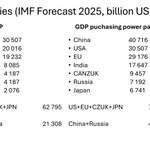
Nobody in defense circles takes official Chinese defense spending figures seriously.
Firstly, they hide a huge amount of defense spending.
Secondly, PPP adjustments have an enormous impact.
Factoring in both, their real defense spending is >500 billion USD

In the 2025 fiscal year, Washington spent $921 billion on its military, nearly as much as the next 14 largest defense budgets in the world combined, according to the International Institute for Strategic Studies. And the gap could widen soon. Read all about it here
gzeromedia.com/graphic-truth…

Ståle Ulriksen retweeted

WARNING: LONG THREAD 🧵
Dear Americans,
Your political and media class has sold you a very convenient fairy tale for decades - the tale of how your tax dollars pay to defend freeloading Europe.
While it's an emotionally satisfying narrative, it's also wrong.
THE U.S. DOES NOT SUBSIDIZE EUROPEAN DEFENCE.
You are not running a charity, you are running an empire. And empires are costly.
Your forward deployments, your bases, your carrier groups, etc. - they are the pillars of a global security architecture that mainly serves you: to protect your trade routes, your currency, your corporate supply chains, your ability to project force anywhere on the planet in hours and days, not months.
Let’s walk through this like adults, and not emotional toddlers, shall we?
Ståle Ulriksen retweeted
Recently, President Trump publicly said that the United States doesn't "have to be there for NATO." US Defense Secretary Pete Hegseth refused to directly confirm the US commitment to Article 5, saying that it is up to President Trump to decide.
Europe will likely have to realize that the moment when it finds itself facing its problems alone is much closer than it seems.
I've tried to look at possible scenarios and critical vulnerabilities for Europe in case the US withdraws from NATO.
From a legal point of view, the US withdrawal from NATO is a slow and complex process: under Article 13, it takes at least one year after notification. Additionally, starting from 2023, the US president cannot do this alone - a two-thirds majority in the Senate or an act of Congress is required. But the problem is that even without a formal withdrawal, Washington can already significantly weaken NATO politically, militarily, and psychologically. And that's exactly what is happening.
At the same time, Europe is no longer where it was ten years ago: defense spending is rising rapidly. But this still does not replace the United States. Key dependencies remain - nuclear deterrence, command and control, intelligence, logistics, long-distance transport, missile defense, and ammunition stocks. There is no strategic autonomy yet.
◼️Scenario 1. Shock without withdrawal.
Most likely, Trump will not formally withdraw the US from NATO. Instead, he undermines the Alliance through threats, humiliating allies, and doubting Article 5. NATO does not collapse, but begins to crumble from within due to mistrust.
In this scenario, Europe frantically rearms itself but still counts on the American security umbrella. And for Russia, this is an almost perfect window of opportunity: not for a major war with NATO, but for sabotage, cyberattacks, provocations in the Baltics and the Arctic, and strikes against critical infrastructure. Moscow's goal is to prove that NATO is incapable of acting.
◼️Scenario 2. A de facto withdrawal without a de jure withdrawal.
This is the most dangerous scenario: The US formally remains in NATO but effectively undermines the Alliance from within - reducing its presence, stalling decisions, and making security guarantees conditional. This is something Trump could do, as it does not require a complex legal procedure. For Europe, this is the worst kind of uncertainty: NATO seems to exist, but whether it is capable of acting is unknown. For the Kremlin, this is also very convenient, especially if Russians are confident that the US will not respond.
◼️Scenario 3. The formal withdrawal process is initiated, but resistance emerges in the US.
Trump attempts to turn threats into legal action. And this is where the resistance begins: the Senate, Congress, the courts, some Republicans, Democrats, the Pentagon, and the foreign policy apparatus. Formally, NATO will remain in place for at least another year. But the strategic blow comes sooner: the very initiation of the procedure undermines the basic assumption that the US remains the reliable core of the Alliance.
◼️Scenario 4. Europe becomes independent.
This is a forced adaptation. Europe accelerates its rearmament, integration, and joint production. NATO does not disappear, but becomes less American: the US weakens as a political center, while Europeans become more influential. The problem is that this transition is slow and dangerous. The money is already there, but command, production, and nuclear gaps cannot be closed quickly.
◼️Scenario 5, the worst one: A crisis within NATO coincides with a Russian strike.
Moscow is not waiting for the Alliance to collapse. It needs only a moment when trust in Article 5 has vanished, and Europe hasn't yet had time to get stronger. Then, rather than a major war, there will be a limited strike aimed at causing a split: sabotage, a cyberattack, or an attack on infrastructure. The goal is not necessarily to seize territory. The goal is to demonstrate that NATO is incapable of responding quickly, unanimously, and decisively.
◼️For Ukraine, the consequences are direct. Any erosion of the US role in NATO simultaneously reduces the predictability of support for Kyiv, increases the burden on Europe, and strengthens the Kremlin's temptation to expand the war as a tool to pressure the entire European order. The question of NATO's reliability directly affects Ukraine. It is a question of whether Europe can adapt quickly and maintain political stability and unity in the face of a real threat.
Finally, it is worth mentioning President Trump's claims to Greenland, which, in light of his intentions regarding NATO, add further grounds for concern.


Ståle Ulriksen retweeted

Surely the main missile threat is from the Northern Fleet? Firing from way ooop North, and with SFA interceptors to handle it. Or anything else to detect, trail and if necessary kill SSGNs, SSNs and SSKs. All missile armed, both conventional and nuclear-tipped. Plus surface ship missile firers.
Ståle Ulriksen retweeted

When Chinese leaders & diplomats talk about "peace" & international laws & rules based order, show them this!
China Maritime Militia vessels swarming Filipino fishermen inside the Philippines’ Exclusive Economic Zone & harassing innocent Filipinos.
Ståle Ulriksen retweeted

Everyone is covering the force majeure. Everyone is covering the 13 million tonnes. Everyone is covering the gas prices and the geopolitics and the five-year timeline.
My good friend Veron Wickramasinghe just asked the question nobody else is asking: how do you rebuild when the machines that make the molecules take three to four years to manufacture, ship through a closed strait, and commission in a war zone?
Read what he found.
Every LNG train at Ras Laffan requires high-purity nitrogen from Air Separation Units: cryogenic plants cooling air to minus 190 degrees to distil it into component gases. Pearl GTL needs 30,000 tonnes per day of pure oxygen from eight Linde-built ASUs. Each cold box: 470 tonnes, 60 metres tall. Lead time from contract to commissioning: three to four years. If destroyed, replacement arrives no earlier than 2029.
But here is the choke point that Veron identified that nobody else has. The heart of every cryogenic ASU is a brazed aluminium plate-fin heat exchanger called a BAHX. These exchangers operate with temperature differentials of one to two Kelvin and require precision brazing in vacuum furnaces. Only five companies on Earth are qualified to manufacture them. Five. For every cryogenic heat exchanger in every air separation unit, every LNG train, every industrial gas facility, and every hydrogen plant on the planet. Fives Cryo in France. Kobelco in Japan. Linde in Germany. Sumitomo in Japan. Chart Industries in La Crosse, Wisconsin. Current lead times: 12 to 18 months or more. And their order books are already full.
Veron was honest about what is confirmed and what is not. QatarEnergy CEO al-Kaabi confirmed LNG Trains 4 and 6 are damaged: 12.8 Mtpa offline, 3 to 5 year repairs, $20 billion annual revenue loss, force majeure up to 5 years. Shell confirmed Pearl GTL Unit 2 needs roughly one year of repair. What has NOT been confirmed is whether the ASUs themselves were destroyed. Shell’s one-year timeline is inconsistent with total ASU loss, which would require four to five years. Veron flagged this honestly and gave you the analysis both ways.
And then he showed you the cascade nobody else sees.
Qatar produces one-third of the world’s helium from the same facility. Helium is irreplaceable in semiconductor fabrication: cooling wafers, purging chambers, detecting leaks. Samsung and SK Hynix import 64.7 percent of their helium from Qatar. Spot prices have doubled. Liquid helium vaporises within 35 to 48 days. Fourteen percent of capacity is permanently damaged.
The LNG trains, the ASUs, and the helium plants all sit on the same rock, fed by the same gas field, accessed through the same strait. One set of missile strikes on March 18 to 19 took out 17 percent of global LNG, threatened one-third of global helium, and exposed a supply chain that runs through five workshops in Germany, France, Japan, Italy, and Wisconsin with three-year lead times and full order books.
This is what Veron understood that the headline analysts missed: the recovery is not constrained by money or political will. It is constrained by vacuum furnaces, aluminium metallurgy, and the physics of brazing at tolerances measured in single-digit Kelvin. You cannot accelerate physics. You cannot surge-produce a 470-tonne cold box. You cannot commission cryogenic equipment in a war zone.
Five companies. Five workshops. Three-year lead times. Full order books. A closed strait. An active war.
That is not a recovery timeline. That is a sentence. Read Veron’s full analysis. It is the most important thing written about this war that does not involve a missile.


Ståle Ulriksen retweeted

Deeply disturbing news

The "Narva People's Republic" now has a flag, a coat of arms, and a Telegram network. Ukraine saw this playbook in 2014 – now it's appearing in a NATO member state.
The same "People's Republic" branding that preceded Russia's Donbas occupation is targeting Estonia's border region.
euromaidanpress.com/2026/03/…


Ståle Ulriksen retweeted
Many people in Europe are skeptical about Russia's intentions to attack Europe. They believe that Putin (Russia) will be satisfied with just Ukraine. That is why even some politicians and intellectuals voice the call to "give Ukraine to Putin" and thus "save Europe."
This outlook is wrong. And it is very dangerous, above all for European countries.
The truth is that Putin has turned Russia into a war machine that is very difficult to stop. And he does not want to stop it because the current regime survives only thanks to war.
Arguments on this subject are presented by the OpenMinds research project:
◾️ Russia has switched to a war economy, and the reversal process is extremely difficult;
◾️ growing amounts of intelligence indicate hybrid, cyber, and information operations, as well as sabotage attempts in Europe;
◾️ consolidation, increasing influence, and coordination of the authoritarian axis and its satellite states.
‼️ But there is another important argument that is often overlooked:
◾️ Russia's preparation of a new militarized generation.
Moscow has normalized war for younger generations of Russians. Russian propaganda has already turned Ukrainians into "Nazis and fascists" - subhumans who must be killed. Now it is doing the same with Europeans.
A new OpenMinds investigation, "Kids with Drones," analyzed how stories involving children are spread on Russian social media to promote war.
The most important findings include the integration of drone piloting programs into schools, camps, and even kindergartens, alongside the normalization of a narrative of existential confrontation with the West.
OpenMinds analyzed 30,000 posts across 4,000 Telegram channels. Here are the conclusions:
◾️ In just the first seven months of 2025, there were 8,600 unique posts about involving children in work/training with drones - six times more than in the whole of 2022. This means that it is not only the existence of such programs that is important, but also the work of information campaigns to normalize them in society and create a new paradigm of upbringing.
◾️ More than 2,000 posts in July set a record since the start of the full-scale invasion. One of the most widely shared stories was the opening of infrastructure for drone 'competitions' in six kindergartens in Perm.
◾️ It's not only about Russian children. Drone programs are also being promoted among Ukrainian children in the occupied territories — 963 posts were found about tournaments and learning sessions, often organized by Russian military personnel.
◾️ About one-third of the posts relate to education - lessons and courses ranging from kindergarten classes to the "Cadres for UAVs" federal program within the framework of University 2035. And in May, the education ministry even released a textbook for 8th-9th grade students with guides on how to control FPV drones.
The full report can be viewed at the link: openminds.ltd/reports/kids-w….
Ståle Ulriksen retweeted

A Russian-crewed cargo ship has attracted attention after its movements coincided with drone incursions over German military installations. (h/t @auonsson) ukdefencejournal.org.uk/are-…

Ståle Ulriksen retweeted

🧵How many times is it worth repeating that Putin is not interested in an armistice or a peace deal to end the war in #Ukraine? I have little patience left for the breathless speculation in US and European media about what it may/may not take to get the Russians to the table.1/5
Ståle Ulriksen retweeted

Europe has the capacity and opportunity to cripple Russia and significantly reduce the threat posed to the continent if its states can coordinate their efforts. But the window of opportunity is closing, warns @Jack_Watling.
rusi.org/explore-our-researc…

Ståle Ulriksen retweeted

I don't know how else to reach you, so I'm asking you - maybe they'll hear us this way.
Please share these photos. Show them to your politicians. This is the Kyiv metro.
Every night, Ukrainians hide here from Russian missiles. Families sleep on the cold floor with their children.
Please, help us. Close the sky over Ukraine.
📷Yan Dobronosov


Ståle Ulriksen retweeted

Again, ruzzia is using the church to conduct espionage activities. This time it is in a NATO country. I will attach a thread regarding this.
united24media.com/latest-new…

Ståle Ulriksen retweeted

Chinese Foreign Minister Wang Yi told the European Union’s Kaja Kallas on Wednesday that Beijing does not want to see a Russian loss in Ukraine because it fears the United States would then shift its whole focus to the Indo-Pacific scmp.com/news/china/diplomac…

Ståle Ulriksen retweeted



Meanwhile in Russia: decorated state TV host Vladimir Solovyov urged strikes against Europe and assured fellow propagandists and the viewers that Trump won't step up to defend the Baltics when they are invaded by Russian troops.
youtube.com/watch?v=uT_EGY3x…

Ståle Ulriksen retweeted

Today's Russian papers: “Trump becomes the President of War", "Trump makes America Wage War Again.” Plus, Putin’s comment that “Where the foot of a Russian soldier steps, that’s ours.” One paper calls this Putin’s “political faith & long-term political strategy.” #ReadingRussia