

Enterprise agentic customer support and operations platform. Model agnostic. Guardrails, human takeover and evals built in.
Atlanta, GA
Joined August 2025
- Tweets17
- Following13
- Followers3
- Likes2




Proof of concept in hours.
Agents in production by the end of the week when scope is clear.
Custom agents on voice, SMS, chat, and email. Designed with you, not handed over as a blank toolkit.
The prompt decides what an AI agent says to customers. On a customer service agent that is a line like "overnight shipping is never free", and the person who knows it is rarely the person who can deploy it.
Shipped this week: the client can change a deployed prompt from the console. Agents ship with a default, but it can change at any point after deployment. Once saved, the next call picks it up.
An agent inherits prompt files from the deployment and can override any of them, so each file says whose text it is. Values that differ per agent stay as variables, so one file serves all of them.

Someone on your team reads a real customer conversation and sees the agent do something odd on turn 3.
Where does that go? Usually Slack, with a link to the whole conversation. A week later nobody can find turn 3.
We let them leave the note on turn 3 itself.
Notes from live sessions, playground chats and eval cases land in one Feedback list per agent. Open one and you land on the note, at its turn, not the top of a long transcript.
New this week: replies and reactions. The team's read of the agent, kept next to what it's about.
"Which prompt is production actually running?"
Most teams answer that with someone pasting a version into a doc. An assertion, and it goes stale quietly.
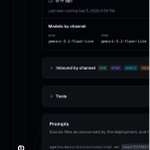
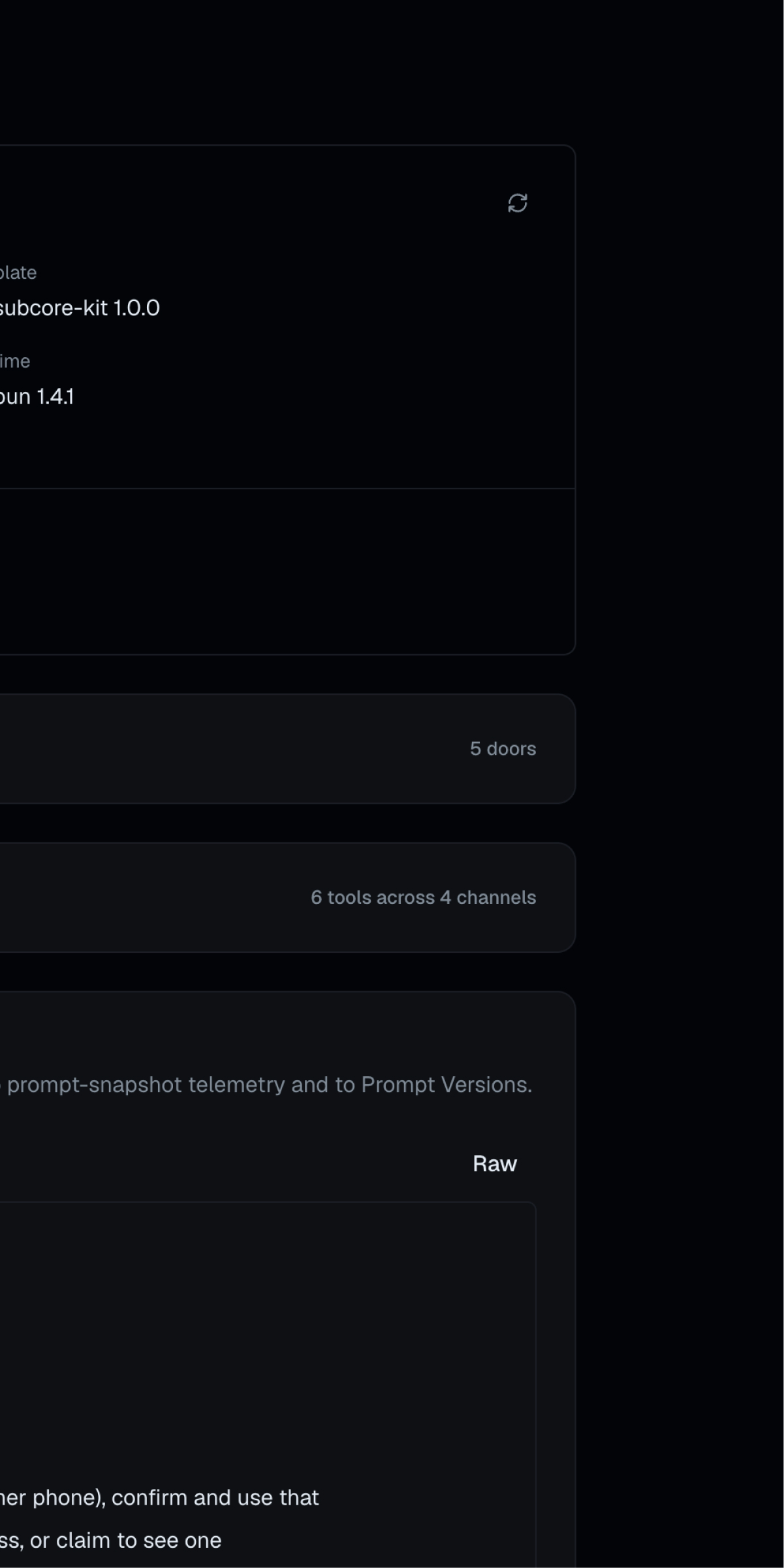
Our console derives it. The deployment announces its compiled prompts, live traffic reports its own hash, and we compare.


Connecting an agent used to need two credentials, copied by hand in opposite directions.
Every idea for simplifying it was really about moving secrets faster. Fetch it at boot. Derive it. Rotate it on a schedule.
All machinery to distribute a thing we could stop having.
We built a playground into our console — talk to your agent on any channel it serves (chat, email, voice, SMS) without touching production.
Told a client, expecting "nice, easier to test."
What came back: it'll help onboard their staff and give them confidence in the system.

We'd built it as a developer tool.
For the people who work alongside an agent every day, it's the first place they get to poke at it with nothing at stake. That's what turns "the thing management bought" into something they'll actually use.
Spent the last few weeks wiring up Subcore's orchestration layer for voice and SMS using real customer workflows. Agents, memory, tools and telemetry are finally all playing nice together. 🤝
Big update to Subcore’s memory layer.
Our AI agents can now store and recall custom data inside conversations, not just messages.
More context. More control. More intelligent outcomes.

Best UX for luxury transport isn’t an app, it’s a phone number.
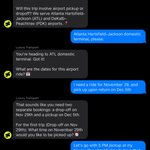
Plug an AI agent into SMS and it becomes a 24/7 booking desk: remembers past trips, handles edge cases, and never forgets to follow up.
Net result: happier riders, and the owner gets their evenings back.

Most AI tools act alone.
Subcore connects them so your agents can think, speak, and act together across chat, voice, and automation.
The future of AI isn’t a single assistant. It’s a connected system.