






Great question! The receiver will normally have the parameters of the system as well, and that combined with the transmitted variable are enough to generate the same chaotic mask. This is also why the system is not fully secure as someone can find the parameters eventually.
If you want to learn more about chaos and dynamical systems, we recommend "Nonlinear Dynamics and Chaos" by @stevenstrogatz, which most of this thread is based on. Also, check out Prof. Strogatz's lecture series on Youtube on a course he taught based on the book above.
2
In other words, by just sending one of the three variables, the two chaotic systems lock themselves into synchrony over time! This allows the receiver to subtract out the chaotic mask to reveal the original message.
2
2
Given what we know about chaos, this seems extremely improbable. Not only do two chaotic systems synchronize, they synchronize on the scale of milliseconds, and by only sending 1/3 of the information!
1
In fact, we can show that the difference dynamics (the resulting dynamical system from subtracting the transmitter signal from the receiver signal) goes to zero at an exponential rate!
1
The idea is that, no matter the initial conditions (where u, v, and w are at when time=0), the differences between the two systems go to zero as time increases.
1
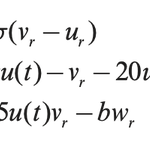
Each device models a scaled model of the Lorenz System shown below (the subscript r stands for "receiver"). Notice there is a shared variable, u(t). That is what is sent (and the only thing sent) from the transmitter to the receiver.


1
Now that we have an understanding of chaos and the Lorenz system, let’s get back to our goal of synchronization and signal masking.
1
1
Consider the waterwheel. Notice how each loop around a wing corresponds to a rotation of the waterwheel in one direction, while a switch from one wing to the other (which happens chaotically and, hence, unpredictably), represents a reversal in direction.
1
1
One may ask, what does this butterfly pattern have anything to do with chaos? It looks pretty orderly to me.
1
1
The Lorenz system is used to model various chaotic phenomena in nature, such as convection rolls in the atmosphere or a chaotic waterwheel. Check out the chaotic waterwheel here:
youtube.com/watch?v=Lx8gMBJB…
1
1
The ẋ, ẏ and ż means that we have a derivative with respect to time. So, this system tells us how trajectories move and how the system changes with time. However, we will try to explain it intuitively, and not get too "mathy" (perhaps, even counter-intuitively)!
1
1
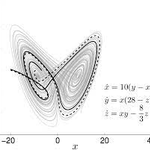
I know these equations(below) may seem complicated to someone who has never worked with dynamics before. The Lorenz System is what we call a three dimensional system of non-linear differential equations; it is an extremely famous and important system in the field of dynamics.

1
2
Before we can understand what we just said, let's first discuss this 3D dynamical system called the Lorenz system, which, when plotted, traces out this beautiful looking butterfly pattern.

1
2
But, surprise! Pecora and Carroll showed that you can synchronize two chaotic systems by sending just one third of one of the systems to the other! (But what does that even mean!?)
1
1
Intuitively, one would imagine that such systems are hard to synchronize (i.e. get them to do the same things at the same time), because any random error, no matter how small, would exponentially blow up! After all, as we mentioned above, chaos implies unpredictability.
1
1
So, if you start a chaotic system at two minimally different starting points (perhaps due to measurement or experimental error), these differences in the behavior of the system will grow, often exponentially, with time and the trajectories will quickly diverge!
1
1
But before we dive into the details, what really is chaos, anyway? Many people have an intuitive sense of chaos: craziness, randomness and unpredictability. In science and math, a system is said to be chaotic when it has sensitive dependence on initial conditions.
1
1
Kevin Cuomo, a student of our beloved @stevenstrogatz, implemented a circuit that generates this chaos, and also synchronizes with it, so we can tune it out to reveal the hidden message. Check it out here:
youtube.com/watch?v=J-ca_bqW…
1
1