

The research program of TEFRA is the first comprehensive and interdisciplinary study of cremations from Greece on a broad geographical and time scale 🔥 🦴🇬🇷
Thessaloniki, Greece
Joined June 2022
- Tweets40
- Following118
- Followers167
- Likes9


TEFRA Project retweeted

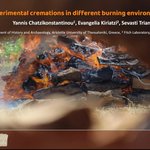
Οur open access paper «Experimental insights into different funerary burning conditions on Crete island, Greece» is now available in JAS: Reports
If you investigate cremations, have a look to the different burning dynamics that can affect a burning event
sciencedirect.com/science/ar…


New methodological paper about the study of burnt skeletal remains.
An offprint is available here:
researchgate.net/publication…


If you are interested in #cremations and especially the study of burnt bones, this paper may be useful for your research. 💀 🔥
In this paper, we present the guidelines we have been using when dealing with burned human remains . 🥼
Aegis vol. 29 Louvain, Belgium.


69
TEFRA team and friends will have the opportunity to reunite in Rome for the #EAA2024. See you there. 💀🔥

TEFRA Project retweeted
"ARCHAEOZOOMS: Aspects and Potential of Modern Archaeological Research" is now available in electronic format and OPEN ACCESS from the Propylaeum publishing house of the University of Heidelberg. The book is available for free download via the link below:
books.ub.uni-heidelberg.de/p…

The first workshop of our project is coming on 30/11-1/12 at the @Auth_University. The first results of our bibliographic, macroscopic, and experimental research concerning the funerary practice of cremation in prehistoric Greece will be presented.
*Zoom link is also available


TEFRA Project retweeted
Presenting “Biological profiles of cremated individuals from prehistoric Greece”, highlighting the importance of the meticulous macroscopic study of the burnt bones and the cautious application of the suggested methods involving biological sex and age estimation. 🔥

This week the Brussels Bioarchaeology Lab is heading to @archaeologyEAA's #EAA2023 conference in Belfast! Below are the presentations involving our team members 👇
See you there 👋🔥

TEFRA Project retweeted
Examining the earliest cremations in Greece for @TEFRA_auth project. Mesolithic Franchthi Cave (circa 7,900 – 7,500 BC)

A particularly important part of the study is the careful selection of the samples to which various analytical methods will be applied. Proper sampling contributes to the formulation of innovative archaeological questions related to the use of fire in prehistoric Greece 💀 🔥


TEFRA Project retweeted
CALL FOR ABSTRACTS
Early career scholars are invited to contribute through their work to the contextualization of fire in prehistoric Aegean by examining fire in two main axes:
a) the concept and the perception of fire
b) the material dimension of it
⬇️
forms.gle/6XkMa5cA1s3ujgeBA


The biggest experimental event in Greece involving the use of fire on animal bones, pottery, plant remains and micromorphology is coming soon. You are all invited to Crete on Saturday 1 & Sunday 2 of April. Event designed by @ychatzikon & supervised by S. Triantaphyllou.

With great contributions from @BrusselsBioarch 🇧🇪 @ICAC_cat 🇪🇸 @STARC_CyI 🇨🇾 @Bölcsészettudományi Kutatóközpont Régészeti Intézet 🇭🇺 @HebrewU 🇮🇱