

Tech investor for ~25 years. Ran large hedge fund for 10 of those. Here to help. Not investment advice. I never reach out to sell ANYTHING.
NYC
Joined July 2018
- Tweets2K
- Following351
- Followers19.5K
- Likes2.5K


Pinned Tweet
Happy belated 4th.
My occasional reminder that the best gift you can give yourself and everyone around you is the awareness of index ETFs.
99% of investors cannot beat these incredible ETFs that provide exposure to the best companies in the strongest economy in the world, automatically rebalance to add winners / remove losers, can be held forever, and require you to pay little to no taxes.
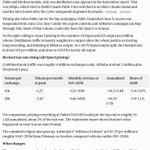
SPY: 13.8% compound return over 15 years. Up 11% YTD. Trades at 21x forward P/E vs 10 year mean of 20x. Average of 9% EPS growth over past 10 years. (If you want the SP500, buy VOO which has lower fees instead of SPY).
QQQ (Nasdaq 100): 18.5% compound return over 15 years. Up 18% YTD. Trades at 24x forward P/E vs 10 year mean of 25x. Average of 13% EPS growth over past 10 years.
SMH (Semi's): 24.8% compound return over 15 years. Up 71% YTD. Trades at 25x forward P/E vs 10 year mean of 20x. Average of 22% EPS growth over past 10 years.
IGV (Software): 16.0% compound return over 15 years. Down -12% YTD. Trades at 20x forward P/E vs 10 year mean of 35x. Keep in mind this EPS also is a blend of consensus so excludes plenty of SBC depending on the company (just saying despite the SaaS-pocalypse, the group doesn't stand out as "cheap"). Average of 12% EPS growth over past 10 years.
Think about that for a second. You can own QQQ which is America's best tech companies (and the world buys American tech) for 24x EPS or a 4.2% yield on NTM that goes to a 4.7% yield on Y+1 to a 5.3% yield on Y+2, ... And you regularly get to buy QQQ at 20x or a 5.0% yield that increases over time. To me, that's a shockingly good deal compared to a risk-free rate that pays you in devaluing USD and is taxed.
It's kind of remarkable that vehicles that have provided better returns than 99% of the active management industry (and 100% of the industry on an after-tax basis) with pretty digestible downside volatility aren't at least 50% of everyone's portfolios.
I guess there is no face to these vehicles out there promoting them non-stop and no fees to feed an eco-system of advisors / marketers / etc.
Anyways, I just encourage people to actively think about VOO / QQQ. Have you outperformed it over 20 years on an after-tax basis? Have your fund managers? ...

Seems like we may be good to go here:
-AI functionality is genuinely mind-boggling and ROI is obviously there (not categorically of course). People who say otherwise might as well try to convince me the sky is green. I just don't see it that way based on my lived reality.
-OAI growth expectations tempered from irrational. Funding will be completed soon.
-ANT had a soft Q3 but should accelerate in Q4. S1 looks great - no gotchas. Positive surprises in a lot of places - particularly with improving compute margins and being solidly FCF positive. IPO will get done at reasonable price. ($DXYZ).
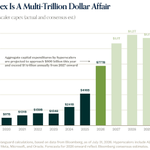
-SPCX / META spending / capital raise plans already out there / getting completed.
-Hyperscaler earnings likely all positive.
-Semi supply constraints likely limit spending growth in 2027 regardless of customer balance sheets / appetite. Helps de-risk pace of investment and lower probabilities of a big digestion period in 2028.
-Multiples basically at trailing lows w/ US yields stabilizing / improving.
-Momentum selloff pretty fierce compared to priors w/ X filled w/ AI bears doing victory laps. So always better to be buying into negativity.
Let's see.
3 random thoughts on $META
1) Re: The Cheeky Pint podcast - It's kind of crazy they admitted that their AI buildout is a huge bet that will have "very, very, very bad" financial consequences if it doesn't work out. Especially bc monetization is likely far into the future so doesn't that suggest 2027 potentially sees material EPS headwinds as the depreciation comes online?
I get it. There isn't a way to be competitive in AI w/o making big infra bets and I'm sure they were excited in the moment about Muse success. But certainly pulled the curtain back a bit...
2) Muse is great. I get a monthly note on all local events in my area (sports, music, theater, restaurants, etc.). I paid two parking tickets with it. And I have it looking for a new pair of dress shoes and a PS5 Pro (we haven't found either to my liking so the search continues).
But I'm not sure what else to do with it so I haven't checked the app much after that.
3) I assume the Muse data will be added to the knowledge graph. That's interesting bc now META knows far more about me and my ongoing searches. I would think that has to improve targeting / pricing on core META properties.
As opposed to just showing me general products that match my interests / pixel data, they now know that I am in need of new dress shoes on an ongoing basis since the search is still outstanding - and I would think advertisers that have shoes exactly like or even adjacent to what I'm looking for would want to target me on FB / IG.
Anyways, the thought is maybe monetization of Muse actually first shows up as higher monetization of core META.
Ok, it might be over folks.
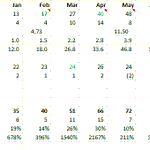
Anthropic revenue disclosure maps to ~5.8b in September revenue or 70b ARR which means August / September only increased by 2-3b ARR in each month.
[There is no way that ARR is calculated using last day of the month as that would be more aggressive than anything I've ever seen out of companies this size (exception: Musk).]
Worst monthly numbers by far this year. (Maybe some self-infliction from cleaning up distillation?).
My rough math indicates OAI / ANT ARR monthly add softened from 16b in July to 10b in Aug to 9b in Sept. That is no bueno...
Supportive of the view that either CAPEX is getting cut or pricing is going to weaken substantially.

For what it's worth, I think Anthropic ARR and revenue are both gross per their consistent commentary that they are the principal in transactions.
So the revenue and ARR tie nicely, and mention of 85% GMs likely means the cloud partner share is categorized as S&M.
So I think this all foots.
And, fwiw, Claude says cleaning up distillation is at most 500m / mo headwind so that's not it. But apparently company is saying otherwise?
Dumb question but what's the advantage of $META having spent 100b+ to develop their own model under Muse, as opposed to having kept that money and just built Muse with whatever model gets the job done?
$MS Q3 CIO survey had some interesting results.
These surveys aren't super reliable - partly because big company CIOs are often very political so have to take all feedback with a grain of salt.
Highlights
-AI is at top of enterprise priority list. Basically every other category decreased including security.
-LLM share of AI spend jumped from 11% in Q2 to 16% in Q3 – not surprisingly the biggest jump.
-LLM share of AI spend over next three years jumped from 17% in Q2 to 21% in Q3 – again, the biggest jump amongst answers
-Nearly all SaaS companies declined in expected incremental share of AI budgets – foots with slow progress on product / sales of AI products at SaaS companies
-50% of CIOs said they were funding AI from net new dollars directed towards AI.
-50% of CIOs said they are not using any open source AI models today; 4% said open-weight usage is >50%. [I’m honestly guessing most CIOs have no clue or answered for budget share and not workload share]
-42% of CIOs said not sure about ROI on token spend. [Again, CIO’s are typically large company politicians so not sure what to make of this answer. Also what was the immediate ROI on giving employees PCs or cell phones?]
-43% have token spend controls in place
OpenAI at 70b net never really made any sense intuitively.
Still seems like net ARR added in September was 17b similar to 17b in August. 17b is still pretty ridiculous and suggests we finish the year ~200b gross across ANT / OAI.

Another day, another bit of AI functionality, and another question as far as incumbents...
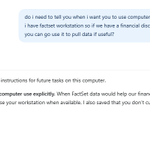
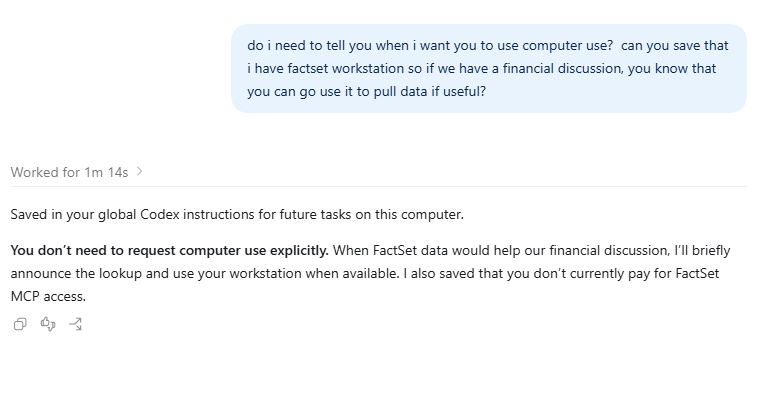
So I previously tested $FDS MCP which was a huge advance for AI financial functionality, and a growth driver for $FDS subscriptions (call it 20% uplift to enable).
And then today I tested just using OAI's computer use on the regular desktop session, and it worked pretty well albeit a lot slower.
Kind of funny how quickly some of the SaaS bear points from earlier this year are materializing...
In this case, it's that usage of the SaaS app becomes more automated from outside and becomes unmonetizable...
(Separately, being bullish on $CRM Claudeforce is really puzzling to me - that felt more like a defensive point for the SaaS won't go away tomorrow than an offensive point for SaaS will participate in AI).

Should have added that OAI simply saved down that I have $FDS and will just use it when it needs to going forward....!
I'm really curious to know what percent of $GOOGL / $AMZN ad spend consists of brands buying sponsored listings for their own search terms - basically spending to defend their own screen turf from competitive ads.
See below for searches for Speedo Goggles:
GOOGL: The entire visible screen is sponsored ads which Speedo has to pay for. The next screen down has Speedo in a thin organic result followed by a Deals market ad where Speedo again has to pay for shelfspace.
Using Gemini search for "Find me speedo goggles" only showed Speedo branded goggles.
AMZN: Speedo has an organic link in the bottom left and right, and otherwise is surrounded by competitive listings. Interestingly Speedo not paying up here (maybe realized using branded term this close to checkout means consumer is buying Speedo regardless).
Using Alexa AI search for "Find me speedo goggles" only showed Speedo branded goggles.
I personally find GOOGL / AMZN search results to be over-monetized w/ ads that don't add value - and, in fact, make it more annoying for me to find what I want.
AI search for products on AMZN works really well for me fwiw so I must already be seeing far fewer ads simply by this usage shift.
I don't really know what happens to this "traffic defense" spend in an agentic world. Feels like it would be less necessary in a world where agents need to be trustworthy to win consumer preference. So hard to imagine I ask an agent for speedo goggles and it spends 80% of the answer discussing competitive brands like regular search results do today...
Maybe consumers always want choice so there is room for other brands to pay to be mentioned within the AI results - while still not being dilutive to the consumer's experience?
Or, maybe agents can find the best 2-3 products so less need for brands to advertise within search and just put those dollars towards improving product quality / Internet posts to drive agentic preference?
Random thoughts...


I tried Muse / Instinct for an upcoming trip to a dense metro.
Ideas: Both were pretty good as far as providing 4-5 ideas. I realize that prompting for hotels is challenging because there are a lot of details I don't know I care about until I do a regular search. But I should probably create a long-form prompt for travel preferences.
Selection: Both seemed to draw heavily from $BKNG / $EXPE which makes sense as far as time-to-market w/ good inventory selection.
Pricing: A bit all over the place. Some listings included tax - others didn't, some were wrong, etc. But not wildly unreliable and I'm sure will get there.
Ultimately, Muse told me to book a hotel via my loyalty app for the points.
On one hand, maybe this is good for the OTAs as initial AI drives more bookings share, and smaller hotels continue to rely on OTAs for expanded value prop (coordinating AI purchases / cancellations / etc.).
Or maybe it's bad for the OTAs because, over time, agents can simply go populate inventory directly off hotel websites, build even better review systems (as the AI agent asks for detailed feedback from your stay in order to do better next time, and anonymously pools this data), and AI agents participate in that 13-18% OTA take-rate pool at a much lower rate?
Will the OTA's have their own agents? Yeah, but I guess they aren't exactly tech leaders and their customer relationship lacks context (calendar, email / messaging traffic related to trip, etc.) compared to $GOOGL / $META / etc. Also, their own AI agents are pretty mediocre right now.
Pretty sure travel is $GOOGL's largest advertising vertical. And even when discovery has moved off their platform, they retain the monetization prize because of last touch attribution (ie users go Google the hotel they want to book and the eco-system disproportionately says Google brought the customer in). But if the discovery and booking move off $GOOGL, that's likely going to be a real issue.
Random thoughts. Had to consider it as a contrarian long with $BKNG at 13x street 2027 GAAP EPS but probably too tough.
I'm going to date myself here but I remember a time when I was teenager, and the software functionality in the PC-era was advancing at such a rapid clip that it was next to impossible to keep up.
Windows would have tons of new features every year, browsers advanced, email clients advanced, photo-editing tools advanced, etc.
I don't know why my physician parents bought a computer but I'm really glad they did. I made sure I knew about every single feature / option across the hardware (I'd open it up and upgrade RAM, sound cards, etc.), operating system and apps.
That was a time when you could buy books to learn Lotus 123 or Photoshop or whatever. And the books were super useful but also stale by the time you finished reading them.
The mobile / Internet cycle for some reason felt slower to me.
The AI cycle feels similar although maybe faster. Back in the PC era, my ability to use the new thing came down to my having the time / budget to go upgrade my hardware / software.
Every time I log into Claude / Chat, there is a bunch of new stuff I haven't tried yet, new offerings weekly, etc.
And it's all immediately available for basically free.
This is a worthless comment but that "real functionality advancing far faster than adoption" was a 1995-1997 feeling, not a 2000 feeling.
And there will be a time when Office kills off Lotus 123, Windows NT kills off Novell NetWare, Access kills off Borland, Adobe kills off QuarkXPress, etc. But maybe that's a handful of years out?
$QQQ forward P/E has averaged ~25x for the past 10 years.
It currently trades at ~20x the 2027 EPS estimate.
Let's assume a big recession in semis. I cut the 2027 EPS estimates for NVDA, AVGO, AMD, MU, LRCX and AMAT by 50%.
$QQQ is then trading at 24.5x the revised 2027 EPS.
Obviously, that isn't going to happen but shows that the market is already effectively pricing in an outcome like that already. [Maybe that's too optimistic and market would trade at 20x EPS in that scenario which would present 20% downside from here if it were to unfold].
I'm not smart enough to have a view on 2028 yet but doesn't feel like capex is going to get cut materially unless Anthropic / Open.AI growth dramatically decelerate.
Separately, AI in Excel is pretty solid. Just obvious to me AGI is already here.

