




“Mormons turned a swamp into a metropolis. Then they turned a desert into an empire. It’s the most American story.”
Their religious beliefs take them to Missouri. Neighbors learn they are anti-slavery and violently drive them out.
They go to Illinois and turn a swamp into a city that rivals Chicago. Only to have violent mobs run them out.
They walk toward Utah. Hoping to find a safe place to gather.
Jim Bridger mocks them. He bets $1,000 they can’t grow crops in Utah. They continue anyway.
The Utah soil is so hard it breaks their plows. So they engineer a way to water a desert.
Their crops grow. Salt Lake City sprawls. They expand. Latter-day Saints settle 500 towns across the West. A network of farms, commerce, and faith.
Their women become the first women to vote. They elect America’s first female state senator.
Their women organize themselves. With very little training, they create a system that lowers infant mortality to among the lowest rates in the country.
When the Depression hits, Latter-day Saints implement the most effective welfare program in the country. Decades later, Ronald Reagan studies it and calls it a model for the country. Its impact is seen today as Utah has the lowest usage of federal food assistance in the country.
The pursuit of knowledge and science becomes a hallmark. They start universities. They send their smartest men and women back east to learn the latest ideas and bring them back.
They are innovative. Technology that changes the world emerges from their culture. The television. The artificial heart. The weapons that won WWII. The beginnings of the internet.
The work ethic and cooperation that propelled them to develop the American West continues today. Their outsized influence on the world is famous.
They know religious persecution better than most. So they champion religious freedom for all, even those they disagree with.
Sociologists are obsessed with their outcomes. A Princeton researcher studied teens in America. She concluded that “Mormon teens are faring best.” Harvard data recently found that kids who grow up in Latter-day Saint homes are the most likely to say they feel loved by both parents. Other national studies consistently find them to be the happiest people in the country.
Gallup finds they are the most observant Christians in the country, a dedication to their faith that is unrivaled. Pew Research finds they know many Bible stories better than any other Christians.
A swamp became a metropolis. A desert became an empire. A persecuted people became the happiest in America. That’s the most American story ever told.
Someone praying for you in another building can change your brain in real time. There is a study that proves it.
Researchers at North Hawaii Community Hospital placed 11 people inside fMRI scanners, fully isolated. In a separate building, spiritual leaders who knew them personally sent focused intentions toward them at random two-minute intervals. The receivers had no way to know when. Their brains lit up at the exact moments the senders focused on them. Specific regions associated with attention and awareness activated on cue. The odds of this happening by chance were less than one in seven thousand.
Most people have never heard of this. Here are three more.
Hand-holding and pain. Researchers placed 22 couples under EEG caps. When the woman was in pain and her partner held her hand, their brain waves synchronized. The more empathy he felt for her, the more their brains coupled. The more their brains coupled, the more her pain decreased. Touch combined with focused care produced a measurable analgesic effect. The lead researcher got the idea while holding his wife's hand during the birth of their daughter.
Two brains in shielded rooms. A Mexican neuroscientist named Jacobo Grinberg ran a series of experiments at the National Autonomous University of Mexico. Two participants meditated together for 20 minutes. Then they were placed in separate electromagnetically shielded rooms more than 14 meters apart. One participant was shown 100 random flashes of light. The other, hooked to an EEG with no sensory contact of any kind, registered matching brain-wave responses one out of every four flashes. Pairs who had not bonded showed nothing.
Group prayer. Andrew Newberg at Thomas Jefferson University has spent more than two decades scanning the brains of praying nuns, meditating monks, and chanting Sikhs. His imaging work shows a consistent pattern. The frontal lobes activate. The parietal lobes quiet. The effect amplifies in groups. Brains in shared prayer entrain to one another the way two pendulums swinging in the same room eventually fall into the same rhythm.
These studies measure what physically happens to the human nervous system when people focus caring attention on each other, in the same room or at a distance. The findings are consistent across labs, methods, and decades.
The basic finding, that human brains synchronize during empathic connection, is now mainstream neuroscience. Newberg alone has published more than 250 peer-reviewed papers.
People have been doing this for thousands of years and calling it prayer. Christians alone offer a window into the variety. Latter-day Saints kneel as families. Catholics pray the rosary. Protestants join hands in prayer circles.
What is actually happening when you pray? On the imaging, something measurable. On the EEG, something synchronized. On the pain scale, something diminished.
Prayer works.

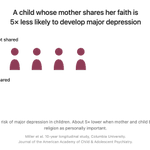
The most powerful protection against childhood depression is having a mother who values religion.
When a mother and her child both said religion was personally important to them, the child was 80 percent less likely to develop major depression.
Five times lower risk.
That comes from a 10-year longitudinal study at Columbia led by psychologist Lisa Miller. It's the largest protective effect against depression she has found anywhere in the resilience literature.
A decade later, Miller's team put adults from the same cohort in MRI machines. People who rated religion or spirituality as personally important had thicker cortices in the exact brain regions that thin in people at high familial risk for depression. The protection has a physical signature.
The variable wasn't belief alone. It was shared, internalized importance. Mom and child both meant it.
The strongest known buffer against depression in kids is a parent and child who share a faith that actually means something to both of them.

Poor Americans who attend church regularly are happier than rich Americans who never go.
Behavioral scientist William von Hippel thought he'd made a coding error. He hadn't.
"Regularly attending services has a bigger impact on your happiness than wealth," he writes. "Money buys a fair bit of happiness but connection gives you more bang for the buck."
What's happening? Rich people already have most of what money buys. What they lack is what churches provide for free: weekly, repeated contact with people who know your name.
Von Hippel is direct about the cost: "I suspect that wealthy, educated urbanites are paying a steeper price for their lifestyle than they realize. Many of us have paid too great a price in connection for our increased autonomy."

"If I told you there was one free thing you could do every Sunday that would make your kids happier, healthier, smarter, and closer to you, you'd think I was selling something."
Take your kids to church regularly. I don't care if you believe. The data is so lopsided that skipping it is the parenting equivalent of refusing vegetables because you don't like the taste.
Grades. Religious teens get As at almost twice the rate of nonreligious teens. In a class of 100, that's 24 A-students instead of 14. Church gives a kid the same academic boost as being born rich instead of poor.
College. Working-class religious kids earn bachelor's degrees at double the rate of their nonreligious peers. Middle-class kids do it at 1.5x the rate. For families without a trust fund, this is one of the most powerful forms of upward mobility social scientists have measured.
Character. Religious teens are far less likely to lie, cheat, or do things they hope their parents never find out about. They're more likely to care about racial equality, the elderly, and the poor. They reject the idea that morality is whatever works for you in the moment. That kind of kid doesn't happen by accident. It's built.
Closeness. 60% of parents of religious teens say they feel "extremely close" to their kid, compared to 50% of nonreligious parents. The kids report the same thing back. They get along better with their parents, talk about hard stuff, and actually want to spend time with their family.
Despair. Religious teens are dramatically less likely to be depressed, anxious, lonely, or feel that life is meaningless. 90% of devoted religious teens never binge drink, compared to 41% of the disengaged. Economists named the modern epidemic "deaths of despair." Regular church attendance is one of the strongest known buffers against it. Parents are spending fortunes trying to solve teen mental health. The most evidence-backed intervention is free.
Purpose. Religious young adults report higher purpose, gratitude, life satisfaction, and resilience. These are the exact traits every parent says they want their kid to have.
Here's why it works. Affluent families already surround their kids with networks of stable, accomplished adults through neighborhoods, schools, and parents' colleagues. Working and middle-class families usually don't. A congregation is often the last institution in American life that puts your kid in weekly contact with dozens of stable, employed, sober adults who know their name. It used to be called "a village." Now it barely exists outside of churches.
"But I don't believe." Your kid doesn't need your theology. They need you to show up.
"But church is boring." So is sitting through a kindergarten music recital. Parenting is the deliberate choice to be bored on purpose for someone you love.
There's a church within 15 minutes of nearly every American home. You don't need money, connections, or credentials to walk in. Nothing else in this country will surround your kid with engaged adults, teach them moral seriousness, and give them a stable weekly rhythm at zero cost.
You already drive them to practices that produce far less. The free thing on Sunday produces more, on more dimensions, than almost anything else you do as a parent.
You don't have to believe anything. You just have to take them.


God delivers a message to an uneducated boy from a poverty-stricken family.
He is mocked.
Through him, God reveals America’s greatest literary work. Proof that he is a prophet.
He is hated.
His followers gather in Missouri.
Many are murdered.
They flee to a swampland called Nauvoo.
The Prophet is martyred.
His people move on.
They cross the plains and settle a desert.
They thrive.
The government threatens them and passes laws meant to cripple them.
They overcome.
They thrive.
They fill the earth with a message of Christian hope.
The media treats them as a spectacle. A national obsession.
They thrive.
The story of The Church of Jesus Christ of Latter-day Saints is America’s greatest story.

