

A non-partisan statewide coalition advancing the factual case for responsible electric transmission infrastructure investment in Texas
Austin, TX
Joined May 2026
- Tweets152
- Following59
- Followers121
- Likes4





“Every Texan already pays a congestion charge and in 2025 it cost ratepayers about $2.5 billion. You can keep paying it forever to work around wires that are too small, or you can spend once on wires that are big enough to avoid those charges. Texas studied that question and chose to build. We need to get on with it.” — Bill Lauderback, Executive Chair, Texans for Responsible Infrastructure Investment
zurl.co/lGvp2
Detours do not add capacity. Wires do. Build the backbone once, at the right scale, and the congestion charge Texans are already paying starts coming down instead of going up. zurl.co/jG9hU

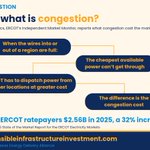
Two Texans can use the same amount of power at the same moment, yet pay very different amounts for its delivery. That gap is the price of moving power across a grid that is running out of room — and in 2025 it cost ratepayers roughly $2.5 billion. zurl.co/hFrlM

“A congestion charge is the grid telling you it is out of room. Texas has been paying that bill for years. In Far West Texas it has stopped being all about money and started being a load-shed plan — a reliability problem. You do not negotiate with a thermal limit — you build past it.” — Bill Lauderback, Executive Chair, Texans for Responsible Infrastructure Investment
zurl.co/ZuJSy
“Nearly $12 billion is not a forecast, a model, or an advocacy estimate. It is what Texans have already paid because more transmission is needed to keep up with demand. Every year that we debate the backbone instead of building it, we add billions to ratepayer bills.” — Bill Lauderback, Executive Chair, Texans for Responsible Infrastructure Investment
zurl.co/nv67t
On a bill, congestion is a cost. In the control room, it is a limit — and in Far West Texas that limit now carries the most serious designation ERCOT assigns. zurl.co/5ZOnN

Add up the Independent Market Monitor’s real-time congestion figures from 2021 through 2025 and Texas consumers have absorbed roughly $11.7 billion in costs that exist for one reason: the transmission system could not deliver the lowest-cost power to the people and businesses who needed it. zurl.co/nwezZ

“Where is the congestion? ERCOT’s Market Monitor answered that question in May, pointing to West Texas as the location of the largest problems. The Permian Basin doesn’t have the transmission capacity to bring in the power it needs, and the Panhandle doesn’t have the capacity to export the power it generates. In 2025, that congestion cost Texas ratepayers hundreds of millions of dollars.” — Bill Lauderback, Executive Chair, Texans for Responsible Infrastructure Investment
zurl.co/Z8YjS
“The people accused of engineering this plan for their own benefit just testified under oath to the Texas Senate Committee on Business and Commerce that the accusation is patently false. The Legislature — not some utility executives — overwhelmingly approved the Permian Basin Reliability Plan in 2023 because the reliability problem is real, and ERCOT chose 765kV because its engineers ran the numbers and found that to be the best solution. Texans deserve a debate about this grid based on facts, and not on myths.” — Bill Lauderback, Executive Chair, Texans for Responsible Infrastructure Investment
zurl.co/7nbhz
Congestion cost the ERCOT ratepayers $2.56 billion in 2025, and the single most congested region in Texas is the Permian Basin, where the cost rose 86% in one year because power cannot get in. Read our latest blog: zurl.co/6ILrH

Dismantling the Trapped-Electrons Myth: “It Is Simply Not True” zurl.co/yzwl4

We are excited to announce that three economic development and business organizations — the Greater Arlington Chamber of Commerce, the Parker County Economic Development Council, and @LaredoEDC — have joined TRII. zurl.co/9YUxt

“The load is already here, the wires take years to build, and under the rules on the table, the customers driving the need are the ones who will pay for it. Texas can have that conversation now, while there is still time to build — or it can have it later, while explaining to employers why the grid could not keep up with growth.” — Bill Lauderback, Executive Chair, Texans for Responsible Infrastructure Investment
zurl.co/NzkPD
"The answers to most of these questions have been on ERCOT’s website since January 2025. The regional and system-wide import paths need expansion under every imaginable scenario, and 765kV is the best high-energy alternative available. Texans deserve to ask hard questions. They also deserve to have the record read." — Bill Lauderback, Executive Chair, Texans for Responsible Infrastructure Investment
zurl.co/libQd
The claim that ERCOT’s models were “rigged” rests on a simple premise: that two different studies, designed to answer different questions and examine different geographical areas, should have identical assumptions. The premise is flawed from the start. zurl.co/trCMi

Additional generation and upgraded transmission are two halves of one reliability equation, not rival answers to it. zurl.co/SdKGX

Reliability means having power when and where Texans need it. Record demand, a queue full of new load, and rising congestion costs all point to the same conclusion — and the wires are the longest-lead investment on the grid. zurl.co/mbDE1

“There is no policy that makes a turbine appear faster. Texas’ utilities did the one thing the supply chain rewards — they got in line early, and the PUCT made them prove it. Throwing that place in line away for another year of argument would be an enormously expensive delay, and one that the state and ratepayers continue to pay for in the meantime.” — Bill Lauderback, Executive Chair, Texans for Responsible Infrastructure Investment
zurl.co/SlinB
“The need for more transmission in Texas is not a matter of opinion. It is in the grid operator’s annual report, in the Independent Market Monitor’s findings, and in the statutes the Legislature approved. Texas can keep paying for congestion and hoping generation appears behind a constraint, or it can build the network that delivers power to the Texans counting on it.” — Bill Lauderback, Executive Chair, Texans for Responsible Infrastructure Investment
zurl.co/9yapx
The demand for more electricity in Texas is not a forecast — it is already here. Grid experts and a decade of legislative and regulatory action all point the same direction: the state needs more capacity to move power, and new generation alone will not supply it. zurl.co/8EKar
