

The Source of ground-truth multimodal human motion & behavior data for Physical AI. From world models to humanoid control | 5+ years, trusted by leading labs
Joined October 2025
- Tweets67
- Following17
- Followers707
- Likes31





Pinned Tweet
Training humanoid robots?
You need motion data. Real, high-fidelity, human motion data. And until now - there was no open dataset purpose-built for humanoid robotics.
For 5 years, we've been building the largest enterprise-grade human motion and behavior datasets for embodied AI. Our data powered breakthrough SONIC research.
Today, at GTC, with @NVIDIARobotics, we're opening a piece of it to the world.
BONES-SEED:
→ 142,200 motion capture animations
→ Up to 6 natural language descriptions per motion
→ Temporal segmentation of every action
→ Curated for humanoid robotics
→ In NVIDIA SOMA and Unitree G1 (MuJoCo) formats
From text to action. Now yours.
Go build → bones.studio/datasets/seed
#NVIDIAGTC
When a model transfers motion from one body to another, does it keep the original motion?
A new NeurIPS 2026 paper shows it often doesn't.
BONES data in Research #05
The team at @AaltoUniversity used 355 BONES-SEED clips across 90 action groups, with matching Unitree G1 retargets, for a controlled human-to-robot study.
They trained the same model with correct pairs, without pairs, and with random pairs matched only by action. Correct pairs preserved differences between source clips. The other two training setups lost most of that variation.
Their Source-Instance Fidelity (SIF) metric checks whether outputs differ in ways that reflect the differences between their inputs. It helps expose what an action-level score misses.
Two people can perform the same action differently. Preserving those differences is part of what makes motion retargeting useful.
Congratulations to Zhiyuan Li, Wenyan Yang, @marttinen_pekka and @JoniPajarinen!
Paper: arxiv.org/abs/2609.37297
Project: cross-skeleton-retargeting.n…
BONES Research Network gives researchers access to open human motion data: research.bones.studio
#BonesResearchNetwork #BonesSeed #MotionRetargeting #Robotics
Walking, handling objects and getting back up. All with one controller.
Gary Yang, Junheng Li and Aaron Ames, the PAC-MAN authors we featured in #01, return to our series as part of the HANDOFF team.
BONES data in Research #04
When you reach for an object, you think about where your hand needs to go. The rest of your body coordinates in the background.
HANDOFF brings this idea to humanoid control. The planning system uses text instructions and visual observations to set hand targets, walking speed, and body height. One controller coordinates the robot’s movement.
The team distilled motion-tracking, walking, and fall-recovery teachers into a single policy. The motion-tracking teacher learned from human motions in BONES-SEED, retargeted to the robot.
The authors demonstrated different object tasks on a real G1 without task-specific controller fine-tuning.
Congratulations to @lzyang2000, @Junheng_Li1, Nehar Poddar, Yiling Hou, @giohuh_, Robert Griffin, @georgiagkioxari and Aaron Ames!
Paper: arxiv.org/abs/2606.06493
BONES Research Network gives researchers access to open human motion data: research.bones.studio
#BonesResearchNetwork #BonesSeed #HumanoidRobotics #RobotLearning
A real Unitree G1 navigated rooms and carried boxes on language commands. It never saw a single real-world demonstration.
The model that generated its navigation training data learned from G1 motions in BONES-SEED.
BONES data in Research #03
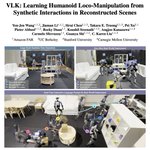
Researchers affiliated with Amazon FAR (@AmazonScience), @UCBerkeley, @Stanford and @CarnegieMellon developed VLK, accepted at CoRL 2026.
Instead of collecting expensive teleoperation data, they generated it: a navigation model trained on G1 motions from BONES-SEED synthesized new trajectories in reconstructed 3D scenes (the object-interaction model was trained on OMOMO sequences retargeted to G1). The team paired the generated movements with rendered camera views and language instructions to train the policy.
Then came the real robot: a Unitree G1 navigating to targets, picking up boxes and carrying them, without real-world fine-tuning
Congratulations to @wangyenjen, @jiaman01, @eric_srchen, @TakaraTruong, Pei Xu, @pabbeel, @rocky_duan, @KoushilSreenath, @akanazawa, @carlo_sferrazza, @GuanyaShi and C. Karen Liu!
Paper: arxiv.org/abs/2606.30645
BONES Research Network gives researchers access to open human motion data:
research.bones.studio
#BonesResearchNetwork #BonesSeed #HumanoidRobotics #PhysicalAI

Unitree G1 walked, opened doors and picked up objects, controlled by one operator through VR.
BONES data in Research #02
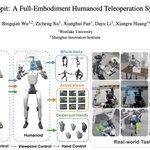
In Teleopit, @BotRunner64 (Bingqian Wu), Zicheng Xu, Xianghui Fan, Dayu Li and Xiangru Huang used 63,237 retargeted BONES-SEED clips alongside other motion data to train a whole-body motion tracker for VR teleoperation.
Congratulations to the authors!
Paper: arxiv.org/abs/2608.01834
BONES Research Network gives researchers access to open human motion data: research.bones.studio
#BonesResearchNetwork #BonesSeed #HumanoidRobotics #PhysicalAI

Unitree G1 dodged 19 of 20 throws with onboard vision - BONES data in Research #01
In PAC-MAN, @lzyang2000, @Junheng_Li1 & Aron Ames use selected BONES-SEED avoidance motions as human-motion priors for whole-body dodging.
Congratulations to the authors!
Paper: arxiv.org/abs/2607.28623
BONES Research Network gives researchers access to open human motion data: research.bones.studio
#BonesResearchNetwork #BonesSeed #HumanoidRobotics #PhysicalAI
Congratulations @zhengyiluo! Front page of Science. What a day :)

New in @ScienceMagazine 🎉
Really excited to share that SONIC is now published in Science Robotics!
SONIC formulates super-scaling motion tracking as the foundational task for more natural and robust whole-body control. Our learned tracker and latent space further support foundation models like VLA/WAM training.
Huge thanks to the team and collaborators who made this happen.
science.org/doi/10.1126/scir…
New checkpoints coming in today!
#ScienceResearch #ScienceRoboticsResearch

Congratulations to @yukez and the @NVIDIA team. SONIC published in Science Robotics and featured on the front page of Science.
Not the robotics front page. The Science front page. Humanoid whole-body control just became one of the most important stories in all of science.
Happy and proud our motion data could play its part.

SONIC is officially published in Science Robotics today and it made the Science front page.
We show the promise of scaling motion tracking toward natural, robust whole-body control for humanoid robots.
Huge thanks to the team, and more exciting work is on the way.
Paper: science.org/doi/10.1126/scir…
Code: nvlabs.github.io/GEAR-SONIC

Real-time, controllable, 33ms latency. ARDY is what next-gen animation systems will look like.
Congrats @kaifengzhao, @MathisPetrovich, @haotianz4, @TingwuWang, @SiyuTang3, @davrempe - amazing research, good luck at SIGGRAPH 2026!
Proud that our data helped power this one. 🔥
Special thanks to @SimonYuenNV and @cyrushogg for the great collaboration.

Introducing ARDY — real-time, controllable 3D human motion generation
Streaming text prompts + flexible kinematic constraints — root waypoints, full-body keyframes, joint targets — all at interactive speed
To be presented at SIGGRAPH 2026, Paper & demo
research.nvidia.com/labs/sil…
1/5
The motion stack for humanoid robots is getting bigger.
Proud to see our data becoming part of the foundation it’s built on.
Thanks, @lukas_m_ziegler for the clear breakdown 🙌

This is actually sick! 🤯
A motion generator for robotics. and gaming.
This is MotionBricks cooked by @NVIDIAAI. It's a 15,000 FPS real-time motion generation for robots and games.
MotionBricks shipped to SIGGRAPH 2026 with code that integrates directly into NVIDIA's GR00T Whole-Body Control stack. 15,000 FPS, 2ms latency, 350,000 motion skills from a single neural backbone.
Okay, let's have a look how it works: first train one generative model on 350k production-grade mocap clips (BONES-SEED dataset from Bones Studio).
Then add "smart primitives" on top, a unified interface where you specify navigation targets, object interaction keyframes, and style prompts. The network generates everything else in real-time.
There's no animation graph., and no per-task fine-tuning.
Their demo-character navigates, picks up a sword, vaults a bench, sits down, switches between zombie/injured/skipping styles. Every frame generated by the network, in real-time.
I think that this matters as MotionBricks is now core to GR00T Whole-Body Control which is the same stack powering humanoids widely used in research across the globe.
Btw. code ships with an interactive G1 demo, but a full robotics-integrated release coming in ~1 month.
The motion stack for humanoid robots is getting bigger! 🔥
Check it out here: nvlabs.github.io/motionbrick…
cc: @NVIDIARobotics
~~
♻️ Join the weekly robotics newsletter, and never miss any news → ziegler.substack.com
Pick and Place is easy. Until it isn't...
Episode 02 of Ground Truth drops soon.
A lot of confidence about to be misplaced.
Welcome to Ground Truth!
A series where in a not-so-serious way we share our experience from building datasets for Physical AI.
In this first episode, two robots learn that the real world is messy, unpredictable, and full of... stairs that are all slightly different :)
SONIC just crossed the embodiment barrier.
@Solo_Tech ported NVIDIA's SONIC to the @AGIBOTofficial X2 Ultra – a completely different humanoid morphology - using ~2,550 clips from BONES-SEED.
Same data. Different robot. It works.
This is why we built BONES-SEED as a universal motion foundation – not for one robot, but for many of them.
Congratulations to the @Solo_Tech team on this milestone.
bones.studio/datasets/seed

🚀 @Solo__Tech breakthrough: NVIDIA Sonic goes beyond the G1. 🌏
We’ve achieved a global first: migrating NVIDIA Sonic to a completely different humanoid morphology, the AGIBOT X2 🥇
This is a massive leap for transferable humanoid intelligence. We are moving away from single-robot controllers toward architectures that generalize across diverse embodiments.
The Specs:
Hardware: AGIBOT X2 Ultra (31 DoF)
Precision: 14-DoF Dexterous Hands
Capabilities:
- End-to-end whole-body locomotion with manipulation
- Single leg balancing and stylized motion
- Upper body gestures
Big respect to the team fueling this innovation all the way!
@meetsitaram @zeeshaan_7788 @Samarth_1506 @DevSodhi @flyingtaxiguy @build @frontiertower @nvidia @AGIBOTofficial @nebiusai @UFBots @vitl2907 @XeniaBulatov @NVIDIARobotics
To learn more about Solo Tech at the frontier of Physical AI: getsolo.tech/blog
#PhysicalAI #Robotics #Humanoids #NVIDIA #AGIBOT #SoloTech #EmbodiedAI #SoloSeven
SONIC. Kimodo. Now MotionBricks. Three @NVIDIA breakthroughs, all powered by our motion data.
From research to real-time production at 15,000 FPS. From digital characters to Unitree G1 robots.
This is what happens when great data meets great research.
Congratulations @TingwuWang and the entire team.

What is missing to bring real-time motion research into AAA games and real-world robotics?
We present MotionBricks, a step toward bridging this gap with two key components:
- a single generative latent motion backbone covering 350,000+ motion skills, running at 15,000 FPS with 2 ms latency and substantially improved quality and reliability.
- a unified smart primitive interface for locomotion, object / scene interaction, with fine-grained control over generated behaviors.
Webpage: nvlabs.github.io/motionbrick…
Code: github.com/NVlabs/GR00T-Whol…
Paper: arxiv.org/abs/2604.24833 (ACM TOG / SIGGRAPH 2026)