

Professor at Rutgers, director of a cognitive & network neuroscience lab – neuroimaging, connectivity, cognitive control, NeuroAI. Author of Brain Flows
Rutgers University-Newark
Joined July 2013
- Tweets1K
- Following846
- Followers3.8K
- Likes2.3K





Inspired by Edinburgh’s legacy of big ideas (e.g., Hume), on a train leaving the city, I crafted a book proposal about big ideas in network neuroscience—how brain flows generate representations that compose our minds. The rest is history, and this book: shorturl.at/dSfwB

Thanks to first author Lakshman Chakravarthula
and coauthors Takuya Ito and Alexandros Tzalavras!
The paper: nature.com/articles/s41593-0…
colelab.org/pubs/Chakravarth…
19/n

Together, these results suggest the brain's network geometry is a computational substrate, not just wiring: low-dimensional connectivity compresses representations for generalization, while high-dimensional connectivity expands them for task-specific implementation 18/n
In an independent dataset (Human Connectome Project, n = 352), the compression-then-expansion pattern replicated (347 of 352 participants showed association-cortex compression), and higher representational dimensionality predicted fluid intelligence (r = 0.29) 17/n

And expansion? In an exploratory analysis, expanding regions encoded conjunctions of task features, e.g., stimulus × demand × response combinations (r = 0.46). Activity flow models reproduced this (r = 0.34), consistent with expansion situating abstract info in context 16/n

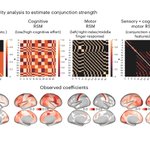
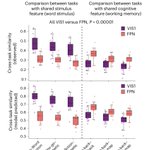
These shared factors were interpretable. The primary visual network (VIS1) treated word-based tasks as similar, while the frontoparietal network treated working memory tasks as similar despite their different stimuli. Activity flow models reproduced both patterns 15/n

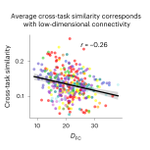
What does compression buy? Regions with lower-dimensional connectivity had more similar representations across tasks (r=−0.26), consistent with shared latent factors that can support generalization. Simulations confirmed low-dimensional connectivity generally produces this 14/n

Transformation, not just transfer: flow-generated representational geometries were closer to the target region's actual geometry than to its sources' geometry in 339 of 360 regions. Connections didn't simply copy representations from one region to another 13/n
Activity flow over resting-state connectivity reproduced the compression-then-expansion pattern at the individual-subject level: high dimensionality in visual networks, compression in default-mode (and auditory) networks, and re-expansion in motor networks 12/n

The models also generated each region's representational dimensionality (r = 0.55), with all results beating shuffled-connectivity null models. Residuals were informative too, showing where local computations likely add to (or reduce) dimensionality beyond the flows 11/n

Correlation isn't generation, so we built activity flow models: each target's task activity predicted from source activity weighted by resting-state connectivity. These empirical neural network models accurately generated activations and representational geometries (RSMs) 10/n

This relationship isn't mathematically inevitable. In simulations, nonlinear local computations decoupled connectivity dimensionality from representational change (r = 0.98 linear vs. 0.05 nonlinear). The brain seems to sit in between, with connectivity as a strong constraint 9/n
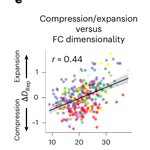
Key result: connectivity dimensionality predicted compression vs. expansion across all cortical regions (r = 0.44). Lower-dimensional connectivity went with compression, higher-dimensional with expansion. This held after controlling for region size, SNR, and other confounds 8/n

First, we recovered the compression-then-expansion (U-shaped) pattern of representational dimensionality along the sensory–association–motor hierarchy. Connectivity dimensionality broadly tracked this profile 7/n

We estimated vertex-level connectivity in two steps: graphical lasso (regularized partial correlation) to find connected region pairs, then principal component regression for vertex-to-vertex weights. Dimensionality = participation ratio (number of dimensions to fit the data) 6/n
We used fMRI from 18 participants performing 16 diverse tasks (96 task conditions; multi-domain task battery from King, Diedrichsen et al.), plus resting-state fMRI from the same people. Rest connectivity and task representations were measured in separate brain states 5/n

The intuition: if a target region's vertices all have similar connectivity patterns (low-dimensional connectivity), incoming flows get squeezed into fewer dimensions (compression). Diverse connectivity patterns (high-dimensional connectivity) preserve or expand dimensions 4/n
It's often assumed that connections play a passive role (like cables between computers), with transformation happening within regions. We hypothesized instead that the geometry of connectivity itself (its dimensionality) shapes how representations change from region to region 3/n
Prior work (Ito & Murray 2023) found task representations are compressed in association cortex and expanded in sensory and motor cortex. This is thought to support flexibility: generalizing across tasks while keeping task-specific details. But what generates this pattern? 2/n

Do brain connections just carry information between regions, or do they transform it?
Lab's latest out in Nature Neuroscience, led by Lakshman Chakravarthula: "Network geometry shapes the transformation of task representations across the human cortex"
colelab.org/pubs/Chakravarth… 1/n

My latest post to Neural Flows!
"Fluidized brain flows and the dynamics of consciousness"
A new model from my forthcoming book (Brain Flows) that may help explain the purpose of the brain’s "dark energy"
neuralflows.substack.com/p/f…
