




The break-even point typically hits around age 82-85.
If you live past 85, the lifetime guarantee of an annuity tends to outperform SWP. If you pass away earlier, an SWP leaves an inheritance behind, whereas an annuity leaves nothing to your heirs.
#statistics #datascience
1
16
The hybrid split:
• The Floor (40-50% Annuity): Locks in guaranteed cash flow for non negotiable living expenses.
• The Growth (50-60% SWP): Provides inflation hedging, portfolio flexibility, and legacy wealth.
#acturial #acturialscience
12
1. True Point-In-Time Data: Your algorithm must only see what was known at the exact millisecond of the trade. No lookahead, no future corporate action leaks.
2. Survivorship Free Datasets: Include bankrupt/delisted assets. Ignoring failure over-inflates returns.
#statistics
3. Micro Market Friction: We simulate dynamic slippage, borrow fees, and execution lag, not static 5bp assumptions.
4. Automated Risk Metrics: Continuous, tracking of drawdown, leverage, and capacity.
The goal is live market predictability.
#DataScience

Expiry week is when F&O contracts die.
Volumes look exciting.
Charts look drunk.
People confuse noise with a signal.
If you don’t have a written reason to trade expiry, you don’t have a reason.
Watching is free. Clicking is not.
#statistics #datascience #Nifty50

Everyone obsesses over asset allocation.
Smart investors obsess over asset location.
Holding the exact same 60/30/10 portfolio in
the wrong tax wrappers can bleed ~1.5% in net CAGR. Over 15 years, that tax leakage costs you a third of your terminal wealth.
#Fintwit #statistics

1
1
49
• Debt: Bank FDs bleed 30%+ slab tax every single year. Shift to Arbitrage to preserve compound interest.
• Gold: Physical & ETFs trigger capital gains. SGBs are 100% tax free at maturity.
• Equity: Avoid frequent churn (20% STCG). Let gains compound inside equity funds.
1
1
22
Tax drag doesn’t just take your tax today, it destroys every rupee of compounding that money would have generated over the next decade.
Before optimizing for an extra 0.5% alpha, audit your wrappers. Asset location is the only free lunch left in investing.
#datascience
1
1
28
Two investors.
Same ₹10,000 monthly SIP.
Same 12% market CAGR over 10 years.
Yet Investor A ends up with 35% MORE wealth than Investor B.
Your SIP isn't working because of average returns, it's working (or failing) because of sequencing
#statistics #FinTwit

SIPs compound units.
• Early Crash: You accumulate peak units at rock-bottom prices when your capital base is tiny.
• Late Crash: A drawdown hits when your portfolio is at peak size, wiping out years of gains.
Same index start and end point. Radically different terminal wealth.
1
11
Stop pausing SIPs during early drawdowns, they are unit accumulation gifts.
The risk shifts as your portfolio grows: ₹1L at -30% is a ₹30k dip; ₹50L at -30% is a ₹15L loss.
Glide into debt via STP 2-3 years before your target goal date.
#datascience
4
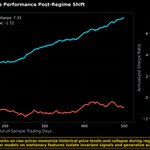
Markets change faster than your retraining schedule. Batch retraining models monthly is laggy and computationally wasteful in non-stationary environments.
By the time you refit, the regime has already shifted. It’s time for real-time adaptation. #statististics #Quant

Visual proof: Monthly Batch Retraining (Blue) vs. Online SGD Updates (Green).
Following a major market regime shift, the online model adapts instantly. The monthly model stays stuck in the past.
Stop building static models for dynamic markets.
#DataScience #TradingStrategy
1
13
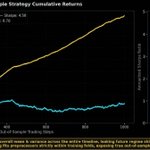
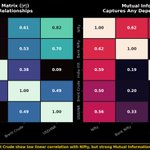
A 10-layer Neural Network trained on raw prices will lose to a 1-layer linear model trained on stationary returns every single time.
Model architecture is secondary to feature stationarity.
#QuantFinance #MachineLearning #DataScience #statistics

1
1
35
Raw price levels trick deep models into memorizing the training trend.
When an out-of-sample regime shift hits, the deep network collapses because it doesn't understand high price levels in a bear regime.
#Algotrading #DeepLearning
1
10
In quantitative finance, the signal-to-noise ratio is near zero.
Without regularization, your model isn't learning market dynamics, it's memorizing historical noise. Out-of-sample failure isn't a surprise; it's a mathematical guarantee.
#Fintwit #machinelearning

It comes down to loss landscape geometry:
• Unregularized: Sharp, narrow minima. Perfect backtests, catastrophic live performance.
• Regularized (L1/L2/Dropout): Broad, flat minima. Parameters tolerate real-world regime shifts.
1
16
L1/L2 penalties and Dropout aren't optional hyperparameter tweaks in finance, they are the entire reason a model works live.
Smooth your loss landscape, or watch live execution crumble against shifting market regimes.
#statistics #datascience
11