

Global investor. In-depth research on quality stocks. 1. Strong and durable businesses for the long term. 2. Low Volatility 3. Low Fees. No investment advice!
Global
Joined April 2013
- Tweets1.7K
- Following137
- Followers4.3K
- Likes4.3K


Pinned Tweet
Superinvestors Performance Analysis
This is my annual, long-term analysis of the performance of selected fund managers.
Warren Buffett remains the greatest of all time.
Thanks to all who contributed to this dataset!
@GSpier @WilliamGreen72 @MnkeDaniel @MohnishPabrai @ValueStockGeek

I'm not saying that all areas of the market are overvalued, but:
The S&P 500 as a whole is as expensive as it has been in only four instances since 1881 (145 years), at least relative to bonds.
The Excess CAPE Yield, developed by Nobel laureate Robert Shiller, measures the cyclically adjusted earnings yield relative to the risk-free real interest of 10-year Treasury bonds.
Historically, stocks have shown an average excess earnings yield of 3.3% relative to real bond yields.
Since 10-year real interest rates are currently around 2.96%, the current excess return of stocks is extremely unattractive.
Of course, this is all based on the past 10 years of earnings, and perhaps the aggressive earnings estimates of analysts will materialize. However, if history holds true, it doesn't look good for stocks...

2
601
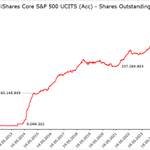
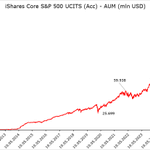
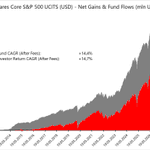
I analyzed the S&P 500 UCITS ETF to understand the return the average investor achieved in the fund.
Lately, I've been preoccupied with the topic of fund volatility and outflows at the wrong time, and why this is a crucial factor in generating value for clients. We're all familiar with examples like Peter Lynch's Magellan Fund, which generated exceptional returns while the average investor lost money, or funds like Cathie Wood's, which, despite strong positive performance since inception, have seen the average investor lose 14.7% p.a. since the fund's launch.
The S&P 500 ETF, however, presents a very different picture. Here, too, I suspected that investor timing would negatively impact performance, resulting in lower returns for individual investors than those of the ETF.
I was wrong: The average money-weighted investor (IRR) outperformed the underlying index, and the fund now consists primarily of net gains for investors. I can't say exactly why this is, but many people probably tend to prefer safer ETFs during times of crisis or choose savings plans that buy more shares when prices are low. In any case, it's a fascinating insight for me and further proof that ETFs are a phenomenal idea.

2
2
539


What percentage of the time do you estimate the S&P 500 spends at all-time highs (including dividends, since 1993, weekly prices)?
Correct answer:
28%10%
8%15%
24%20%
40%25%
25 votes • Final results 1
539
Here is Terry Smith's portfolio in the Fundsmith SICAV Equity Fund. As he mentioned in his Semi-Annual Letter to Investors, he has made significant changes to his portfolio. Only one position remained unchanged $CHD. In my opinion, under pressure from fund investors to outperform the stock market, he has tilted his portfolio more towards weak, momentum-driven companies. This may help him in the short term, but I think it will have a negative impact in the long run. We will see.

1
1
767
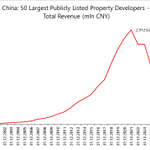
These are the revenues of the 50 largest publicly listed real estate developers in China. After a historic increase from 2000 to mid-2021, revenues have now plummeted by more than 55%. Currently, there is a massive shift in transaction volume from new construction to existing housing.

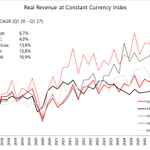
Richemont $CFR today released very strong quarterly results, suggesting that the luxury market in the APAC region, particularly in China, is on the road to recovery. While real CAGR, at 4% since 2019, remain below average, they have increased significantly in recent quarters.


2
525
What surprised me was how much of the global stock market's performance is driven by very old and established companies:
The weighted average age of a company in the MSCI all Country Index is 80 years. 36 of the 100 largest companies worldwide are over 100 years old.
1
5
664
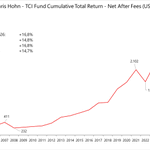
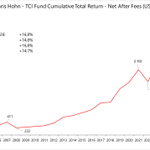
I hung this chart on my wall.
It shows the performance of Chris Hohn's TCI Fund. Before fees, he avhieved a return of over 20% since 2003. He accomplished this solely with a concentrated portfolio of extremely high-quality stocks with very high moat durability. The weighted average age of his holdings is currently exactly 100 years, demonstrating how little technology dependence these companies have and how low the disruption risk is.

In recent years, it has been very difficult to find precise data on Chris Hohn's portfolio and performance. However, we finally have access to Chris Hohn's long-term performance figures and his complete portfolio. A recent interview has now revealed the numbers for the most profitable hedge fund of all time:

Chris Hohn currently manages approximately 75bn USD and has achieved an annualized return of around 17% after fees over a period of more than 22 years. With management fees of 1.5-2.0% and a performance fee of 20%, he has achieved return of over 20% p.a. before fees, putting him in the same league as Warren Buffett.

His portfolio currently consists of only 15 high-conviction positions. He is effectively invested in just four sectors: aerospace (40%), infrastructure (27%), credit ratings (15%), and payments (11.5%). He recently made headlines when he sold his 8bn USD stake in $MSFT. The reason for this is the increased risk of AI disruption to the business.

I analysed the performance of semiconductor stocks, and the results are as follows:
Semiconductor stocks have significantly outperformed the market for several consecutive years and have been the main drivers of market performance. This acceleration has been driven by massive shortages. They accounted for almost 60% of the S&P 500's YTD performance.
$NVDA, $AVGO, $MU, $AMD, $CSCO, $LRCX, $INTC, $AMAT, $KLAC, $TXN, $ADI,

2
773
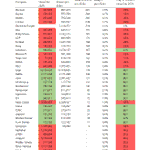
Terry Smith has just filed his latest annual report, in which he outlines some interesting changes to his portfolio:
He significantly further reduced his FANG holdings between June last year and now, and generally reduced his largest positions while relatively increasing his smaller ones.
In February, he sold his Nike position and acquired an intial stake in Wolters Kluwer, as well as indirectly acquiring a stake in Magnum through the Unilever spinoff.

Chris Hohn has just filed details of its latest portfolio holdings.
This overview of the changes to his portfolio includes his non-US positions.
He increased his positions in $MSFT & $SPGI and decreased his positions in $V, $CP % $CNR.
Chris Hohn's focus is on businesses with a strong competitive advantage and long-term durability, a fact that is perfectly illustrated by this portfolio.

Even though Gold/Silver have rallied massively in recent weeks, I am constantly reminded that I would rather own productive assets that generate a yield.
With gold, I am unable to decide whether the price is too high or low based on earnings or future yield.

1
1
837

Mohnish Pabrai's Total Performance
I'm a big admirer of what @MohnishPabrai has done for the investing community, but the performance of his PIF2 fund has lagged behind the S&P 500 by a signifcant margin since 2011.
It may well be true that traditional value investing is a thing of the past.
According to his latest holdings, he is still focusing on very cheap, lower-quality businesses, which have struggled over the past decade.

