

We provide free, open-source software to simulate public policy. Follow our country accounts too: @PolicyEngineUS and @PolicyEngineUK
UK + US
Joined August 2021
- Tweets752
- Following162
- Followers1.8K
- Likes876




PolicyEngine retweeted

Estimates for Prop 40, the 2026 Billionaire Tax Act, run from ~$100B in revenue (Galle, Gamage, Saez & Shanske) to a −$39B mean net present value (Jaros & Rauh). Our open calculator splits the gap by assumption.
Webinar Fri Oct 30, noon PT: us06web.zoom.us/meeting/regi…

PolicyEngine retweeted

At 4:30pm GMT on Budget day, Wednesday 28 October, we'll present our first estimates of what the Autumn Budget means for public finances, household incomes and poverty, and take your questions.
Register free: us06web.zoom.us/meeting/regi…

PolicyEngine retweeted
Four new models on PolicyBench. Claude Sonnet 5.5 lands level with GPT-6 Luna: both get 92.1% of tax and benefit answers within $1, with no tools. GPT-6.1 Sol gets 90.6%, Grok 4.7 88.3% and DeepSeek V4.1 Flash 87.1%. GPT-6 Sol still leads all 46 at 95.0%.

ALT PolicyBench leaderboard, September 30: share of tax and benefit answers within $1, no tools. 1 GPT-6 Sol 95.0%, 2 Claude Opus 5.5 93.7%, 3 GPT-5.6 Sol 93.6%, 4 GPT-6 Luna 92.1%, 5 Claude Sonnet 5.5 92.1% (new), 6 GPT-6 Astra 91.7%, 7 Claude Fable 5.1 90.8%, 8 GPT-6.1 Sol 90.6% (new), 12 Grok 4.7 88.3% (new), 16 DeepSeek V4.1 Flash 87.1% (new), of 46 models.
PolicyEngine retweeted
This morning, the Census announced that the SPM child poverty rate was 13.4% in 2025, down 0.1 pp from 2024.
Today we're launching the Child Poverty Impact Dashboard: a tool to analyze how reforms can affect this rate across all 50 states and DC.
policyengine.org/us/child-po…

PolicyEngine retweeted
PolicyBench tests how accurately AI models compute US taxes and benefits. Two new rows: Ox Alpha, a cloaked preview model with no maker named, debuts fourth of 32 at 84.2% of answers within $1. @grok 4.6 debuts eighth at 82.8%, 1.9 points past Grok 4.5.
policybench.org

PolicyEngine retweeted
.@thinkymachines' first model debuts on PolicyBench as the strongest American open-weight model: Inkling lands #4 of 29, computing 83.8% of US tax and benefit amounts within $1 — ahead of GPT-5.5 and every Claude.
@Alibaba_Qwen's new Qwen3.8-Max debuts #25 at 71.5%.
policybench.org

PolicyEngine retweeted
.@AnthropicAI's Claude Opus 5 debuts on PolicyBench at #8 of 27 — 79.8% of US tax and benefit amounts within $1, 0.1 points behind Claude Fable 5 and +7.2 over Opus 4.8, the second-biggest version jump we've measured.
policybench.org

PolicyEngine retweeted
New from @BudgetHawks, built on PolicyEngine microsimulation: New Approaches to Social Security Benefit Taxation — 16 reform options scored year by year through 2100 on the 2026 Trustees baseline. crfb.org/papers/new-approach…

PolicyEngine retweeted

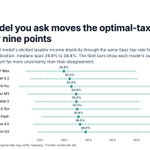
1/ We asked 28 frontier LLMs — GPT, Claude, Gemini, Grok, DeepSeek, Qwen, Kimi, GLM, MiniMax — for the same 26 economic parameters, 15 times each. 10,920 elicitations, every prompt and response in a public repo.
The headline: where economics has settled, the models have settled — and where it's still arguing, the models still argue. That unresolved part moves the US optimal-tax answer by about nine points.
policyengine.org/ai-beliefs

PolicyEngine retweeted
.@Kimi_Moonshot's Kimi K3 debuts #2 of 25 on PolicyBench — the first open-weight model to crack our top ten. 86.2% of US tax and benefit amounts within $1, no tools, +21.6 points over Kimi K2.6: the biggest version jump we've measured.

PolicyEngine retweeted
GPT-5.6 joins PolicyBench, our benchmark of how accurately AI computes US taxes and benefits (no tools, scored against PolicyEngine):
Sol #1 of 23 — 88.7% within $1 (prior best 83.5%)
Luna #2 — 84.5%
Terra #4 — 83.4%
policybench.org

PolicyEngine retweeted
PolicyBench now scores 20 AI models on how accurately they compute US taxes and benefits — adding Claude Fable 5, Claude Sonnet 5, and five open-weight models: DeepSeek, Qwen, GLM, MiniMax, and Kimi.
GPT-5.5 leads, Fable ranks #2, and DeepSeek v4-pro tops the open-weight models.

PolicyEngine retweeted
Last week, @GovDanMcKee signed the Rhode Island Fiscal Year 2027 budget, which includes a new refundable Child Tax Credit.
Beginning in 2027, taxpayers can claim $330 for each child under the age of 19.
Using our RI CTC calculator, we analyzed the impact of this program.
PolicyEngine retweeted
Can a language model compute a household’s taxes and benefits from the prompt alone — no tools, no lookups?
We tested 13 frontier models against PolicyEngine on 100 representative US households and 18 tax and benefit outputs.
New benchmark: PolicyBench.
policybench.org

PolicyEngine retweeted
Earn a dollar more, take home less. Benefit cliffs happen when a household loses more in benefits than it gains in earnings.
CliffWatch shows where, when, and how — across earnings levels and US states.
Live demo Fri May 29, 1pm ET → us06web.zoom.us/meeting/regi…

PolicyEngine retweeted
New @UHEROnews analysis uses PolicyEngine to simulate Hawaii's childcare credit bills — first the direct household effect of the expanded CDCC, then the integrated CDCC, EITC, SNAP, WIC, and state income tax impact when a second earner enters the workforce in response.


PolicyEngine retweeted
We added a ton of ingredients to @ThePolicyEngine cauldron last month:
- 1,039 PRs merged (7× April 2025, 2× March 2026)
- 341,318 source-code lines changed
- 19 new repos
Childcare subsidy rules, Forbes 400, better reproducibility - all make our models more accurate & useful.

PolicyEngine retweeted
The first analysis from our AI and economics research initiative answers the question: What happens if income shifts from labor to capital?
We find a 10% shift raises the top 1%'s market income share from 25.7% to 29.3%. After taxes and transfers: 21.4% to 24.4%. Policy absorbs about 19% of the increase.
policyengine.org/us/ai-inequ…


PolicyEngine retweeted
NEW INTERACTIVE: @repkmr has released the Working Parents Tax Relief Act (WPTRA), which increases the maximum EITC benefit by $5,500 for each child under 4 in a tax unit.
We project the bill would:
- Lower federal revenues by $184.1B over 10 years
- Benefit 2.9% of households and reduce child poverty by 1.4% in 2026

PolicyEngine retweeted

See
- @PSLmodels: pslmodels.org/
- OG-Core: pslmodels.github.io/OG-Core
- @ThePolicyEngine: policyengine.org/
- Tax Calculator: taxcalc.pslmodels.org/
- Cost of Capital Calculator: ccc.pslmodels.org/
- @PSLFoundation: psl-foundation.org/


Something I've been thinking about - I am bullish on people (empowered by AI) increasing the visibility, legibility and accountability of their governments.
Historically, it is the governments that act to make society legible (e.g. "Seeing like a state" is the common reference), but with AI, society can dramatically improve its ability to do this in reverse. Government accountability has not been constrained by access (the various branches of government publish an enormous amount of data), it has been constrained by intelligence - the ability to process a lot of raw data, combine it with domain expertise and derive insights. As an example, the 4000-page omnibus bill is "transparent" in principle and in a legal sense, but certainly not in a practical sense for most people. There's a lot more like it: laws, spending bills, federal budgets, freedom of information act responses, lobbying disclosures... Only a few highly trained professionals (investigative journalists) could historically process this information. This bottleneck might dissolve - not only are the professionals further empowered, but a lot more people can participate.
Some examples to be precise: Detailed accounting of spending and budgets, diff tracking of legislation, individual voting trends w.r.t. stated positions or speeches, lobbying and influence (e.g. graph of lobbyist -> firm -> client -> legislator -> committee -> vote -> regulation), procurement and contracting, regulatory capture warning lights, judicial and legal patterns, campaign finance... Local governments might be even more interesting because the governed population is smaller so there is less national coverage: city council meetings, decisions around zoning, policing, schools, utilities...
Certainly, the same tools can easily cut the other way and it's worth being very mindful of that, but I lean optimistic overall that added participation, transparency and accountability will improve democratic, free societies.
(the quoted tweet is half-ish related, but inspired me to post some recent thoughts)