

MACV-SOG/FORCE RECON Researcher- Producer of The Reconnaissance Cast ⚡️☠️
Dothan, AL
Joined April 2023
- Tweets8.7K
- Following1.4K
- Followers13.6K
- Likes34.2K



Pinned Tweet
Jim Bolen was a highly decorated Special Forces Green Beret who served with the highly classified Military Assistance Command, Vietnam – Studies and Observations Group (MACV-SOG) during the Vietnam War. He led over 40 dangerous, top-secret missions into Laos and Cambodia, primarily targeting the Ho Chi Minh Trail and Sihanouk Trail.Bolen's expertise included infiltration, intelligence gathering, and prisoner snatch operations, often under heavy enemy fire
New Interview with Jim -youtube.com/live/Bik9J3ZOH8g…

1st MACVSOG OP from FOB2 with Pat Watkins youtu.be/MRbiwgqBj9E?is=G1kj… via @YouTube
heavily laden member of Co 'B', 2nd Royal Australian Regiment, crosses a ditch during a search and clear operation.
Photo taken: August 1970 by PFC Laszlo Kondor.

General Sir Peter Edgar de la Cour de la Billière KCB KBE DSO MC & Bar DL
On 6 October 1990, a soldier who had joined the British Army as a private thirty-eight years earlier landed in Riyadh to take command of every British serviceman in the Middle East. Lieutenant-General Sir Peter de la Billière inherited a force that was still building, and would become Britain's largest deployment since the Second World War, and with it the task of making British arms count inside an American-led coalition under General Norman Schwarzkopf. It completed one of the most improbable rises in the modern Army. Born in Plymouth on 29 April 1934, he had lost his father, a naval surgeon, when HMS Fiji was sunk by German bombers off Crete in May 1941; he enlisted in the King's Shropshire Light Infantry as a private in 1952, was commissioned into the Durham Light Infantry in 1955, and joined the Special Air Service the following year. What followed was three decades of undeclared wars: Malaya, where he was mentioned in despatches; Oman in 1959, where he led a troop in the assault on the Jebel Akhdar and won the Military Cross; the Radfan and Borneo from 1964 to 1966, which brought the Bar to the MC; and Dhofar in the early 1970s, for which he was appointed to the Distinguished Service Order. He commanded 22 SAS from 1972 to 1974, and from 1979 to 1983 he commanded the SAS Group, the officer in overall command in May 1980 when the SAS stormed the Iranian Embassy at Princes Gate.
The Gulf command tested everything those small wars had taught him. As Commander British Forces Middle East he was Schwarzkopf's British counterpart, and he forged the close working relationship with the American commander on which the British contribution depended. He deployed his old regiment deep into western Iraq in patrols hunting the Scud launchers that were threatening Israel and the coalition, and when the ground offensive began on 24 February 1991 his forces formed part of the coalition's great "left hook" through the Iraqi desert. The 1st Armoured Division under Major General Rupert Smith passed through the minefield breach cut by the Americans and, in a hundred hours of fighting, covered 170 miles and took the surrender of thousands of Iraqi troops, in the largest British armoured operation since the Second World War. Kuwait was liberated and the ceasefire came on 28 February; 47 British servicemen had been killed. De la Billière's war had been the headquarters' war, the briefings and the coalition politics, and he had played it as a soldier who had spent his career on the other side of such rooms, in the deserts where the plans met the enemy.
He was appointed a Knight Commander of the Order of the British Empire, promoted to full general, and made a special adviser to the Ministry of Defence on Middle East affairs before retiring in June 1992 after forty years in uniform. In 1992 he published Storm Command, his personal account of the Gulf War, and in 1994 Looking for Trouble, his autobiography; both were bestsellers, though his willingness to write about special forces drew sharp criticism from within the regiment he had once commanded. His documented contribution is the arc itself: a private soldier who won gallantry medals across three decades of the Empire's last small wars, and who rose to command Britain's last victorious large-scale conventional campaign, becoming the public face of a war that was fought by a coalition, won in a hundred hours, and ended with its objectives intact. Few careers have spanned the full distance between the troop commander on the Jebel Akhdar and the general who sat beside Schwarzkopf in Riyadh, and that distance is the measure of him.


If it’s 100% they are guilty I think certain crimes, like child trafficking/abuse- Animal Abuse- Elder Abuse - Spousal Abuse - Killing women children or old folks (anyone tbh) you should be drug out of court immediately tarred n feathered or Hanged, Drawn, and Quartered.. Guaranteed this cuts down the bs

Uno de los presuntos feminicida de una menor y su abuela en Ostuacán #Chiapas fue retenido por los habitantes de este lugar…
The Young Wolf 🐺 (HOWL)

Así fue la Batalla del Bosque Susurrante que la serie omitió, en la que Robb capturó a Jaime Lannister.
Una de las cosas que más me gustan de los libros es cómo George R.R. Martin convierte una batalla en un juego de estrategia.
El Bosque Susurrante es un buen ejemplo.
Robb sabía que no podía enfrentarse de frente al ejército Lannister, que le superaba en número. Así que decidió engañar a Tywin.
Envió a la mayor parte de su infantería (unos 16.000 hombres), bajo el mando de Roose Bolton, directamente hacia él. Tywin creyó que se enfrentaba a todo el poder del Norte.
Mientras tanto, Robb tomó en secreto a toda su caballería pesada (unos 6.000 jinetes, entre norteños y fuerzas Frey) y marchó a toda velocidad hacia Aguasdulces, donde Jaime Lannister mantenía el asedio.
Ahí empieza lo bueno.
Jaime tenía sus fuerzas divididas en tres campamentos alrededor del río y, aburrido del asedio, subestimó por completo al “Joven Lobo”. El Pez Negro (Brynden Tully) salió con una pequeña fuerza, atacó las líneas de suministro y las patrullas Lannister, y luego fingió retirarse.
Jaime, convencido de que solo estaba persiguiendo a unos cuantos cientos de jinetes rebeldes, mordió el anzuelo y salió tras ellos con unos 2.000 hombres de su caballería de élite.
No sabía que estaba entrando en una trampa.
El Pez Negro lo atrajo hacia un valle boscoso y angosto, de noche. Cuando la caballería Lannister se internó en el Bosque Susurrante, sonaron los cuernos de caza de Maege Mormont.
Los arqueros norteños, ocultos en las laderas, empezaron a lanzar lluvias de flechas, y la caballería de Robb cargó desde varias direcciones.
Jaime quedó rodeado, atrapado por el terreno y superado en número.
Pero en lugar de intentar escapar, hizo algo desesperado: reunió a los hombres que le quedaban y cargó en línea recta hacia el estandarte de Robb Stark, con la idea de matarlo y acabar con la guerra de un solo golpe.
Ahí vemos al Jaime de los libros.
Se abre paso entre la guardia personal de Robb y acaba con varios hombres, entre ellos Torrhen Karstark y Eddard Karstark. Está a punto de llegar hasta Robb cuando su espada queda atrapada.
Ese instante basta.
Una marea de norteños, entre ellos el Gran Jon Umber, se le echa encima, lo derriba del caballo y consigue capturarlo.
La victoria de Robb es absoluta: destroza la fuerza de Jaime, captura a varios lores del Oeste y, sobre todo, se hace con el Matarreyes. El equilibrio de la guerra cambia de golpe.
Siempre me ha dado pena que nunca pudiéramos ver esta batalla en la serie.
No solo porque está muy bien planteada en cuanto a estrategia, sino porque habría sido la oportunidad perfecta para ver a Jaime demostrar por qué, en los libros, se le considera uno de los mejores espadachines de Poniente.
Ese último ataque desesperado contra Robb habría sido una auténtica locura de ver en pantalla.

WHO was going to teach reconnaissance for the Vietnam War??? To start with PROJECT DELTA reconnaissance men ☠️⚡️⚔️

Master Sgt. Henry Erwin lived through after a midair accident over Japan during World War II. The 23-year-old suffered horrific burns down to his bones after a smoke bomb burst in his airplane. The efforts he put forth to save the rest of his crew from death earned him the Medal of Honor in an unprecedentedly quick fashion.
Erwin was positioned behind the forward gun turret toward the front of the plane. Once he got the order to light the bombs, he dropped them down a chute that launched them out of the aircraft before they exploded.
But something went wrong with one of them. It didn't leave the chute, instead bouncing back into the aircraft, striking a kneeling Erwin in the face. The intensely burning bomb obliterated his nose and completely blinded him. To make matters worse, smoke quickly filled the front part of the plane, obscuring the pilot’s vision.
Despite his wounds, Erwin knew the plane and crew would not survive if he didn't get the bomb outside. So, despite the fact that he was physically on fire and his skin was burning off, he picked up the incendiary at his feet and, feeling his way instinctively through the plane, crawled toward the cockpit.
His path was blocked by the navigator's table, which he had to unlock and raise to get around. To do that, he had to clench the burning bomb against his body. Erwin then struggled through the narrow passage and stumbled forward into the pilot’s den. He groped around until he found a window and threw the bomb out.
Completely on fire, Erwin collapsed between the pilots. He had journeyed only 13 feet, but later he said it "seemed like miles when you are burning."
The plane had been on autopilot during the crisis, but to keep it from stalling out, the pilot had to drop altitude. When the smoke finally cleared, he realized they were only 300 feet from hitting water. The pilot managed to pull the plane out of its dive, abort the mission, and head for Iwo Jima, the closest place for medical aid.
During that time, the crew sprayed Erwin with a fire extinguisher to put the flames out, and they gave him morphine for the pain. Somehow, Erwin stayed conscious during the flight and even asked about the crew's safety.
Once at Iwo Jima, doctors labored for hours to remove the white phosphorus that had embedded in his eyes. Since it combusts when it's exposed to oxygen, each fleck that was removed burst into flames – small bits of torture for the already struggling airman.
No one thought Irwin would survive, but his entire crew knew he deserved the Medal of Honor for his actions. So, while he was getting treatment the night of their botched mission, the officers in his unit were preparing a Medal of Honor citation. The next morning, they presented it to Maj. Gen. Curtis LeMay, commander of the 21st Bomber Command, so he could sign it. LeMay managed to get it approved in an unprecedented amount of time. They were all hoping to give it to Erwin before he died.
Three days after the incident, a still-living Erwin was flown to a Navy hospital on Guam. For days afterward, doctors performed blood transfusions, did surgery, and gave him antibiotics to fight infection.
On April 19, 1945 — one week after the incident — officials pinned the Medal of Honor on a heavily bandaged Erwin as he lay in a hospital bed. The medal itself was from a display case at U.S. Army Headquarters in Honolulu. It was the only available one in the entire Pacific Theater.


SEAL TEAM 8 vet Dave Hall shares EERIE stories from deployments youtube.com/live/1JX3hvluIDs… via @YouTube

Rhodesian Alouette K-car armed with Matra 151 cannon using 20 mm shells. During a contact, the gunner would aim for boulders (if not the guerrillas) where it would splinter sending deadly fragments in all directions. Matra 151/20 was a WWII Luftwaffe cannon, Mauser-built, that France recycled into Alouette door mounts.
Courtesy of The Rhodesian History Society

'This iconic 1968 photo depicts then-Lieutenant Colonel William "Wild Bill" Weise (who later achieved the rank of Brigadier General), commander of the 2nd Battalion, 4th Marines (known as "The Magnificent Bastards") during the Vietnam War. He is shown lying on a stretcher, calmly smoking a cigar while holding up his own IV drip bottle after being seriously wounded during the fierce Battle of Dai Do in May 1968. His battalion suffered heavy casualties but successfully turned back a much larger North Vietnamese Army force heading toward the major combat base at Đông Hà. Under his command during this battle, two of his company commanders-James E. Livingston and M. Sando Vargas-earned the Medal of Honor."
Photo taken by unknown USMC photographer. Most likely taken between 01-03 May 1968.

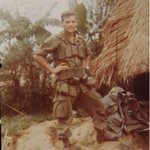
Dean Hendrickson, Ft Dodge Ia (formerly Fairmont, Mn) in Combat Gear, 11th Inf Bde, Quang Ngai Province, Oct 1969. Photo by Sgt Douglas Koning, Holland, MI (KIA Feb 1970).
Close Encounter by Dean Hendrickson.
“It had been a long hard ten mile sweep of lowland jungle and rice paddies that day, and we were just dropping our 50 lb rucksacks when the “good” news came down: “2nd squad, keep your shit on! You’re pulling ambush tonight!
The CO (company commander) was a real Gung-Ho ROTC Ranger who was trying to make a name for himself. He didn’t mind sacrificing a few of us in the process. This was a real sore subject among the line troops who had been in country longer than him and knew as much or more than he did.
He had spotted an area a few clicks back that he thought looked like a good spot to set up an all-night ambush position. Our squad’s job was to find our way back to that position in the dark with no lights (without getting ambushed ourselves!) and stay up all night waiting for the enemy to enter our kill zone. Ambush duty meant you humped for 12 hours, stayed up all night on ambush, and then humped again the next day for 12 hours.
The 4 of us started out at dusk as it started to drizzle. We had an M-60 machine gunner, 2 riflemen with M-16’s and myself, the RTO or radioman. An RTO was basically a rifleman with the additional responsibility (and payload) of PRC-25 backpack radio. When we reached the ambush site we split up into 2 positions. It was too dark to try to establish fields of fire, so we didn’t split up very far. We barely knew we were in the right position at all. You couldn’t see your hand in front of your face, and the rain muffled the noise quite a bit.
My partner Dennis and I sat together and pulled a poncho over our heads to keep as warm and dry as possible, and proceeded to open up some C Rations. We knew we shouldn’t eat on ambush because of the aroma of the food, but we were starved from humping all day. We would adhere to the other rules – no smoking, no noise, and no lights.
The ambush site the CO picked out was actually pretty good. We were all concealed by vegetation and below us was a well-used trail. Rice paddies stretched out beyond that. My partner, Dennis Amaro, from Palo Alto, California and I had been together since basic training. We sat in total darkness, whispering about home and the surreal things we had been dealing with since we got to Nam, still finding it hard to believe that we were stuck out in the middle of this God-forsaken jungle.
We both went through Basic and Infantry Training at Fort Lewis, Washington in Feb 1969 (Jungle Training in the snow!) and now we were both assigned to the 3rd platoon of Charlie Company, 3rd of the 1st, 11th light Infantry, the brigade that was in the news for the My Lai Massacre. We were incredulous about the number of civilians reported killed and somewhat sympathetic to Lt Calley because we felt that responsibility for My Lai travelled much higher up the chain of command. Dennis would eventually be wounded twice and be reassigned to a rear job in Duc Pho. I spent 8 mos in the field and was then assigned to our Awards and Decorations section in Duc Pho.
Suddenly, we both froze. Through the sound of the light rainfall something else was commanding our attention. We ate our C Rats, occasionally checking our rifles and the radio frequency and volume. We wondered how the other 2 squad members were doing. We couldn’t see or hear them. The conditions were less than ideal. It was almost like a sixth sense, or a premonition, and we strained our ears to try to confirm what our intuition was telling us.
All our attention was focused on the sound. The raindrops sounded like explosions. The ringing in our ears and our pounding hearts drowned out most of the sound. We held our breath and strained to hear into the darkness until the object of our attention finally unveiled itself: footsteps in the rice paddy! I reached over to Dennis.”

“I knew he had his M-16 ready on full automatic with the safety off, as I did. I knew he was thinking the same things I was. Was it an enemy? A friendly? A civilian? Was there more than one? Did our other guys hear the footsteps? What if they laughed or coughed or sneezed? Could we make it back to the company if we were outnumbered?
We didn’t have to decide what to do because our training took over: let the point man through and ambush the main body. But what if he walked right up on us? My concentration was never greater than it was during those five minutes. Gradually, the sloshing footsteps began to fade and we braced ourselves for the larger force.
It never came.
He or she was a loner, who will never know how lucky he or she was. We stayed on full alert the rest of the night. It could have been a VC with a backpack full of booby traps, or a lady with a baby afraid to travel during the daylight hours. We were relieved that we didn’t have to make a life or death decision that night.”

Just did a recording w Dave Hall about some of the spooky stuff that occurred while he was deployed or training!! We are going to do a Halloween show talking about spooky stuff in the military, ships, bases and battlegrounds.. I’ll post the link directly 🦅⚡️

Why do we still do this / Why did we ever start doing this ?? Seeing Owen Hart and a few other military vets at games either fall abruptly or have a technical issue .
A waste of a a good operator and family man over some stupid bullshit for a football game..
* As a football fan and someone who played , it’s stupid and has zero bearing on the day


“Members of the 5th Plt, Co 'B', 2nd Royal Australian Regiment, receive a briefing from their patrol leader.”
Photo taken: August 1970 by PFC Laszlo Kondor.

For years, this photo was frequently—and incorrectly—misidentified across internet gun culture as fellow Delta Force member Sergeant Major Mike Vining. Vining himself has publicly (actually in an interview with me me) clarified that the operator in the white shirt is actually Bill Cronin..
-Cronin was a Sergeant First Class (SFC) assigned to Delta Force's A Squadron as early as April 1980, later serving in C Squadron during the 1991 Gulf War.. Bill served with the 46th Co in Thailand training troops for Border Police duty & taught reconnaissance to Thai and Cambodian mercenaries to be used in the secret war
