

This page is about Astronomy, Mathematics and Physics
Germany
Joined November 2026
- Tweets39
- Following38
- Followers18
- Likes11



NASA’s Chandra X-ray Observatory has uncovered evidence that a hidden black hole or neutron star may be responsible for a giant star’s mysterious eruptions every 113 days, helping scientists understand this unusual cosmic phenomenon.

3
SpaceX has moved its Starship booster to the launch pad for testing ahead of Flight 15. The mission aims to make history by catching both the Super Heavy booster and the Starship upper stage using the launch tower’s mechanical arms.

13
New research suggests that mysterious little red dots discovered by the James Webb Space Telescope may contain ancient black holes formed shortly after the Big Bang. These findings could help scientists understand how black holes developed in the early universe.

13
What If These Comets Hit Earth?
- 16 real objects strike the same spot in the Swiss Alps, one after another, from the smallest impact to the largest.
Each ring shows the impact radius: how far the blast would flatten most buildings.
9
NASA’s twin ESCAPADE spacecraft have completed their Earth flybys and are now heading toward Mars, where they will study the planet’s magnetic environment and how its atmosphere escapes into space.

7
How Much Does a Spacesuit Cost?
- A NASA spacesuit is one of the most expensive outfits ever made. From its gold-coated helmet and custom gloves to its life-support backpack and cooling system, every component has a purpose. Here's what makes a spacesuit worth millions.
8
Jupiter and Mars will appear unusually close together in the sky on November 15, 2026, creating a beautiful planetary alignment visible to skywatchers.

14
The Solar System Isn’t Standing Still
- The Sun races around the Milky Way at about 230 km/s, and it carries every planet with it.
Because the planets’ orbits are tilted about 60° to that direction of travel,each one traces a long spiral through space as it follows the Sun.
1
46
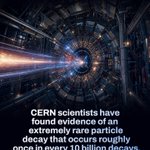
After 40 years of searching, CERN scientists have found evidence of an extremely rare event in which a subatomic particle called a B meson decays into two smaller particles known as muons. This transformation occurs only about once in 10 billion decays, helping scientists test the laws of physics

1
21
US Flights Grounded for 4 Hours (Simulation)
- A simulation of US air traffic yesterday, November 13, 2026, when the FAA ordered a nationwide ground stop.
3:54 PM ET – all departures halted, about 3,500 planes in the air
8:00 PM ET – fewer than 400 still flying
8:15 PM ET – ground stop lifted.
Why the Moon Changes Shape
- The Moon makes no light of its own. Half of it is always lit by the Sun, and as it orbits Earth we see a different part of that lit half. That's what creates the 8 phases: new moon, waxing crescent, first quarter,waxing gibbous, full moon, waning gibbous, last quarter and waning crescent.
1
46
New computer simulations challenge the theory that comets brought the building blocks of life to Earth, raising new questions about how life began billions of years ago.

1
20
Why Soldiers Never March on Bridges
- Footsteps alone can tear a bridge apart. Not weight, but rhythm.Every bridge has a natural frequency, a speed it “wants” to bounce at. When hundreds of boots hit the deck in that same rhythm, each step adds a little more energy, like pushing a swing at exactly the right moment.
Olympus Mons on Mars is the largest volcano in our solar system, standing about 22 kilometers tall, nearly three times the height of Mount Everest.
Its enormous size is possible because Mars has lower gravity and no moving tectonic plates like Earth.

1
16
The Orbital Period of Every Planet
- How long is a year on each planet? A year is the time it takes to go once around the Sun.
Here, all eight planets start lined up together, and each one gets its own moment as it finishes its first lap.
1
11
A sugar cube of neutron star matter could weigh a billion tons.
When a massive star collapses, its core is compressed into an incredibly small space, creating some of the densest matter in the universe.

1
9
Why 45° Is the Perfect Throwing Angle
- Same speed. 25 different angles. Only one lands the farthest.Every ball is launched at exactly 30 m/s.
The only thing that changes is the angle, from 15° all the way up to 75°.
Steep throws climb the highest, flat throws stay low, but neither one goes the distance.
Gravity changes the pace of time. A stationary clock 1 kilometre above sea level gains about 3.4 microseconds over a whole year compared with a clock at sea level. Higher up, Earth's gravity is slightly weaker, so time passes a little faster, just as Einstein's theory of general relativity predicts.

8
He Tried to Stop Time
- He pushed it, jammed it, tied it down… but the clock never stopped, not even for a second. A short animated story about the one thing everyone tries to hold back. Time was never yours to stop, only yours to spend.
141
