

The Budget Lab is a non-partisan policy research center dedicated to providing in-depth analysis of federal proposals for the American economy.
Joined March 2024
- Tweets705
- Following9
- Followers7.3K
- Likes24


The Budget Lab retweeted

So happy to get to chat with @crampell for @nytopinion as we attempt to make sense of the economy ahead of the midterms just days away.
Come for how much is Trump to blame; stay for an impassioned defense of statistical agencies!
Watch/listen here:
nytimes.com/video/opinion/10…

The Budget Lab retweeted
Affordability is defining the midterms just weeks away, and likely to define the next presidential election, too.
Here's my latest for @nytopinion on what I think this crisis is really about -- and what policymakers should do about it.
nytimes.com/2026/10/21/opini…

The Budget Lab retweeted

Great to speak with @AnnieLowrey about why the new jobs that emerge from AI may have absolutely nothing to do with AI and what the fact that our parents all think we spend our money indulgently can teach us. theatlantic.com/ideas/2026/1…

The Budget Lab retweeted

🤖 How will AI reshape the future of work?
@marthagimbel of @The_Budget_Lab and @John_Bailey of @AEI join EIG's @ngoldschlag to explore what AI means for American workers and the policies needed to navigate a changing labor market.
#AmericanWorkerConference

The Budget Lab retweeted

The Survey of Consumer Finances is the best publicly available data on household wealth. As a side effect, it contains lots of tax-relevant insights. A quick rundown of how @The_Budget_Lab uses the SCF, and what the new 2025 data say about tax trends:
budgetlab.yale.edu/research/…

The Budget Lab retweeted

The effects of many public investments build over decades, well beyond a 10-year budget window. In new @The_Budget_Lab work, we find childcare subsidies can boost potential GDP in the long run, but deficit financing can reverse those gains. (1/5) budgetlab.yale.edu/research/…

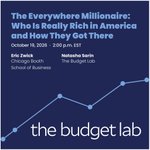
Webinar on Oct. 19 at 2pm ET. A conversation with @NatashaRSarin @The_Budget_Lab @YaleLawSch and Eric Zwick, Professor of Economics and Finance at the @ChicagoBooth on his new book, "The Everywhere Millionaire: Who Is Really Rich in America and How They Got There" (co-authored with Owen Zidar), and what the rise of this hidden class of entrepreneurs means for inequality, opportunity, and tax policy.
Register: yale.zoom.us/webinar/registe….

The Budget Lab retweeted
New work from @The_Budget_Lab looking at:
(1) how much untaxed income there is at the top
(2) why much of that income would disappear if you tried to tax it
(3) how to redesign the tax code so that that (2) is less of a problem
budgetlab.yale.edu/research/…

The Budget Lab retweeted
Thanks to fellow tax nerd @andrewrsorkin @dealbook for highlighting @The_Budget_Lab's new work on taxing top earners:
nytimes.com/2026/10/09/busin…

Jobs Day commentary by Ryan Nunn, Director of Research, @The_Budget_Lab: This is an underwhelming jobs report when you compare it to what we saw a month ago, or to the expectations that analysts had yesterday. That said, this morning’s report indicates a labor market that is doing fine. Unemployment moved up very slightly to 4.18% from 4.14%, which remains low by any historical standard. September employment was up 29k, with downward revisions totaling -60k to the last two months. Averaging over the last three months, we're looking at growth of 51k, which is right in the middle of the range of "breakeven" estimates for payroll growth.
One point that is sometimes confusing is the fact that unemployment moved up slightly even as continued claims (in unemployment insurance) have come down. There are some good reasons to expect different trends in those data, as I discuss here: budgetlab.yale.edu/research/…

And a final note is to always have in mind how payroll growth compares to breakeven estimates, as discussed a few months ago in this article: budgetlab.yale.edu/research/…. Those of us who are used to higher breakeven numbers (when the labor force was growing faster) need to remember that it doesn't take as much employment growth these days to keep unemployment low.

The headline numbers are what we all look at first on jobs day, and for good reason. But there is more to learn about the labor market, either from numbers buried in the report or from the underlying microdata. A new @The_Budget_Lab analysis of inequality in labor force participation does exactly that: budgetlab.yale.edu/research/…

This trend is substantially stronger when looking at a broad array of worker characteristics, rather than simply comparing less- and more-educated people, as analysts typically do.
Diminishing participation gaps are important in their own right, but they may also tell us something about overall labor market strength: clevelandfed.org/publication…

Register for the @The_Budget_Lab webinar this Wed. Sept. 30. "What AI could mean for fiscal policy"
yale.zoom.us/webinar/registe…


Register for the @The_Budget_Lab webinar, "What AI Could Mean for Fiscal Policy" on Wed. Sept. 30, 12:00pm EDT. yale.zoom.us/webinar/registe…
AI has the potential to reshape our economy, changing how work is done and income is distributed. Join us for a wide-ranging conversation with Douglas Elmendorf, Professor of Public Policy, @HarvardKS, and Ryan Nunn, Director of Research, The Budget Lab, moderated by @axios Markets Correspondent @EmilyRPeck
@john_iselin, Associate Director of Economic Analysis at The Budget Lab, will present recent research on how AI-driven growth would affect federal revenues.

@abhiecon spoke with @NPR's Marketplace about the national debt.
“All we need is for Congress to undertake moderate sized, consistent deficit reduction,” he said, “and that will be enough to stabilize debt to GDP going forward.”
marketplace.org/story/2026/0…

Read about the new @The_Budget_Lab Deficit Management Scorecard here: budgetlab.yale.edu/research/…
